
Part of The Access Shift — an ongoing series examining how access is being quietly reshaped across American life.
NEWS DESK | SOCIAL STORYTELLERS COLLECTIVE
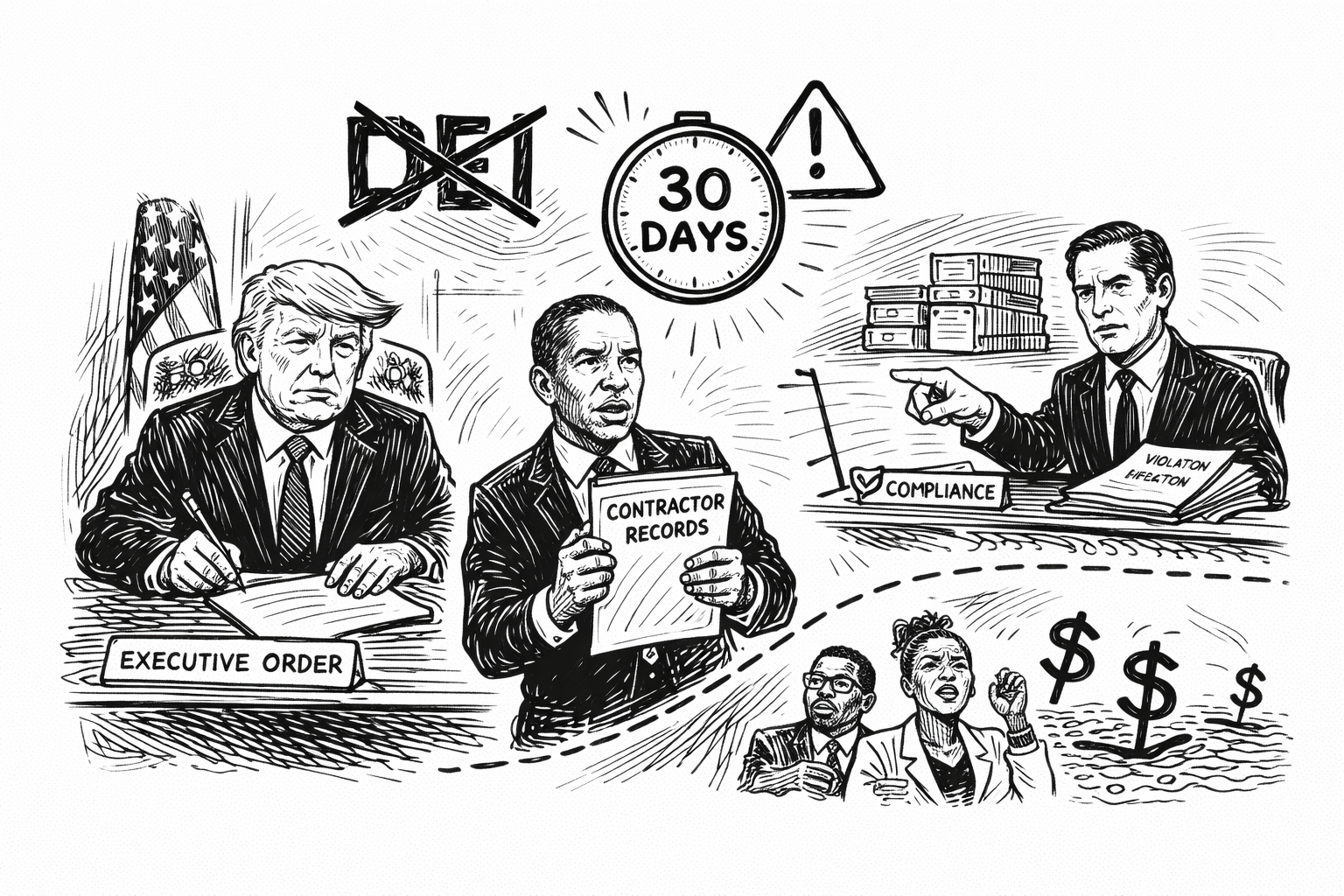
In a continued effort to roll back diversity, equity, and inclusion initiatives across American institutions, Donald Trump signed an executive order on March 26 titled “Addressing DEI Discrimination by Federal Contractors” — extending his administration’s anti-DEI campaign from federal agencies into the private sector companies that do business with the government. Under the order, companies may be required to provide internal financial and operational records to demonstrate compliance. Businesses found in violation could face penalties including the loss or suspension of government contracts.
The order defines “racially discriminatory DEI activities” as disparate treatment based on race or ethnicity across hiring, promotions, vendor agreements, training, and program participation. By April 25, federal agencies must insert compliance clauses into all contracts — extending requirements to subcontractors and lower-tier partners. Legal experts are already raising questions about whether participating in a career fair at an HBCU would now constitute a violation under the order’s broad language.
The stakes are not abstract. The State of the Dream 2026 report estimates cumulative DEI rollbacks have already created an estimated $10 to $15 billion annual gap in federal contracting opportunities for Black-owned firms. Government contractors had been required to implement affirmative action programs for decades — a mandate Trump repealed on the second day of his second term. This new order does not just remove a requirement. It inverts one. The same contracting system that once served as a primary pathway for Black-owned businesses to access federal dollars is now being used as an enforcement mechanism against the practices that helped create that access.
Why This Matters
Federal contracting has historically been one of the most reliable pathways to Black middle-class economic stability — not just for individual businesses, but for the communities they employ and serve. As SSC has tracked across The Access Shift series and When the Economy Slows, the costs of structural rollbacks rarely show up in one place at once. They accumulate quietly, in the data that comes later.
The Access Shift
The gradual redefinition of who systems are designed to serve.
Across sectors—from public infrastructure to healthcare to everyday spaces—access is no longer assumed. As costs rise and systems face increasing pressure, services once built for broad reach are becoming more selective, more conditional, and less universal. The Access Shift explores how these changes are unfolding in real time—and what they reveal about who is included, who is left out, and how the structure of everyday life is quietly being reshaped.