
Part of The Access Shift — an ongoing series examining how access to work, income, and stability is unevenly distributed across American life.
Structural Reality is a series examining how systems produce unequal outcomes across work, income, and opportunity.
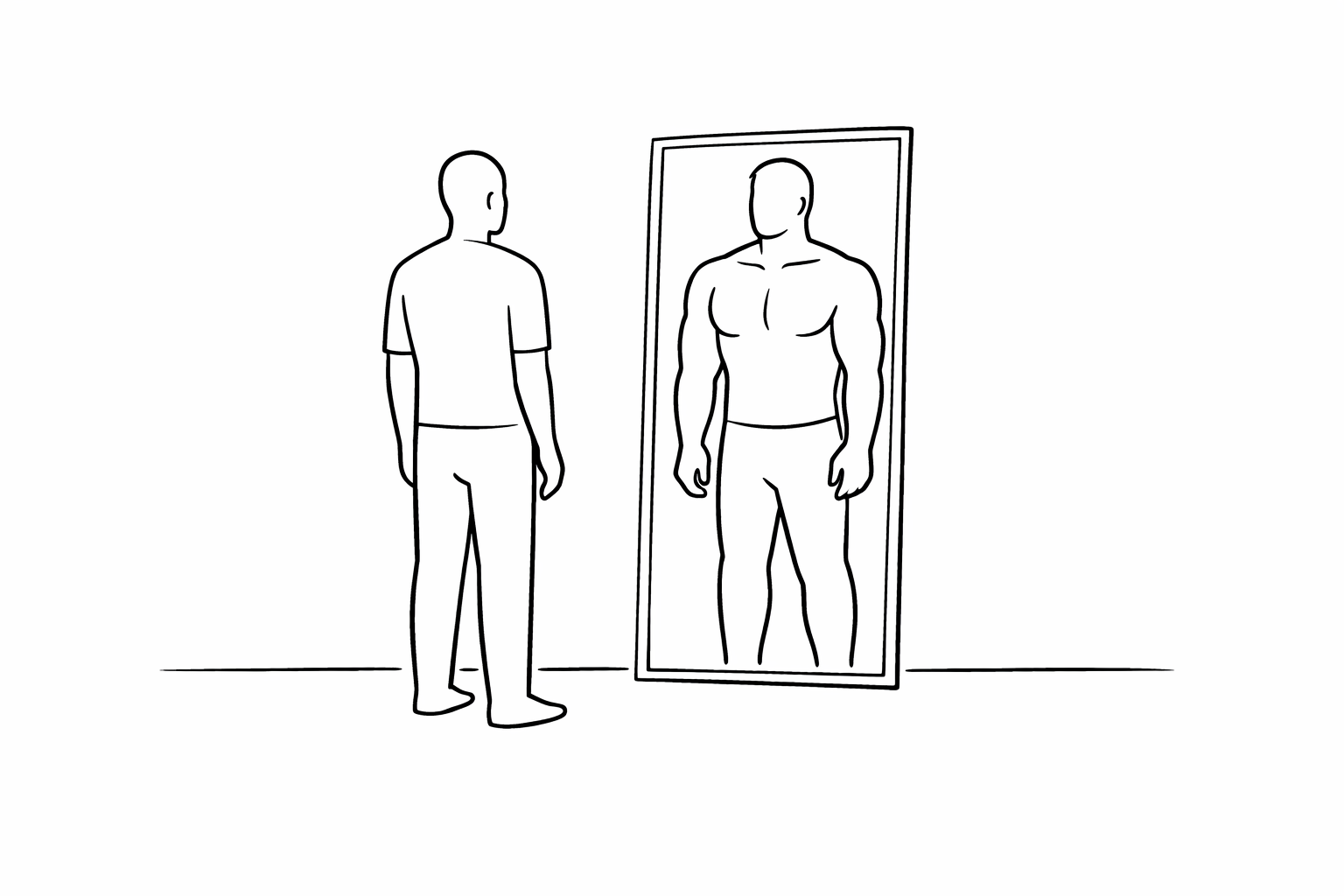
There is a particular kind of suffering that goes unnamed in gyms. It moves through the space quietly — in the man who arrives before the doors open and stays until they close, in the rigidity of the routine that cannot be interrupted, in the mirror that is never quite confirming what the work should have proven by now. From the outside, it looks like dedication. From the inside, it rarely feels like enough.
A 2025 systematic review and meta-analysis published in Behavioural Sciences examined the relationship between muscle dysmorphia, obsessive-compulsive traits, and anabolic steroid use across ten peer-reviewed studies. The findings were significant: a moderate positive correlation between muscle dysmorphia symptom severity and obsessive-compulsive traits, and significantly higher muscle dysmorphia symptoms among anabolic steroid users compared to non-users. Qualitative themes across the studies pointed to compulsive training routines, identity conflicts, and — critically — limited engagement with healthcare services. The people most affected were also the least likely to seek help.
That last finding is not surprising. It is consistent with a pattern that extends well beyond the gym. According to the American Psychological Association, only about 25 percent of Black Americans seek mental health treatment, compared with roughly 40 percent of white Americans. Access barriers play a role — cost, availability, cultural competency of providers — but so does a deeper structural reality: for Black men in particular, the cultural permission to acknowledge struggle has historically been narrow. Strength is expected. Vulnerability is penalized. And the behaviors associated with muscle dysmorphia — relentless training, physical transformation, the pursuit of a body that signals power and control — can be especially difficult to question in communities where physical presence has long been one of the few forms of capital that operates independently of the systems designed to limit access to others.
This is not a coincidence. It is a response to environment. When professional advancement is harder to access, when institutional credibility is withheld, when the labor market does not distribute opportunity evenly — as explored in our coverage of the racial pay gap and Black unemployment — the body can become a domain where effort and outcome feel more directly connected. Work harder, look stronger, project an image that commands respect in rooms that were not designed to offer it freely. That logic is understandable. It is also, at its edge, a vulnerability that the research is only beginning to document.
The fitness industry has largely not reckoned with this. The culture around training — particularly in spaces influenced by social media, performance-enhancing substance use, and the aesthetics of dominance — rarely creates openings for the kind of honest self-assessment the research suggests is needed. Compulsive training routines are celebrated. Identity built around physical transformation is monetized. And the men most at risk of crossing from discipline into disorder are operating in an environment that has few mechanisms for recognizing the difference.
What the research calls for is integrated intervention — addressing both the obsessive-compulsive dimension and the substance-related behavior simultaneously rather than in isolation. But intervention requires access, and access requires acknowledgment. For Black men navigating a culture that simultaneously demands physical strength and withholds permission to be anything less than composed, that acknowledgment is often the hardest part.
The body you can’t talk about is not just a mental health issue. It is a structural one. And until the systems around men’s wellbeing — clinical, cultural, and communal — create space for that conversation, the suffering will continue to move through the gym quietly, mistaken for dedication by everyone in the room, including the man experiencing it.
The gradual redefinition of who systems are designed to serve.
Across sectors—from public infrastructure to healthcare to everyday spaces—access is no longer assumed. As costs rise and systems face increasing pressure, services once built for broad reach are becoming more selective, more conditional, and less universal. The Access Shift explores how these changes are unfolding in real time—and what they reveal about who is included, who is left out, and how the structure of everyday life is quietly being reshaped.