
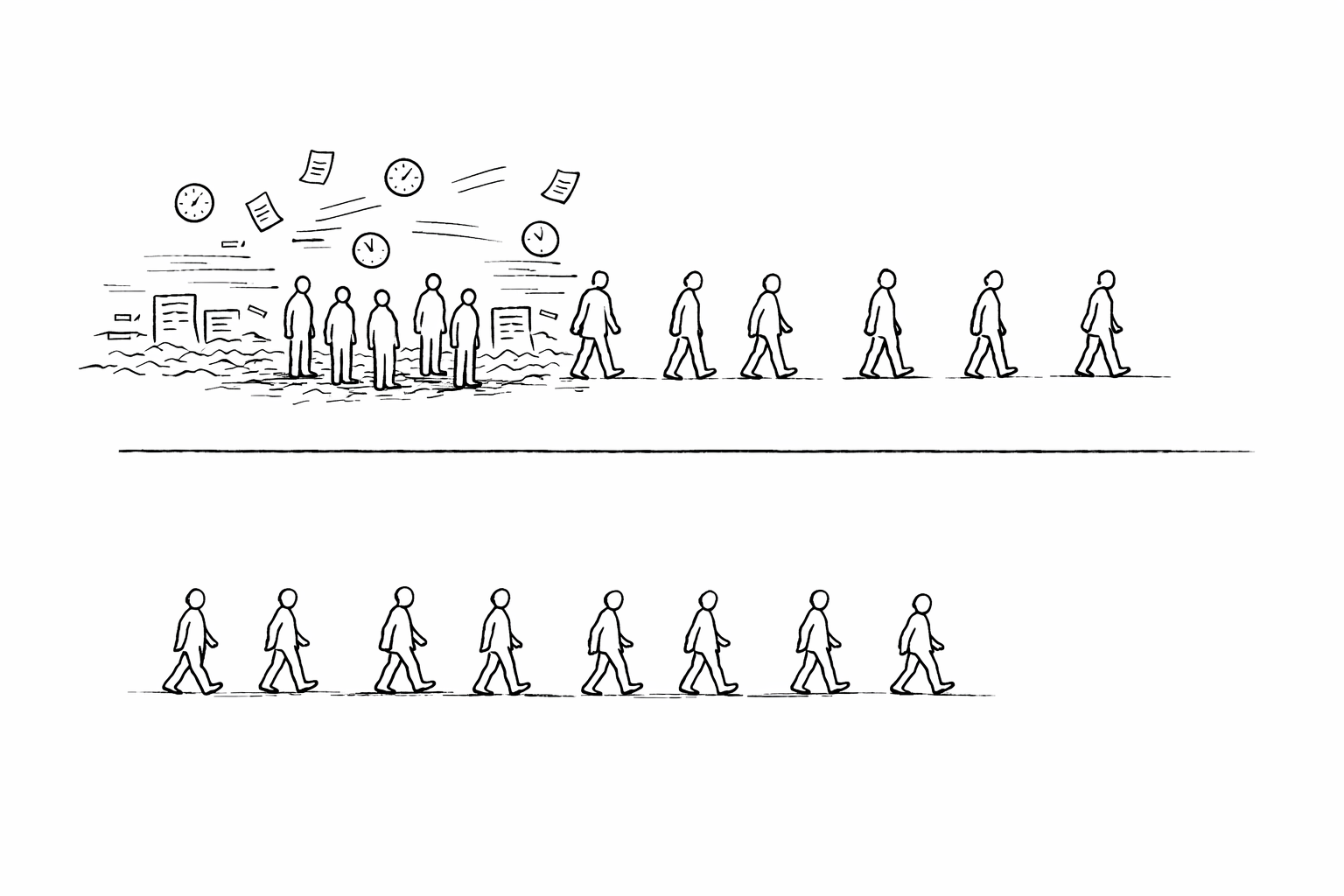
What looks like a cultural trend in Nigeria is, in reality, a structural signal. The rise of “japa” — a Yoruba term meaning “to run quickly” or “to escape” — has less to do with aspiration and more to do with calculation. Migration, in this context, is not driven by curiosity or exploration. It is driven by a narrowing sense of what is possible within the system itself. When effort no longer guarantees progress, exit becomes a rational response.
The economic backdrop makes that calculation unavoidable. Nigeria, Africa’s largest economy by population, continues to face high inflation, persistent currency volatility, and widening cost-of-living pressure that erodes real income. Even for those who are employed, wages often fail to keep pace with basic expenses, compressing the space for long-term planning. What emerges is not simply economic frustration, but economic compression — a condition where forward movement feels structurally constrained. This is part of a broader pattern playing out across the Global South and increasingly in parts of Europe and North America, where young people are recalibrating where opportunity lives. What makes Nigeria distinct is not the existence of that impulse, but the scale, speed, and cultural clarity with which it has been named. It’s the kind of access shift that rarely announces itself — it accumulates, quietly, until leaving feels less like a choice and more like the only logical next step.
According to the World Bank, youth unemployment and underemployment remain persistently high, even among educated workers, creating a labor market where participation does not reliably translate into mobility. In that environment, migration stops being a distant ambition and becomes a near-term strategy for restoring predictability.
What’s changed is not just the volume of people leaving, but the normalization of the decision. For many young Nigerians, the question is no longer whether to go, but when and how. Entire peer networks are dispersing across the UK, Canada, and the U.S., creating a feedback loop where leaving reinforces itself. Each departure lowers the psychological barrier for the next, and over time, staying begins to feel less like stability and more like exposure. “Japa” is not simply a personal choice — it is a collective recalibration of where opportunity is believed to exist.
That normalization is being accelerated by visibility. Social media has collapsed distance, allowing those who leave to document their transitions in real time — new jobs, new environments, new forms of stability. These narratives don’t just inform; they reshape expectations. Migration becomes legible, repeatable, and increasingly urgent. What was once uncertain becomes a template. The result is not just movement, but momentum.
That momentum, however, is increasingly meeting resistance at the border. In recent years, several destination countries have tightened visa scrutiny for Nigerian applicants, citing concerns around overstays, asylum claims, and documentation integrity. While these policies are not unique to Nigeria, their impact is concentrated among populations already navigating limited domestic opportunity — a dynamic consistent with how narrowing access tends to land hardest on those with the least cushion. The result is a second layer of calculation: not just whether to leave, but whether leaving is still accessible. As pathways narrow, migration becomes both more urgent and more uncertain — reinforcing the very pressures that drive it in the first place.
The abandonment critique misreads what’s actually happening. The argument that a country cannot develop if its most educated citizens leave assumes a level of institutional trust that many no longer hold. For those choosing to leave, the decision is less about rejecting home and more about managing risk in the absence of reliable systems. Stability now is weighed against the possibility of reform later — and for a generation that has experienced repeated cycles of promise without consistent delivery, waiting no longer feels like a viable strategy.
“Japa” ultimately reveals something more structural than migration patterns alone. It is not unique because people are leaving — it is unique because leaving has been named, normalized, and culturally encoded as a default pathway. When a society develops a shared language for exit, it signals more than movement; it signals a shift in belief about where the future can be built. And once that belief moves, the system is no longer competing with opportunity elsewhere — it is competing with the expectation that opportunity no longer exists within it.
The Access Shift
The gradual redefinition of who systems are designed to serve.
Across sectors—from public infrastructure to healthcare to everyday spaces—access is no longer assumed. As costs rise and systems face increasing pressure, services once built for broad reach are becoming more selective, more conditional, and less universal. The Access Shift explores how these changes are unfolding in real time—and what they reveal about who is included, who is left out, and how the structure of everyday life is quietly being reshaped.