
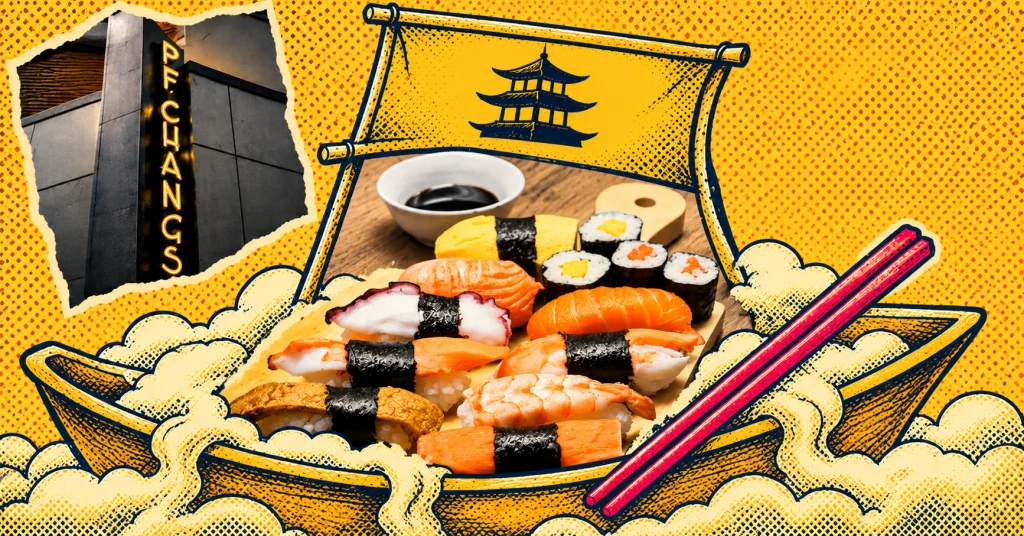
A $49 sushi boat, sizzling dumplings and a smoking cocktail turned a chain on its fourth CEO in two years into one of casual dining’s fastest growers. The spectacle is the price strategy.
By SSC News Desk | November 15, 2026 | Business | 4 min read
When Jim Mazany became CEO of P.F. Chang’s in November 2025, most of the chain’s customers were eating at home. They were ordering takeout rather than coming in. Mazany told CNN’s Jordan Valinsky that the chain wasn’t just competing with other restaurants. It was “competing with people’s couches.” He was its fourth leader in roughly two years, and sales hadn’t grown since 2023. A year later, traffic is up more than 5% and same-restaurant sales rose nearly 10% in the third quarter. It’s the third straight quarter of gains on both measures. Mazany says the chain moved from 22nd to third in same-store sales growth among its casual-dining peers. His fix was to give people a reason to leave the house: a $49 sushi platter served in a wooden boat surrounded by dry-ice fog, dumplings brought out on a sizzling plate and sauced at the table, and a bourbon cocktail that releases smoke when the lid comes off.
The show is the reason to come in
Delivery can bring the food home. It can’t bring the fog, the sizzle or the server’s tableside sauce. That makes the spectacle the moat, at a time when Americans are eating out less across every income group. It also changes how customers think about price. “Consumers are looking for more for their money – not just to spend less money,” said Robert Byrne, Technomic’s senior director of consumer research. A $49 sushi boat doesn’t register as an expensive dinner. It feels like an event you can film, and social media makes it more valuable. Nearly 40% of millennials and Gen Z diners prefer dishes served tableside, according to OpenTable. Every video of a fogged-out sushi boat is free advertising, the same approach Chipotle has used to let the internet shape its business. The sushi boats have brought in $2 million in sales since launching in June.
A menu built for a split economy
The other half of the strategy is what Mazany calls a “barbell” menu. Lunch and dinner deals start at $13.99 on one end, with a $30 lobster and prawn fried rice and a $43 Wagyu steak on the other. Mazany said plainly that the chain is serving a K-shaped economy. That’s a country where paychecks have lost to inflation for seven straight months while higher earners keep spending. The barbell catches both groups without a broad price increase, which Mazany said the chain deliberately avoided. Not every chain has managed that. McDonald’s has watched lower-income diners walk away after years of price hikes. P.F. Chang’s is pricing for two separate customers.
The turnaround also needed work customers don’t see. Mazany retrained staff, tracked online reviews to fix recurring complaints and brought back from-scratch, wok-fired cooking based on the chain’s original recipes. The performance only works if the food holds up.
The turnaround is also an exit plan
P.F. Chang’s has been owned by private equity firms TriArtisan Capital Advisors and Paulson & Company since 2019. Mazany said the recent growth has moved a possible IPO up to next year, ahead of an earlier 2028 target, and the company plans 40 new U.S. locations over five years. Three strong quarters give the owners the growth story an IPO needs. The risk is that spectacle is easy to copy. Expect P.F. Chang’s to file to go public in 2027, while the novelty is still driving traffic. Expect competitors to add their own smoke and fog within a year, which would put the chain right back in the “sea of sameness” Mazany set out to escape. The sizzle got customers back in the door. Keeping them coming after rivals copy it will depend on the food.