

Nigeria’s inflation rate is falling, and government officials say economic reforms are working. But the country’s ₦70,000 monthly minimum wage, equivalent to about $52, is exposing the distance between financial stability and the ability to afford everyday life.
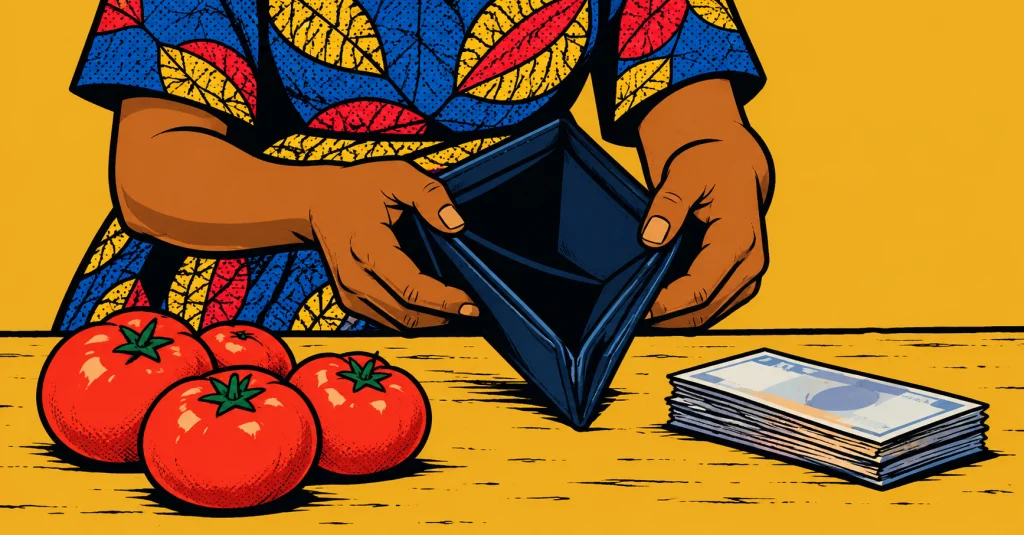
For a Nigerian worker earning the national minimum wage, an ordinary trip to the market can become a calculation about what the family will go without. Transportation costs money before the workday begins. Food prices determine what reaches the dinner table, while electricity, school expenses and household necessities compete for whatever remains. The country’s minimum wage stands at ₦70,000 a month, approximately $52.36 in U.S. dollars at the October 21 exchange rate. That is roughly $1.75 a day when spread across a 30-day month. It is not enough information to determine what any individual household can afford, but it illustrates why millions of workers are paying close attention to a national economic recovery that has not necessarily translated into financial relief.
Nigeria’s government sees meaningful progress. Finance Minister Taiwo Oyedele told an audience at Chatham House in London that reforms introduced under President Bola Tinubu have strengthened public finances, increased foreign reserves and helped stabilize the economy. The government has removed longstanding petrol subsidies, restructured foreign exchange policies and sought to encourage greater private investment. According to Reuters, the administration hopes to achieve average annual economic growth of 7% over the next five years. But for workers who must purchase fuel, commute to jobs and feed their families, the financial consequences of those reforms remain immediate.
Inflation Is Falling. Prices Are Still High.
Nigeria’s annual inflation rate declined to 14.63% in September, compared with 15.39% in August. That is progress for an economy that has struggled with persistent price increases, but it does not mean prices are returning to earlier levels. It means the overall rate of increase has slowed. Food inflation remained at 19.59%, according to figures from the National Bureau of Statistics reported by Reuters. A household whose wages have not kept pace with earlier price increases can continue losing financial ground even as the inflation rate improves. The government’s economic indicators and the worker’s experience can therefore both be accurate while describing very different realities.
The disagreement has become a labor confrontation. The Nigeria Labour Congress issued a 14-day ultimatum beginning October 9, demanding lower petrol prices, renegotiation of the minimum wage, tax relief and immediate financial assistance for workers. On October 20, union president Joe Ajaero reiterated that the ultimatum remained in force. As Nigeria Info FM reported, organized labor argues that the current ₦70,000 wage has lost substantial purchasing power because of transportation and food costs. Government representatives have urged negotiations while emphasizing fiscal constraints. The dispute is about more than compensation: it concerns who should carry the immediate financial burden of rebuilding the economy.
What Does ₦70,000 Actually Mean?
For American readers, the conversion provides useful context, even though exchange rates cannot fully describe living standards. At the October 21 official reference rate of approximately ₦1,337 to $1, Nigeria’s monthly minimum wage is worth about $52.36. Annualized, a worker receiving that wage for 12 months earns ₦840,000, or approximately $628.27. That does not mean a Nigerian worker faces American prices, and direct dollar comparisons should not be confused with purchasing-power comparisons. Local wages, transportation systems, food markets and household arrangements all matter. The more consequential measure is how much of the monthly wage remains after the essentials have been purchased. A minimum wage can comply with national law while still failing to provide adequate financial security.
The government’s fiscal argument also deserves scrutiny. In an October 21 report by Premium Times, Oyedele attributed part of Nigeria’s inflationary pressure to approximately ₦30 trillion, equivalent to roughly $22.44 billion, in monetary financing used to cover government shortfalls. He argued that excessive money creation and petrol subsidy spending helped produce the conditions requiring reform. Those policies carry real economic consequences, and leaving them unchanged could have created additional instability. But acknowledging the need for reform does not resolve the question of how its costs are distributed. Workers have limited control over monetary policy, currency markets and government borrowing, yet changes in those systems reach them through the price of a bus ride or a bag of groceries.
Economic Growth Has to Reach the Paycheck.
Nigeria is not alone in confronting this problem. Across the world, governments frequently measure economic progress through inflation rates, gross domestic product, investment and currency stability. Those indicators are important, but they are incomplete measures of household well-being. A growing economy can coexist with stagnant wages. A stronger fiscal position can coexist with workers reducing essential purchases. Even successful reforms may take years to improve employment opportunities or living standards, while households must meet their expenses every day. The Nigeria Labour Congress is effectively challenging the government to demonstrate that economic improvement will eventually become meaningful income growth rather than remain a story told through financial indicators.
The administration has outlined targeted support, including cash transfers intended to reach 10 million households, alongside policies designed to promote investment and wage growth. Whether those measures provide meaningful relief depends on delivery, coverage and the costs recipients face. The immediate labor dispute offers a test of that commitment. If Nigeria’s reforms are producing a healthier economy, the next measure of success should be whether workers can afford to participate in it. For someone bringing home ₦70,000 each month, the economy is experienced through what that paycheck buys, not through the government’s growth forecast. Nigeria may be moving toward greater macroeconomic stability, but a recovery that has not reached the household budget remains unfinished.
Currency methodology: U.S. dollar equivalents are approximate, calculated using the October 21, 2026 Nigerian Foreign Exchange Market closing reference rate of ₦1,337 per US$1. The figures are nominal currency conversions, not purchasing-power-adjusted earnings. Actual transaction rates and fees vary.
Sources: Reuters; Premium Times; Nigeria Info FM; Channels Television; National Bureau of Statistics inflation figures reported by Reuters; October 21 Central Bank of Nigeria foreign exchange reference data.