
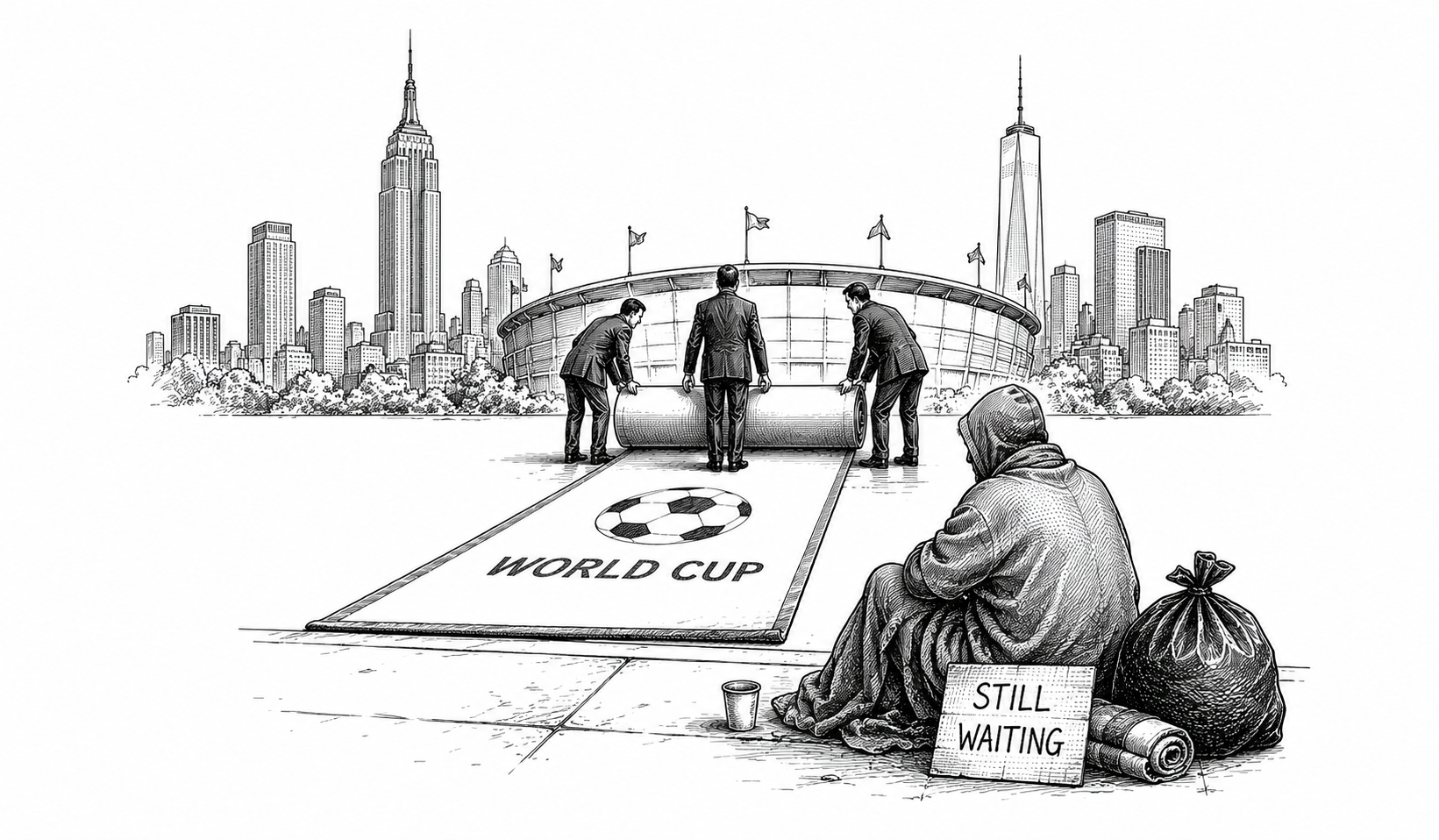
Michael Casey, R.J. Rico, and Charlotte Kramon of the Associated Press reported that most of the 16 World Cup host cities are relying on existing homelessness programs as the tournament begins across North America. That list includes New York and Boston, along with Philadelphia, Miami, Houston, Toronto, and Vancouver. Most have not attached new World Cup-specific funding to the issue. The cities are preparing for fans, broadcast crews, vendors, transit loads, public viewing spaces, late nights, and security. For homelessness, many are asking the systems already in place to absorb the pressure.
That choice matters because major events change what cities decide to see. A tournament does not create homelessness. It changes the audience. Streets that local residents pass every day become international corridors. Train stations, downtown parks, fan zones, hotels, and commercial districts become part of the host-city image. The same person sleeping outside can be treated as a resident in need of housing one month and a visibility problem the next.
AP’s survey shows two different models taking shape. Atlanta, Dallas, and Seattle launched targeted initiatives tied to the World Cup moment, though each has limits. Atlanta’s Downtown Rising effort says it has housed nearly 500 people and is working toward a $235 million goal to house 3,900 citywide by next year. Dallas says a $30 million campaign reduced downtown street homelessness by 87% and moved about 2,000 people into permanent housing. Seattle promised 500 new shelter units and delivered 75 tiny homes before the tournament, missing the target but creating some new capacity.
New York and Boston are taking a quieter route. They are not absent from homelessness response, and neither city lacks existing programs. That is part of the point. Existing systems can become a convenient answer because they allow a city to say it has a plan without admitting the event created an additional test of capacity, coordination, and visibility. The structure stays the same. The public pressure changes.
Boston’s World Cup planning shows how quickly government can move when the audience is tourists. Massachusetts approved extended alcohol service until 3 a.m. during the tournament window, and Boston moved to speed up licensing approvals. That may be reasonable event management. But it also clarifies the hierarchy. Cities can create special rules, compressed timelines, and temporary permissions when the goal is visitor experience. For unhoused residents, the response is more likely to be routed through existing shelter, outreach, and housing systems that were never designed around a 39-day global spectacle.
New York faces a similar visibility problem at a larger scale. The New York/New Jersey region is hosting matches and the World Cup final, while New York City is planning mass public viewing events, including a Central Park final watch party expected to draw tens of thousands of people. That kind of civic staging requires coordination, security, sanitation, transit planning, crowd control, and political messaging. It also puts public space under sharper management. When public space becomes an event asset, the people who live in that space without housing become easier to move, police, or ignore.
The national numbers make the reliance on existing systems harder to defend as neutral. AP reported federal data counted 770,000 people as homeless in 2024 after a double-digit increase from 2023, followed by 745,652 in 2025. Those figures are widely understood as undercounts. They describe a problem that was already beyond routine capacity before the World Cup arrived. Asking ordinary systems to carry extraordinary scrutiny is still a policy choice.
Power moves through that choice. Event organizers and city officials gain the authority to define what preparedness looks like. Tourism and security systems receive urgency. Unhoused residents receive continuity, which sounds stable until the streets around them are being remade for a global audience. The World Cup will leave behind highlight reels, economic impact reports, and host-city branding. The more important record may be quieter: which cities used the pressure to build housing capacity, and which ones treated homelessness as something the old system could keep carrying until the cameras moved on.
— SSC News Desk | Social Storytellers Collective
Get SSC analysis delivered to your inbox every day. Subscribe free on Beehiiv: socialstorytellerscollective.beehiiv.com