
I have been paying attention to how men talk about grooming for longer than the category has been commercially interesting. What I noticed first was not the products. It was the silence around them — the unspoken set of rules about what counted as masculine that governed the conversation before the conversation was allowed to exist. Care could be functional. It could be minimal. But anything that suggested attention, intention, or pleasure risked crossing into territory that required explanation. Grooming was permitted — but only within limits that were rarely defined and consistently enforced, by a cultural barometer that had no official arbiter and no formal code. Just pressure, ambient and persistent, applied to any man who appeared to care too much about how he presented himself to the world.
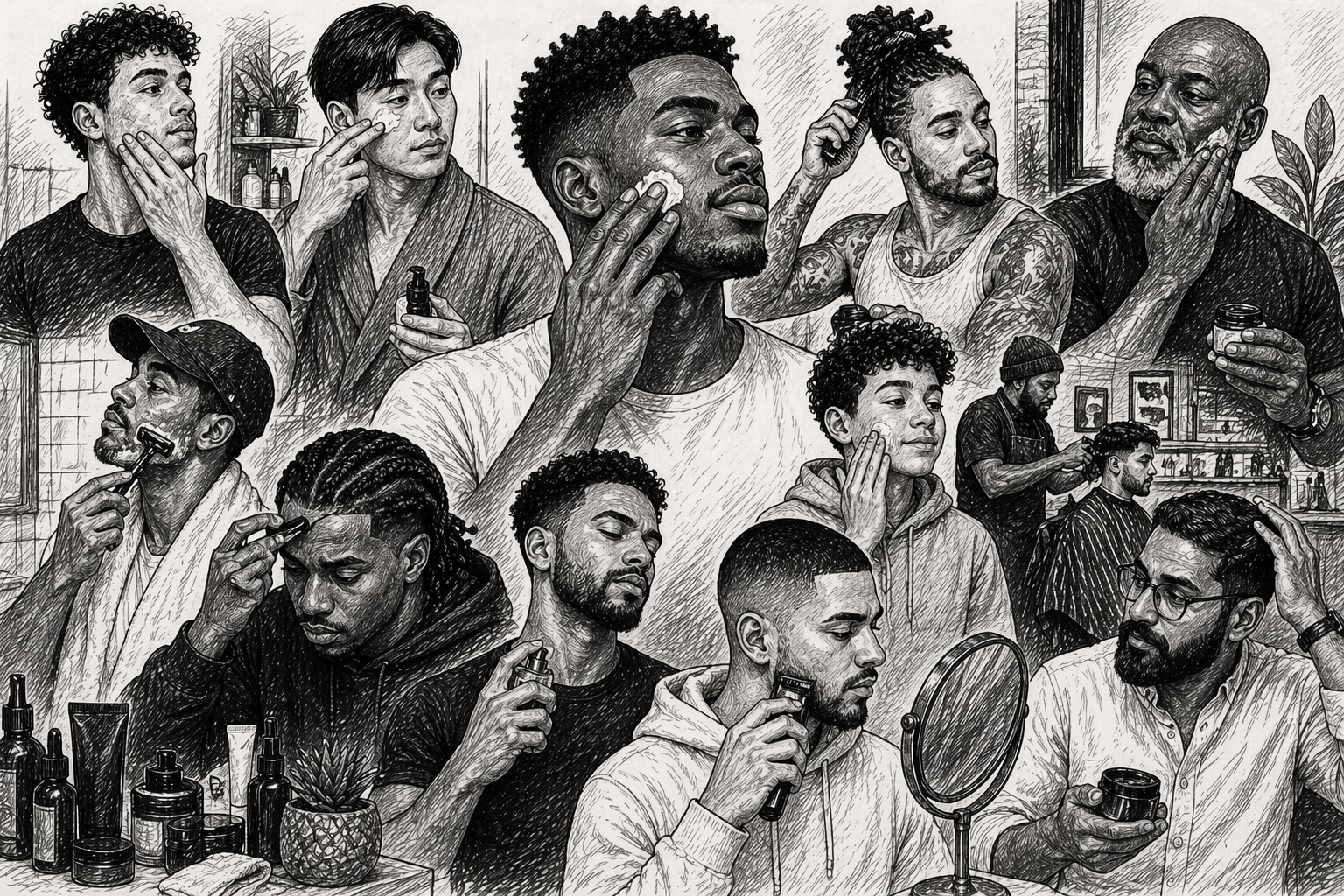
What has changed is not simply behavior. It is authority. Men have not just expanded their grooming routines — they have begun to disengage from the idea that those routines require external validation at all. The shift is visible in small, everyday decisions: more men investing in skincare without framing it as a medical necessity, more men getting manicures without treating it as a punchline, more men approaching hygiene and presentation as baseline rather than exception. The change is not that men suddenly care. It is that caring no longer needs to be justified — and that distinction is the more culturally significant one, because it marks a shift in authority rather than simply a shift in habit.
Brands like MANSCAPED helped accelerate that shift by changing how the category spoke before changing what it sold. Humor became the gateway. What had been awkward or actively avoided was reframed as approachable, even communal — something men could engage with together rather than only in private. The tone did as much structural work as the product. As someone who has watched this category from the outside and used it from the inside, the distinction between a brand that sells tools and a brand that translates a behavior is not abstract. MANSCAPED gave men a culturally legible entry point into a conversation that had previously required either defensiveness or silence. In that sense, the brand did not simply create a market. It translated a behavior that already existed into a language the culture was ready to receive — and that is a harder thing to do than it appears, which is why the brand’s early growth was less about product differentiation and more about category creation through communication.
But the conditions that made that translation effective are shifting in ways that matter strategically. Once a category becomes visible, the language that introduced it begins to flatten. Humor spreads. Competitors replicate tone. The register that once felt like permission begins to feel like expectation — and expectation, for a generation of consumers who have already internalized the behavior, is a significantly less compelling offer than discovery was. At the same time, social media has introduced a new layer of measurement onto masculinity that complicates the category further. As SSC has documented in The Red Pill Effect, the algorithmically driven masculinity debate — looksmaxxing, optimization frameworks, the competitive dating market logic that has moved from niche forums into mainstream conversation — has made the barometer more visible and more contested simultaneously. Grooming brands now operate inside that debate whether they choose to or not. The men who are most engaged with grooming as a practice are increasingly the same men who are most skeptical of being told what their grooming means about them.
This is where the category’s next challenge lives — not in making grooming visible, but in making it meaningful on the consumer’s own terms. The barometer of masculinity has always been inconsistent. What is new is that it is increasingly recognized as immature in the face of how men actually live. A man can invest in how he looks, take care of his body, and move through the world with intention without that being read as deviation. He can be deliberate about his appearance without that deliberateness requiring a cultural defense. The lived reality of men’s self-care is more expansive than the categories historically used to define it — and the brands that will sustain relevance in this environment are not the ones that continue to frame grooming as transgressive novelty. They are the ones that meet men where the behavior already is: normalized, intentional, and no longer in need of a permission structure to justify it.
Grooming sits at the center of that shift because it is both visible and intimate — one of the clearest ways men engage with themselves before they engage with the world. What was once framed as vanity is more accurately understood as alignment. The routine is not about meeting an external standard. It is about establishing a personal one. I think about this as someone who has watched the conversation change in real time — in gyms, in barbershops, in the way men talk about their routines when they think no one is taking notes. The shift is real. And that standard is increasingly self-defined, even as platforms and systems attempt to quantify and rank it from the outside. The next phase of the men’s grooming category will not be won by whoever can make the behavior most visible — that work has already been done. It will be shaped by whoever can speak to a generation of men who no longer need permission but are still figuring out what autonomy actually looks like in practice. Because once the script is broken, the question is no longer what men are allowed to do. It is what they choose to do, and why — and that is a fundamentally more interesting question to be in the business of answering.