In Britain, a Disabled Person’s Freedom to Travel Can Depend on a Postcode

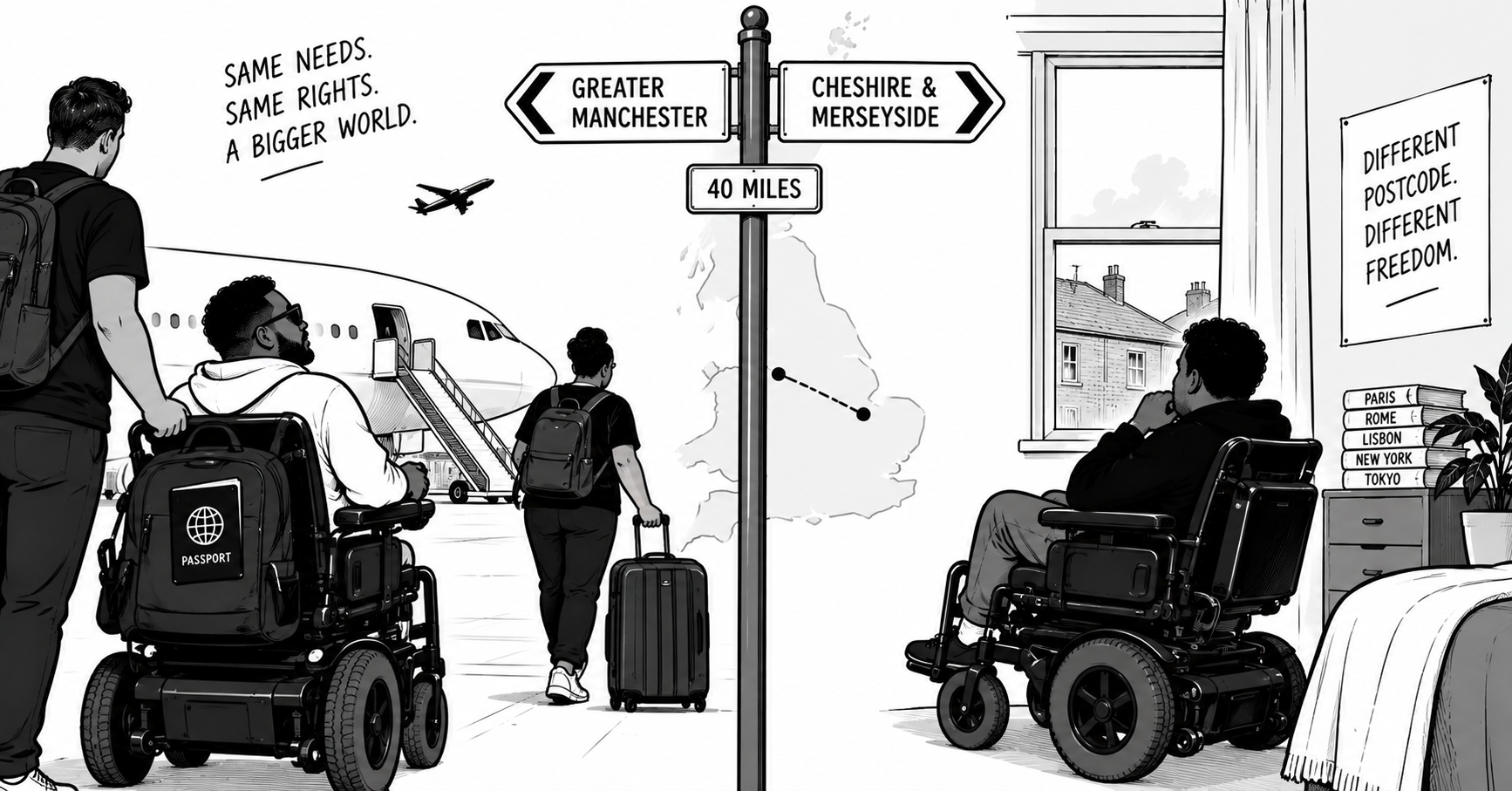
Two men in northern England have the same medical condition, require similar around-the-clock assistance and live roughly 40 miles apart. One has been able to take an overseas trip with his personal assistants, exploring places he might otherwise never see and reclaiming a basic adult experience. The other says he has effectively been unable to travel abroad for eight years because his local NHS body will not contribute toward the travel expenses of the assistants he needs with him. He remains trapped not by his disability, but by a bureaucratic line drawn on a map. The difference between their lives is not the level of care each man has been assessed to require. It is how two local health systems interpret the rules governing that care—and whether freedom of movement is considered essential care or an optional extra.
The Support Need Does Not Disappear at the Border
The men were identified by The Guardian using pseudonyms. Joel, 40, has spinal muscular atrophy and works in marketing for a global company. His health needs require two personal assistants to move, dress, eat and manage his medical care. He can pay for his own travel but says he cannot afford the additional cost of transporting and accommodating his care team—a price tag that transforms a modest holiday into a financial impossibility. Cheshire and Merseyside NHS Integrated Care Board previously permitted him to use his personal health budget toward those costs, but reversed that position eight years ago and has since described the earlier approval as an error.
David, 25, lives in the neighboring Greater Manchester system and has similar support needs. For years, his requests were also rejected, each denial closing another door to independence and ordinary life. But David challenged it, using NHS guidance and human-rights arguments grounded in the U.N. Convention on the Rights of Persons with Disabilities. The decision changed. He now receives an annual allocation of £2,370 toward his assistants’ travel and accommodation and was able to take his first overseas trip without his parents last year—a moment of independence and autonomy that Joel remains unable to experience.
The contrast between these two lives, separated by miles but worlds apart in opportunity, has prompted MPs and disability-rights advocates to call for national rules that would end this postcode lottery. Debbie Abrahams, chair of the House of Commons Work and Pensions Committee, said the restrictions could conflict with principles in the U.N. Convention on the Rights of Persons with Disabilities. Former disability minister Marsha de Cordova has also called for national guidance to ensure that essential care support does not vanish at a border. These are their legal and policy assessments; no court ruling cited in the reporting has established that the local policies themselves violate the convention, yet the inconsistency itself reveals a system that has not grappled with what freedom of movement means for disabled people.
Personal Budgets Were Designed Around Choice
The NHS describes a personal health budget as a set amount of healthcare money organized around an individualized care plan—money meant to be spent on whatever a person’s assessed needs require. NHS England says the model is intended to provide choice and flexibility over how assessed health and wellbeing needs are met, moving away from a one-size-fits-all approach toward support that reflects individual lives and circumstances. The budget can include personal assistants and can be managed directly by the recipient, by the NHS or through a third party, giving disabled people some measure of control over how their own care is structured.
That flexibility has limits, and those limits are where the system breaks down. Spending must be agreed through the care plan, and integrated care boards retain responsibility for deciding whether a proposed use meets assessed needs. The Department of Health and Social Care told The Guardian that boards should consider requests involving overseas PA travel individually, including the potential health and wellbeing benefit to the person. But individual consideration means individual variation. Cheshire and Merseyside’s current policy says such travel costs can be requested but ordinarily will not be funded, a blanket rejection dressed up as discretion. Greater Manchester told the newspaper it does not have a ratified policy specifically governing holiday travel, which has led to different outcomes depending on who makes the decision and what arguments are presented.
The issue affects a system far larger than these two cases. NHS data show that 173,018 people in England held personal health budgets by the end of March 2026, including 147,770 adults and 25,248 children and young people. About 29,800 adults with budgets were receiving NHS Continuing Healthcare, the program covering some people with significant long-term care needs. These are not marginal populations or edge cases. They are hundreds of thousands of people whose mobility, independence and quality of life depend on decisions made in local offices about what counts as essential care.
The Structural Issue Transcends Holiday Planning
The structural issue is therefore not whether the NHS should finance someone’s holiday. The care need already exists and has already been assessed. The dispute is about whether support that makes ordinary life possible at home should remain usable when a person crosses a national border—and whether that answer should change when the person moves from one NHS area to another. For people who cannot travel without assistance, administrative discretion over a care budget can become discretion over freedom of movement itself. When one local board permits overseas travel and another forbids it, they are not making different judgments about medical need. They are making different judgments about which disabled people deserve access to the world beyond their postcode.
The real cost of this inconsistency falls on the people whose independence hangs in the balance. For Joel, it means eight years without the possibility of choosing where he can go. For David, it means that challenging the system worked—but only because he lived in the right area and had the resources to argue his case. For others facing the same restrictions without his luck or access to advocacy, it means accepting that their freedom has already been decided by geography, not capacity.