
Part of The Access Shift — an ongoing series examining how access is being quietly reshaped across American life.
For twenty-five years, the British government operated on a principle that felt self-evident: the country’s great museums should be free. The British Museum, the National Gallery, the Natural History Museum, the Victoria and Albert — all open to anyone who walked through the door, regardless of where they came from or what they could afford. The government of Tony Blair abolished entry charges for England’s national museums in 2001. That policy is now under challenge.
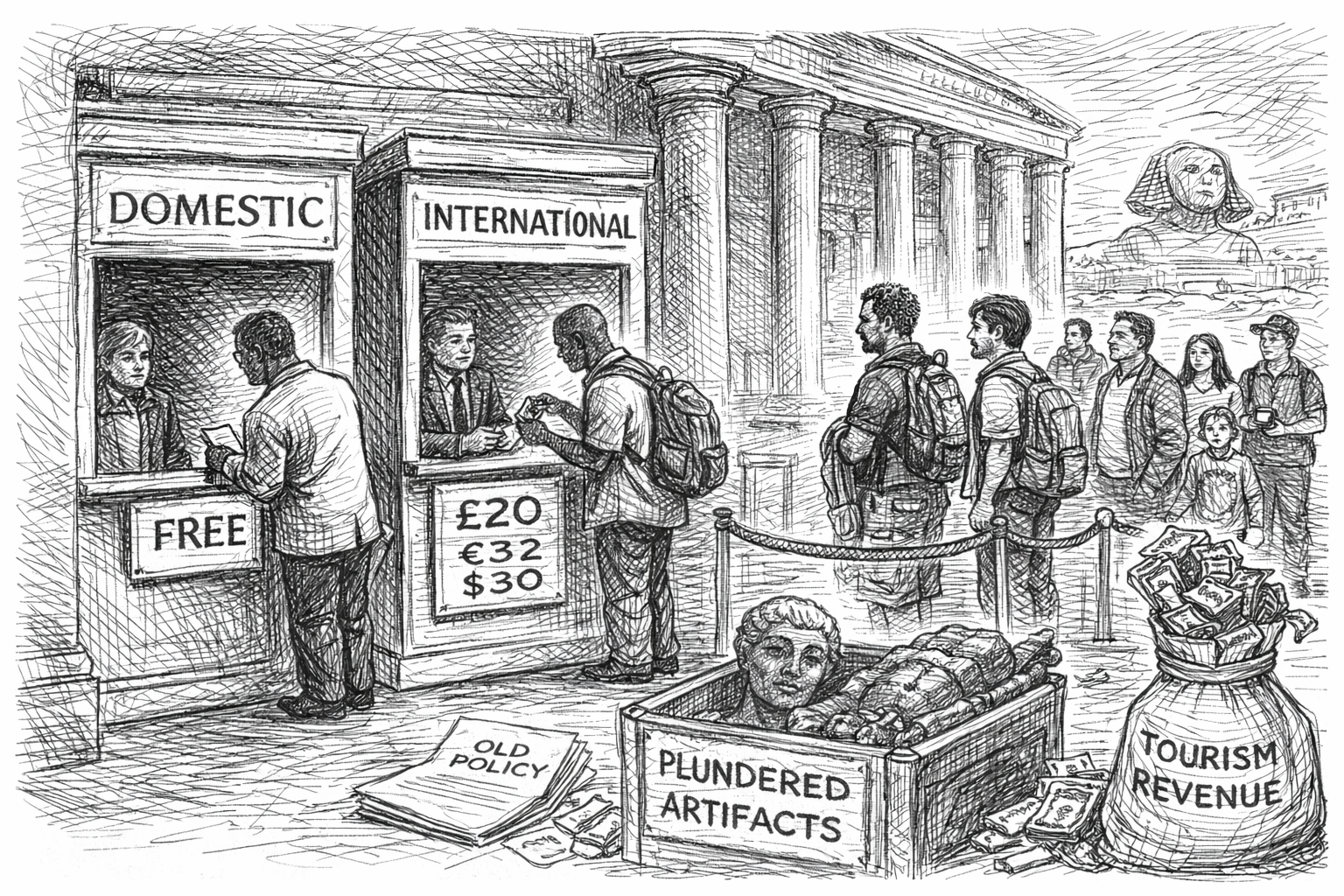
Last week, UK Culture Secretary Lisa Nandy accepted recommendations from an independent review of Arts Council England — led by Labour peer Baroness Margaret Hodge — that would introduce admission fees for international visitors at major national museums. Fees of £15 to £20 are being floated as a benchmark, with the Louvre’s €32 and the Metropolitan Museum of Art’s $30 cited as reference points. International visitors to the UK’s 15 DCMS-sponsored museums numbered 17.5 million in 2023-24 — roughly 43% of total visitors. The government’s stated rationale is financial sustainability. The subtext is that public funding has been squeezed to the point where institutions are being asked to monetize their audiences instead.
National Museums Liverpool recorded a 269% rise in visitors after entry charges were dropped when the Blair government abolished fees in 2001 — a data point that established free access not just as a philosophical commitment but as a measurable driver of public engagement. The current proposal would reverse that logic: access would remain free for domestic visitors, but international visitors would pay. The distinction is presented as equitable. It is also a structural change to what “public” means in practice.
This is happening in parallel with a similar pattern in the United States — where, as SSC documented in Museums Aren’t Just Losing Funding. They’re Losing Control., the mechanism of constraint is different but the outcome is similar. In the UK, financial pressure is pushing institutions toward tiered access as a revenue model. In the US, political pressure is pushing institutions toward content compliance as a condition of funding. One approach prices access. The other conditions it. Both are redesigning the relationship between cultural institutions and the publics they were built to serve.
The access question gets more complicated when you consider which visitors the fee proposal most affects. International visitors to London’s national museums are not a monolith. They include wealthy tourists for whom £20 is trivial, and they include members of diaspora communities — from Nigeria, Ghana, Jamaica, India, South Asia — for whom London’s museums hold artifacts, histories, and cultural materials extracted from their countries of origin and never returned. Tate director Maria Balshaw noted the tension directly: “The British Museum and the V&A, in particular, hold the best of many other nations’ art and culture.” Charging those nations’ citizens to view what was taken from them is not a neutral revenue decision. It is a statement about whose relationship to that material is considered primary.
The broader pattern is consistent with what SSC has tracked across The Access Shift series. Whether the mechanism is a funding termination, a formaldehyde ban that never happens, an entry fee, or an executive order targeting “divisive narratives,” the structure is the same: something that was available as a public good becomes available only under conditions. The conditions are framed as practical. The effect is selective. And the communities least positioned to navigate the new conditions are almost always the communities the institutions were claiming to serve.
Why This Matters
Access is not disappearing. It is being redesigned — in London, in Washington, in Houston, in beauty supply stores and federal grant offices. The question is not whether cultural institutions will adapt to financial and political pressure. They will. The question is what they are willing to trade in the process, and who absorbs the cost of that trade. Free museums were never just a nice policy. They were a claim about who culture belongs to. Pricing that claim — by fee, by compliance, or by omission — changes the answer in ways that are easy to miss until the door is already narrower than it was before.