
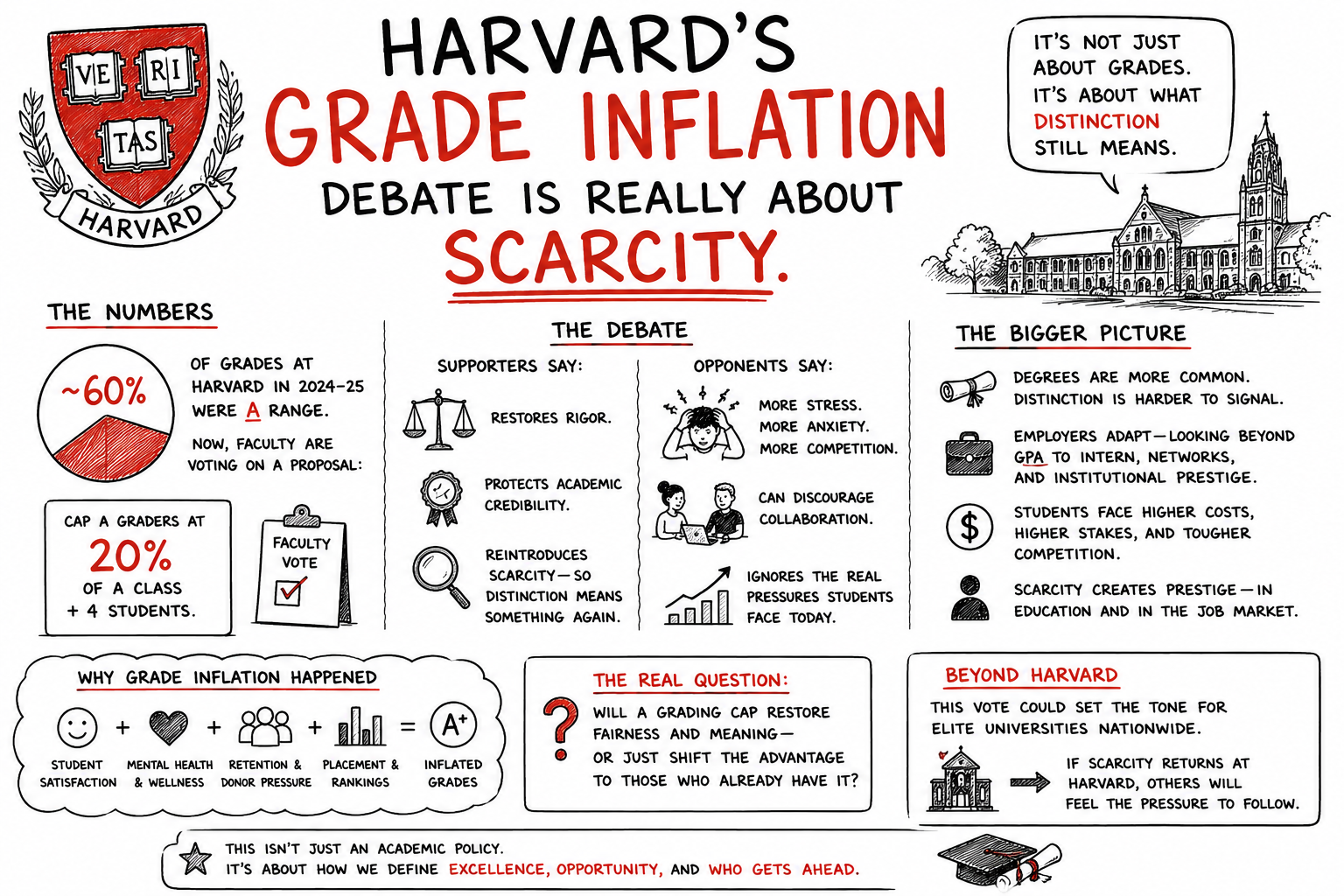
Roughly 60% of grades awarded at Harvard University during the academic year ending in mid-2025 were A-range marks, a figure that has become central to a contentious faculty vote now unfolding across the university. Harvard faculty began voting Tuesday on a proposal that would cap A grades at 20% of each class in an attempt to slow the steady rise of grade inflation that has transformed academic distinction at many elite institutions over the past two decades. Supporters argue the measure is necessary to restore rigor and credibility to academic evaluation. Opponents, particularly students, warn it could intensify stress, competition, and anxiety inside an already pressurized environment where career outcomes increasingly feel tied to microscopic differences in performance.
The debate arrives at a moment when elite higher education is facing simultaneous pressure from employers, policymakers, students, and the public over the actual meaning of institutional prestige. Harvard’s proposal is not emerging in isolation. Universities across the country have spent years quietly grappling with how inflated grading systems affect graduate school admissions, hiring pipelines, scholarship competition, and institutional credibility. Previous attempts at similar reforms at institutions like Princeton and Wellesley either weakened over time or collapsed under backlash from students and faculty concerned about equity and unintended consequences. Yet Harvard’s position inside the symbolic hierarchy of American higher education gives this vote unusual influence. If a grading cap succeeds there, other elite universities may face pressure to do the same.
What makes the story more complicated than a traditional rigor-versus-leniency debate is that grade inflation itself did not emerge accidentally. Elite universities increasingly compete not only for academic reputation but for student satisfaction, mental health outcomes, donor relationships, retention metrics, and post-graduation placement statistics. In that environment, harsh grading can create institutional disadvantages. Students paying tuition that now exceeds $80,000 annually at some elite institutions increasingly behave like high-stakes consumers as much as learners. Universities simultaneously market collaboration, wellness, belonging, and holistic development while also functioning as gateways into hypercompetitive professional pipelines tied to finance, consulting, technology, medicine, and law. Inflated grades became one way to reduce friction inside that contradiction.
The proposal therefore exposes a larger tension surrounding how value is assigned in modern professional life. In many elite spaces, scarcity itself creates prestige. When too many students receive top marks, distinction weakens as a signaling mechanism for employers and graduate programs attempting to sort candidates efficiently. Harvard’s proposal is effectively an attempt to reintroduce scarcity into academic evaluation. That reframes the issue away from pedagogy alone and toward labor market dynamics. The university is not simply debating grades. It is debating how elite institutions maintain hierarchy when credentials become increasingly common among already highly selected populations.
Students opposing the proposal are also responding to broader economic realities that differ significantly from earlier generations of Harvard attendees. Competition for elite internships, graduate programs, fellowships, and entry-level positions has intensified across multiple sectors even as the cost of living in major professional hubs continues rising sharply. A single grade can now feel tied to future access in ways that extend beyond the classroom. Critics of the cap argue that forced grade distribution systems can discourage collaboration and increase psychological strain inside environments already associated with anxiety, burnout, and perfectionism. Research on college mental health has consistently documented rising rates of stress, depression, and emotional exhaustion among high-achieving students over the past decade. Inside that context, grading policy becomes inseparable from wellness culture itself.
At the same time, employers have quietly contributed to the problem universities are now trying to solve. Many major firms recruiting from elite campuses already assume grade inflation exists and have adjusted hiring practices accordingly, placing greater emphasis on internships, networking, extracurricular leadership, and institutional prestige itself rather than GPA alone. In practice, this has sometimes advantaged students with stronger social capital, financial flexibility, or insider access to professional networks. A stricter grading system could theoretically restore academic differentiation, but it may also intensify dependence on the very forms of elite navigation that already shape opportunity unevenly. The question is not simply whether grades should become harder to earn. It is whether tightening evaluation systems actually produces fairer measures of talent.
The debate also reflects a broader institutional recalibration occurring far beyond higher education. Across industries, organizations are attempting to restore distinction after years of expansion, abundance, and credential saturation. Technology companies are tightening hiring after years of aggressive recruitment. Media companies are reducing pathways into full-time work. Professional industries increasingly demand specialized experience even for entry-level roles. In many sectors, institutions are responding to oversupply by raising filters rather than expanding opportunity. Harvard’s proposed grade cap fits inside that larger cultural shift. When access broadens too far, systems often attempt to recreate exclusivity somewhere else.
The legitimacy problem at the center of Harvard’s vote is not primarily about academic standards. It is about what happens when the sorting mechanisms elite institutions depend on stop sorting effectively. Grade inflation weakened one of the clearest signals inside higher education at the exact moment competition for professional security intensified. Harvard’s debate matters because it reveals how institutions respond when abundance begins threatening the prestige structures they were built to protect.