
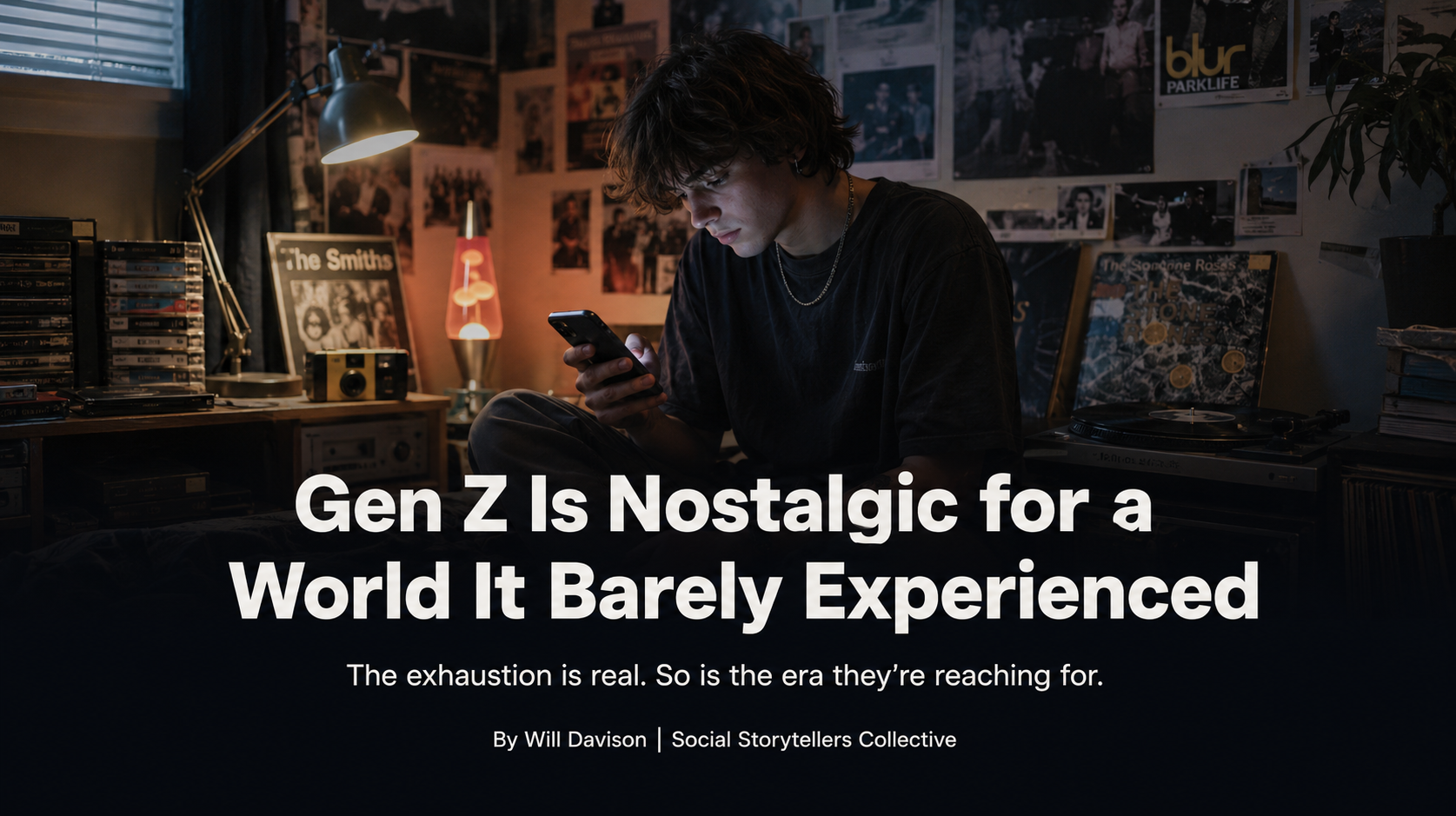
A new NBC News Decision Desk poll finding that 47% of adults between 18 and 29 would choose to live in the past rather than the future initially sounds like ordinary nostalgia. But this is not a generation longing for decades it fully experienced firsthand. Much of Gen Z’s fascination with earlier eras is reconstructed through aesthetics, archived media, inherited memory, and internet mythology. The appeal is less about returning to a specific historical moment and more about escaping the emotional architecture of the current one.
That distinction matters because the poll reflects something deeper than retro fashion cycles or renewed interest in cassette tapes, digital cameras, and 1990s design language. It points toward a generation increasingly unconvinced that the future represents improvement. According to the survey, only 15% of respondents said they would prefer to jump ahead into the future, while nearly two-thirds believe their quality of life will ultimately be worse than previous generations — an extraordinary collapse in generational optimism in a country historically built around the promise of upward mobility.
The cultural response has been visible for years. Young people increasingly romanticize eras associated with slower communication, stronger local social life, lower housing costs, less algorithmic pressure, and more tangible forms of identity formation. The aesthetics dominating youth culture reflect this retreat from hypermodernity: film cameras, wired headphones, physical media, vintage mall culture, flip phones, old cars, thrifted clothing, analog hobbies, and deliberately imperfect technology. The attraction is not simply visual — it is psychological. Older eras are being reimagined as periods where attention still belonged to the individual instead of platforms competing to monetize it.
Social media accelerated this by collapsing all decades into one continuous searchable archive. Previous generations experienced cultural transitions sequentially; Gen Z experiences them simultaneously. A teenager can move from 1970s disco clips to 1990s sitcom culture to early-2000s mall aesthetics within minutes on TikTok or Instagram. As we’ve examined in our coverage of how algorithmic feeds have replaced shared information architecture, the absence of a common cultural baseline isn’t accidental — it’s structural. Nostalgia has become detached from lived experience, replaced by sentiment for periods encountered primarily through mediated reconstruction rather than direct memory.
The economic backdrop cannot be separated from the emotional one. Gen Z entered adulthood during overlapping crises: pandemic isolation, housing unaffordability, student debt pressure, political polarization, labor precarity, climate anxiety, and the normalization of permanent digital surveillance. For many young adults, the future no longer feels expansive. It feels expensive, exhausting, and structurally closed. In that context, nostalgia becomes less escapism and more emotional self-defense.
Researchers pointing to always-online life as a major driver are identifying something real. The internet promised frictionless connection but increasingly produces continuous exposure to comparison, performance pressure, outrage cycles, productivity culture, and economic anxiety at scale. Earlier generations could leave social environments physically. Modern digital life follows users everywhere. What many young adults are rejecting is not technology itself but the psychological conditions attached to constant visibility — the requirement to be perpetually present, legible, and optimized for an audience.
That exhaustion has become an economic signal. Entire industries now monetize longing for pre-digital emotional experience. Fashion brands, entertainment companies, restaurants, music festivals, camera manufacturers, vinyl retailers, and software designers market products through the language of reconnection, slowness, tactility, and authenticity. The conditions producing this crisis are also being packaged and sold back to the people living inside it — a dynamic we’ve tracked in the music industry’s turn toward synthetic intimacy, where authenticity itself has become a product category detached from the source it claims to represent.
The deeper irony is that much of this nostalgia is produced and distributed through the same platforms generating the exhaustion. Gen Z often discovers “simpler times” through algorithmic feeds optimized for engagement. The past becomes another consumable aesthetic delivered through hypermodern systems. What the poll ultimately reveals is structural: younger generations are losing faith that technological acceleration automatically produces a better human experience. That skepticism is not a phase. It is a generational positioning that will shape culture, markets, and politics for the next decade — and institutions that mistake it for trend-chasing will keep misreading what is actually being demanded.