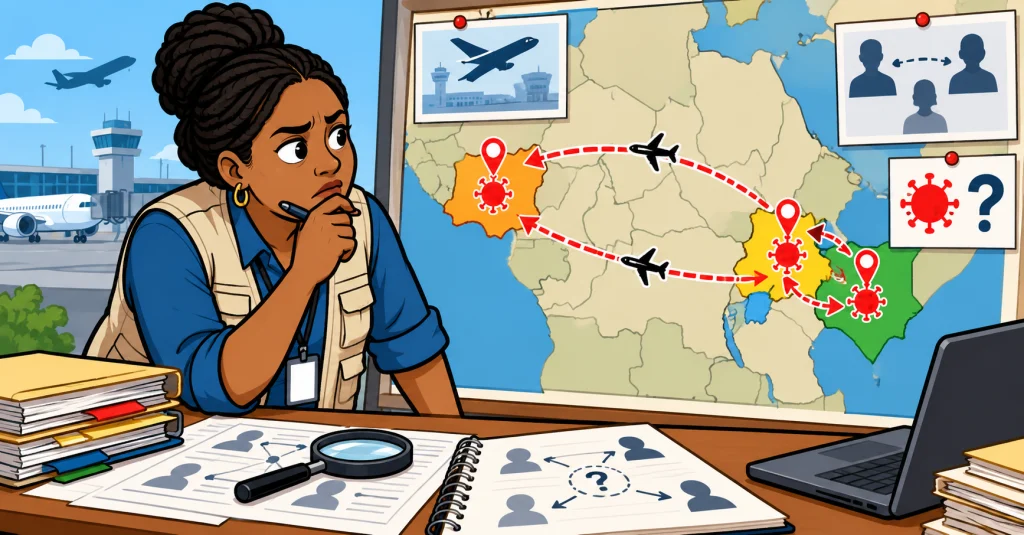
Two travelers passed through Uganda’s Entebbe International Airport on the same day in early October. Both would become part of an expanding Ebola investigation, one in Kenya and the other in Nigeria. African health authorities are now examining whether their journeys intersected in a way that could help explain how the virus reached West Africa. The possibility remains unconfirmed, but the investigation has exposed a difficult problem for disease-control systems: a virus can move between countries faster than health authorities can establish where an infection occurred.
Nigeria confirmed its first Ebola case in more than a decade on October 20, involving a woman who had recently visited Uganda before returning to Abuja. Kenyan authorities had previously reported infections associated with a traveler who returned from the Democratic Republic of Congo through Uganda. According to Associated Press reporting published October 23, investigators are examining whether the two initial patients could have crossed paths at Entebbe airport. A shared travel date, however, does not establish that the patients encountered each other or that transmission occurred there.
The development follows SSC’s October 18 reporting on Kenya’s first confirmed local Ebola transmission, when four additional infections brought the country’s reported total to seven. Three of those infections involved healthcare workers who treated the first patient, while another involved a relative. At the time, Kenyan authorities said there was no evidence of sustained community spread. The subsequent Nigerian diagnosis adds another dimension to that earlier warning. Health officials are no longer investigating only how an imported infection spread among close contacts in Kenya. They must also determine whether the two countries’ initial cases share an exposure source or transmission chain, and whether surveillance systems can identify infections before they move through additional international travel routes.
The uncertainty matters because Ebola is not transmitted simply by being in the same general public space. Infection occurs through direct contact with the blood or other bodily fluids of someone who is sick, or through contaminated materials. The possibility of airport-associated transmission therefore requires careful investigation of actual contact, symptom timing and other exposure pathways. Reuters reported that the World Health Organization had not established the source of the Nigerian woman’s infection and that no infections had been found among passengers or airport employees associated with the Kenyan patient’s journey.
Nigeria’s case is particularly concerning because the patient reportedly experienced symptoms for approximately 13 days before laboratory confirmation. Each day between illness onset and diagnosis can complicate contact tracing, particularly when a patient has visited healthcare facilities or interacted with other people. Nigerian authorities are tracing at least 44 contacts, while health officials have said there is currently no evidence that the country’s confirmed infection has spread into the broader community. Reuters reported October 22 that the delayed diagnosis has raised concerns about potential exposure among healthcare workers, relatives and other contacts.
The wider outbreak began in the Democratic Republic of Congo in May and involves the Bundibugyo species of Ebola virus, for which there is no approved vaccine or treatment specifically targeting this outbreak. By late October, the crisis had resulted in thousands of infections and deaths, placing enormous pressure on healthcare facilities, surveillance systems and international response teams. The outbreak has also affected other countries through travel-associated cases, demonstrating how quickly a health emergency can become a regional coordination challenge.
Detecting Ebola depends on more than screening people at airports. Effective response requires healthcare workers who recognize potential symptoms, laboratories capable of testing samples, rapid reporting between jurisdictions, safe patient isolation and contact-tracing teams with enough personnel to investigate possible exposures. Gaps in any of those areas can delay identification, particularly when patients initially seek treatment for symptoms that resemble more common illnesses.
Cross-border investigations introduce another layer of complexity. A patient may become infected in one country, develop symptoms in another and receive a diagnosis in a third. Officials then need to reconstruct travel histories, compare testing results and exchange information with agencies operating under different national health systems. That process becomes more difficult when border movements are extensive, surveillance resources are limited or information about a patient’s exposure is incomplete.
The human consequences extend beyond the confirmed patients. Families and healthcare workers may face monitoring after exposure, while communities can experience anxiety and misinformation as new cases emerge. Public-health officials must communicate the seriousness of a potential threat without suggesting that every traveler or casual encounter creates the same risk. Clear explanations of transmission, confirmed contacts and the limits of current evidence are essential to maintaining public trust.
The investigation also raises questions about how international disease-response systems are financed. Surveillance networks, laboratory capacity and contact-tracing programs require sustained investment before an outbreak reaches a new country. Funding reductions or fragmented coordination can leave health authorities reacting to infections rather than identifying them earlier. The World Health Organization’s ongoing outbreak reporting documents the challenges of tracking transmission across countries while maintaining emergency response capacity in affected communities.
For now, the possible connection between the Nigerian and Kenyan patients remains a question under investigation, not an established transmission route. Nigeria has reported no evidence of wider community spread from its confirmed case, and authorities continue tracing contacts.
The immediate public-health task is to identify where exposure occurred and prevent further infections. The longer-term challenge is ensuring that national health systems can recognize and respond to cross-border threats before an outbreak becomes more difficult to contain. That work depends less on borders themselves than on the people, laboratories and reporting networks responsible for detecting what crosses them.