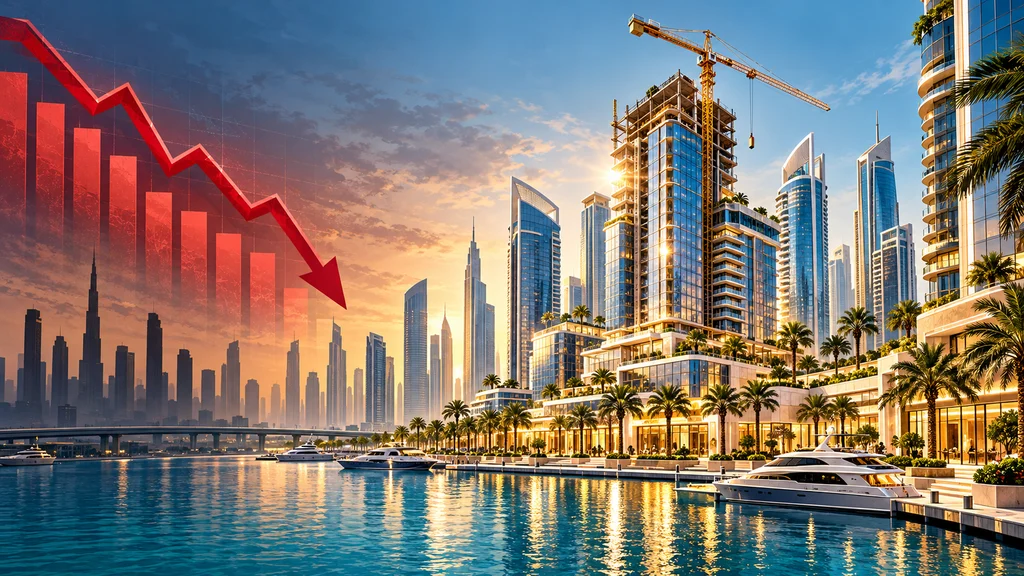
A 50% drop in one developer’s sales has not stopped it from investing in luxury residences, hotels and offices. Dubai is betting its wealthiest buyers and growing financial industry can withstand a regional slowdown.
Dubai is moving ahead with a $1.4 billion real estate development even as regional conflict weakens property sales and raises construction costs. The project, called Water Gardens, will add luxury residences, hotels and premium office space to the Dubai International Financial Centre. Construction is already underway, with about 30,000 workers on site, and completion is expected before the end of 2028, Bloomberg reported on October 15. The developer, H&H Development, says its sales between March and September fell by at least half compared with the same period last year. “I’d comfortably say there is a 50% drop at least, if not more,” chairman Shahab Lutfi told Bloomberg. Yet about 85% of the branded residences at Water Gardens have already been sold.
Those numbers show how differently the same economic conditions can hit different buyers. Dubai’s property market depends heavily on international capital, but investors buying multimillion-dollar residences face different pressures than buyers who rely on mortgages, rental income or quick appreciation. A slowdown in overall sales can coexist with strong demand for a small collection of exceptionally expensive properties.
Luxury Buyers Are Still Spending
Lutfi told Bloomberg that the company recently sold two Four Seasons-branded residences for 35 million dirhams (about $9.5 million) and 45 million dirhams (about $12.3 million). Prices at the development exceed 8,000 dirhams per square foot, roughly $2,178, placing the homes among the most expensive in the area.
Lutfi acknowledged that the broader slowdown was substantial, but he framed it as a correction after an overheated market. “There are cycles in every industry and Dubai always comes out of these cycles much stronger,” he said, as quoted by The Economic Times. His confidence reflects a business model built around buyers who can commit significant capital even when geopolitical conditions make other investors hesitate. Wealthy buyers may have more room to hold property through uncertain periods, although their willingness to spend does not rule out falling values.
The slowdown also has limits worth noting. H&H’s 50% decline measures the developer’s own sales, not a verified citywide collapse. Across Dubai, prices and rents have mostly held, with only marginal declines, while the number of transactions has slipped, according to Bloomberg. Lutfi said some projects in the city may offer discounts of 4% to 5%, though not Water Gardens.
Dubai Is Building Around Its Financial Industry
Water Gardens has a commercial purpose beyond selling luxury apartments. The four-building complex will include a 12-story office tower with about 246,700 square feet of premium workspace, alongside hotels, residences and a members club. H&H plans to keep and operate much of the development, including a 132-unit residential building it will hold for rental income, so the company earns recurring revenue rather than depending entirely on sales.
That strategy is tied to growth at the financial centre, which recently passed 10,000 active registered companies for the first time. Financial firms, technology businesses and international investors have created demand for offices, hospitality and housing close to the commercial district.
The arrangement gives the developer several ways to make money. Office tenants can provide longer-term leasing income, hotels can serve business travelers, and residences can attract executives or international investors who want to live near the financial institutions they work with. Those uses offer some protection against weakness in any single segment, but they also tie the project to the same forces that drive corporate expansion, tourism and foreign investment.
The Cost of Building Keeps Rising
Regional conflict has added another complication. Lutfi said construction materials now cost about 15% more, raising the expense of finishing projects already underway. Developers have to decide whether to accept lower margins, raise prices or count on future rental income to justify those costs.
Large developers with established financing and access to wealthy buyers may be better positioned to keep building during a correction. Smaller builders, especially those that depend on steady presales to fund construction, can face more pressure when sales decline.
This is where real estate downturns can shift market power. Developers able to keep building may come out with more finished inventory and stronger relationships with lenders and commercial tenants, while competitors with weaker balance sheets postpone projects or sell assets. Buyers face different outcomes too: those with plenty of cash can negotiate from a position of strength, while those who depend on financing stay exposed to borrowing costs and income uncertainty.
A Bet on Wealth That Has Yet to Be Tested
Dubai’s expansion assumes that international businesses and affluent residents will keep seeing the city as an attractive place to invest despite the economic fallout from regional instability. The strong sales at Water Gardens support that argument for a narrow slice of the market, but they cannot show how durable demand will be across the wider property sector.
The development also raises a question about how cities direct their growth. Projects built around luxury housing, premium offices and branded hospitality can increase commercial activity and draw substantial investment. Their wider benefits, however, depend on whether that activity produces jobs, accessible housing and lasting economic value beyond the investors buying the properties.
By 2028, Dubai will have a clearer measure of whether this strategy works. If financial firms keep expanding and international buyers return in greater numbers, developers with finished properties could benefit from stronger demand and limited competing supply. If regional instability persists, the city could instead face a growing inventory of expensive buildings competing for a smaller pool of tenants and buyers. Either way, Dubai’s next property cycle may favor developers with the capital to outlast a long slowdown, concentrating ownership and pricing power among firms that can afford to keep building while others retreat.
Sources: Bloomberg, Oct. 15, 2026; The Economic Times, Oct. 16, 2026.