
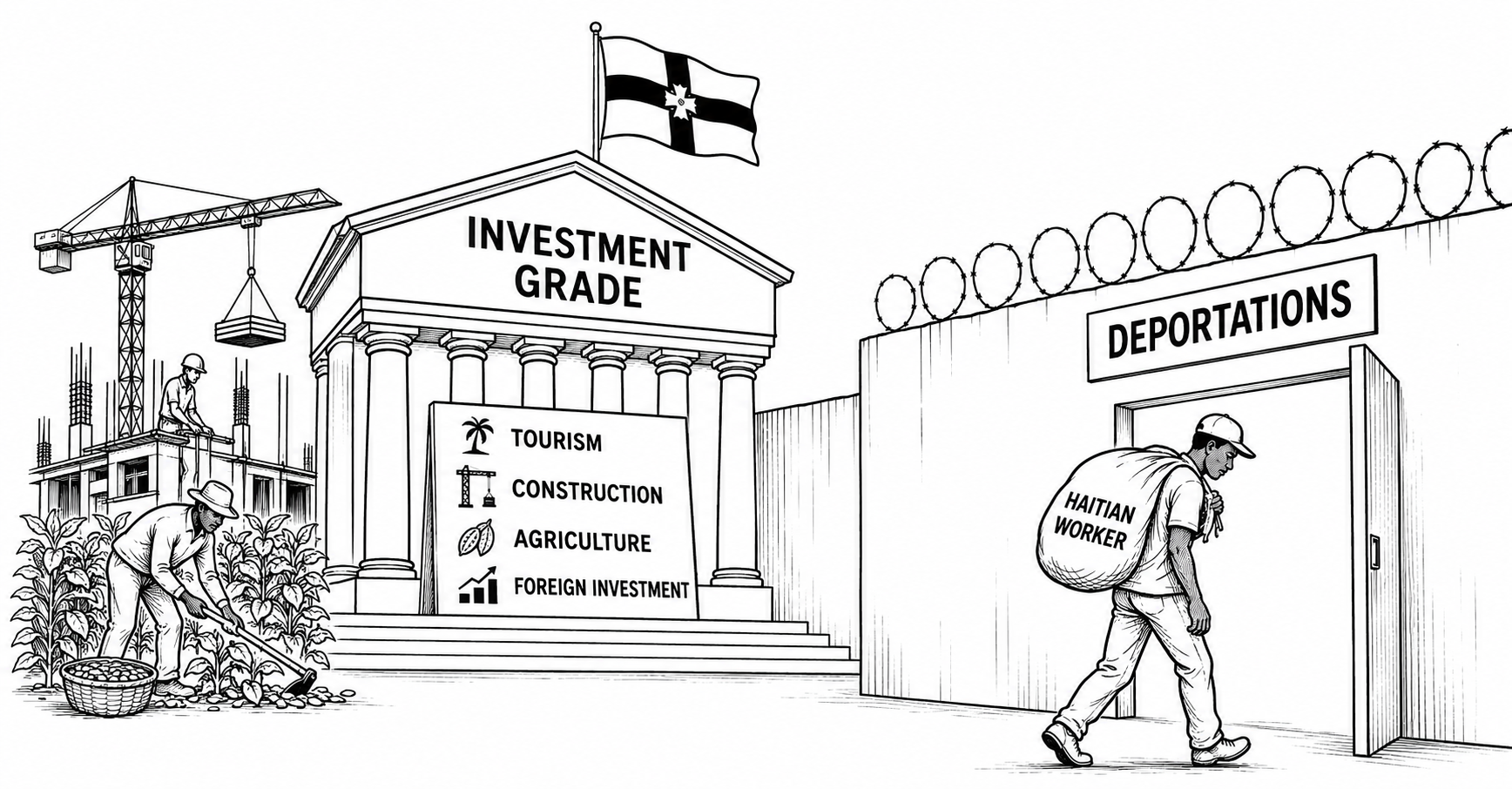
The Dominican Republic deported more than 250,000 Haitian nationals in 2025 alone — tripling previous annual rates — according to the Support Group for Rapatriates and Refugees, reported by The Haitian Times. In the first months of 2026, 68,000 more were removed. The Dominican government’s General Directorate of Migration has described the trajectory as one of “sustained growth.” In May 2026 alone, 34,190 Haitians were deported.
In the same period, the Dominican Republic is pursuing investment grade credit status by 2028, projecting GDP growth of 4.5% to 5% for 2026 and 2027, and recording its fourth consecutive annual record in foreign direct investment — $5.03 billion in 2025, a 97% increase over five years. Palantir and Trinity Investments have relocated to the country. Tourism is booming. The IMF has praised the administration’s pro-market stance.
Those two trajectories are not happening in parallel. They are the same story.
Haitian workers fill an estimated 80% of construction jobs in the Dominican Republic, according to immigration policy researchers cited across regional reporting. The country’s agricultural exports, worth more than $2.2 billion annually, depend on seasonal Haitian labor for crops including coffee and cacao that domestic workers increasingly decline to harvest. When the Dominican government deported a large share of the Haitian labor force working in construction in 2025, the sector contracted for four consecutive quarters. Growth slowed to 2.1% — down from 5% the year before — in part because the economy had removed the workers it was depending on to function.
The contradiction resolves when you look at who the investment grade target is for. Credit rating agencies evaluate sovereign creditworthiness against metrics including GDP growth, fiscal discipline, anti-corruption progress, and institutional stability. They do not evaluate the labor conditions of the workers whose work produces the GDP figure. President Luis Abinader’s administration has invested $100 million in border infrastructure — walls, sensors, and checkpoints — since 2022. It has designated Haitian gangs as terrorist organizations and coordinated deportation operations across multiple branches of the military, navy, air force, and national police. The international investor narrative is about stability, reform, and institutional credibility. The labor narrative is about which workers build the buildings that investors are investing in, and what happens to them when they are no longer needed in the official story.
Sandra Einhorn, Chair of the Florida Housing Finance Corporation, put the underlying logic plainly at a South Florida housing summit in May 2026 — speaking about Miami, but naming a dynamic that applies equally to Santo Domingo: “For every billionaire that we recruit, it yields the additional need for affordable units, and sometimes that gets lost in conversation.” What gets lost in the Dominican Republic’s investment grade conversation is that the workers being deported are the ones whose labor is producing the growth that makes the investment grade target achievable.
The 85% of Haitians deported in 2025 who cited economic conditions as their reason for leaving Haiti in the first place are not a security problem that economic development will eventually solve. They are the evidence that economic development, structured as it is currently being structured in the Dominican Republic, produces the conditions that drive the migration it is simultaneously criminalizing.
When a country builds economic credibility on foreign investment while removing the labor that produces its growth, the question the credit rating agencies are not asking is: who is this economy for? The Dominican Republic’s investment grade target is achievable. The workers whose deportation is framed as a precondition for achieving it are already paying the cost.
— Leena Alridge | Social Storytellers Collective
Get SSC analysis delivered to your inbox every day. Subscribe free on Beehiiv: socialstorytellerscollective.beehiiv.com