
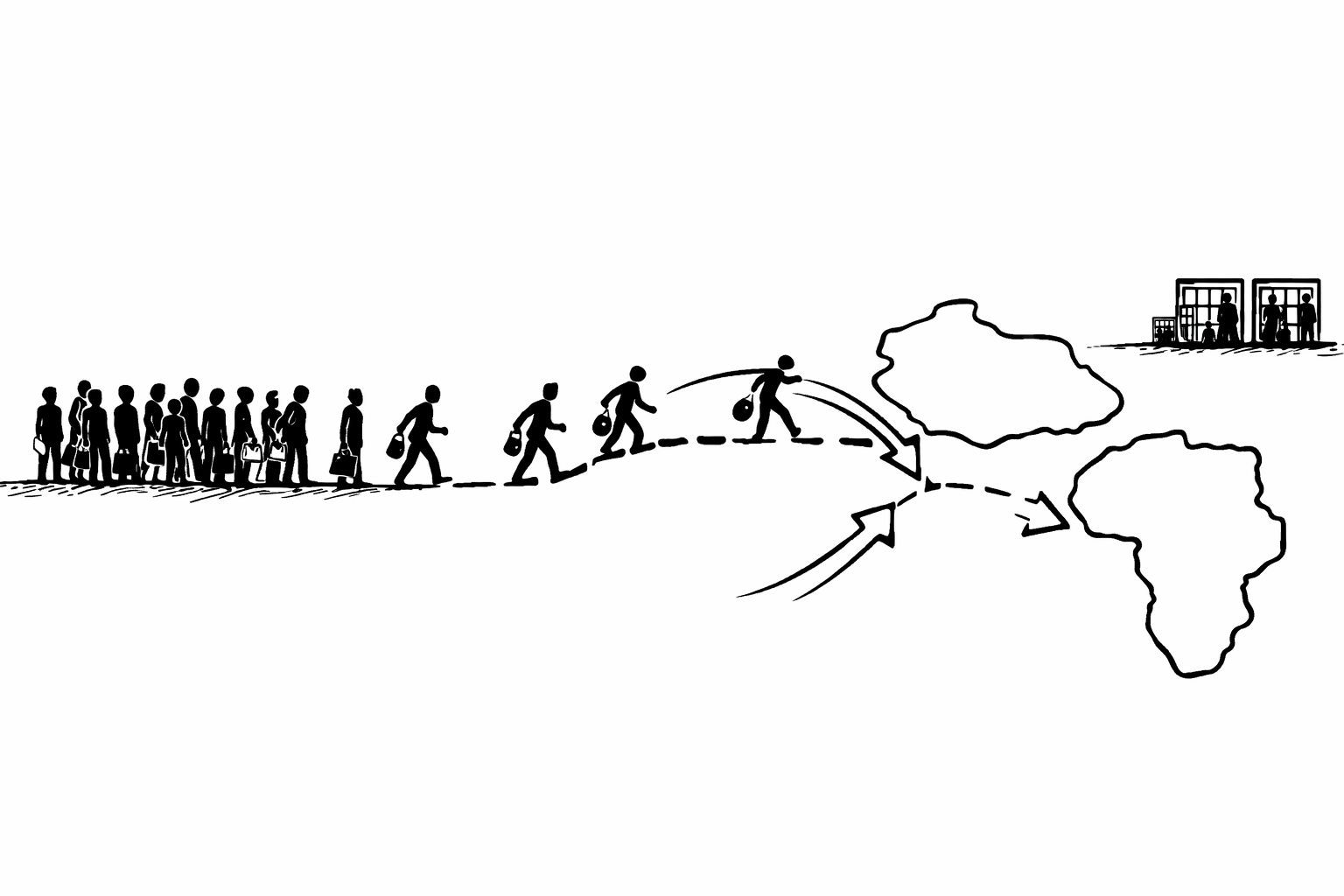
African migrants in the United States are being arrested and deported at sharply escalating rates under Trump’s second term — and the data makes clear this is not about public safety. According to a Capital B analysis of ICE data, deportations of people from African countries are on pace to nearly triple this year compared with the Biden-era annual average. Immigration-related arrests have more than doubled, despite fewer than 40% of those arrested carrying any criminal history. What is driving the surge is not a crime wave. It is a deliberate expansion of who the system targets.
The consequences are already reshaping communities on both sides of the Atlantic. In Ghana, neighborhoods are adjusting to a sustained influx of deportees. For individuals like William Yirenkyi — who self-deported after struggling to find stability in the U.S. — the impact is deeply personal, reflecting a quieter dimension of enforcement where pressure pushes people out before formal proceedings even begin.
Much of this is being enabled through little-known third-country transfer agreements. Countries including Ghana and Uganda have agreed to accept deportees who are not their own citizens — migrants from other African nations, Asia, and Latin America — sending people to places where they have no legal standing, no family, and no support. In November, Capital B reported that a non-native West African woman deported to Ghana attempted suicide in detention. That incident is not an anomaly. It is what this system produces.
Legal scholars are naming the structure directly. Zaria Goicochea of Cornell Law School’s Transnational Disputes Clinic argues that routing deportations through third countries does not dissolve U.S. human rights obligations. Her colleague Tara Nouri warns these agreements are cementing a shadow system of migration control that strips away fundamental protections. Moving enforcement beyond U.S. borders makes it harder to see — but the consequences do not disappear. They multiply.
Organizers with the Movement for Black Lives are direct about what connects all of this: race. Black migrants make up roughly 10% of the Black population in the U.S. and 7.2% of all non-citizens — yet they are disproportionately targeted across every stage of enforcement. This is not incidental. It is a pattern — one that places Black migrants at the intersection of immigration policy and racialized enforcement, with consequences that outlast any single administration.
Why This Matters
When enforcement expands beyond criminal thresholds and begins sweeping up people with no record, the logic shifts from selective accountability to population control. For Black immigrant communities, it hardens an already familiar reality: that legal status alone does not guarantee security, and that visibility itself can become a liability.
The third-country transfer agreements extend enforcement outward into a network of partner states that absorb costs the U.S. has chosen not to bear — a system deliberately harder to track, harder to challenge, and easier to scale.
Black immigrants are concentrated in sectors that hold essential infrastructure together: healthcare, transportation, logistics, service work. Their removal ripples outward, affecting labor supply, continuity of care, and the everyday systems communities depend on.
At its core, this is an Access Shift in practice. The written rules may not have changed — but who they reach, how far they reach, and how little oversight accompanies them has. This is ultimately a story about who gets to exist securely within the system, and under what conditions that security can be revoked without warning.