
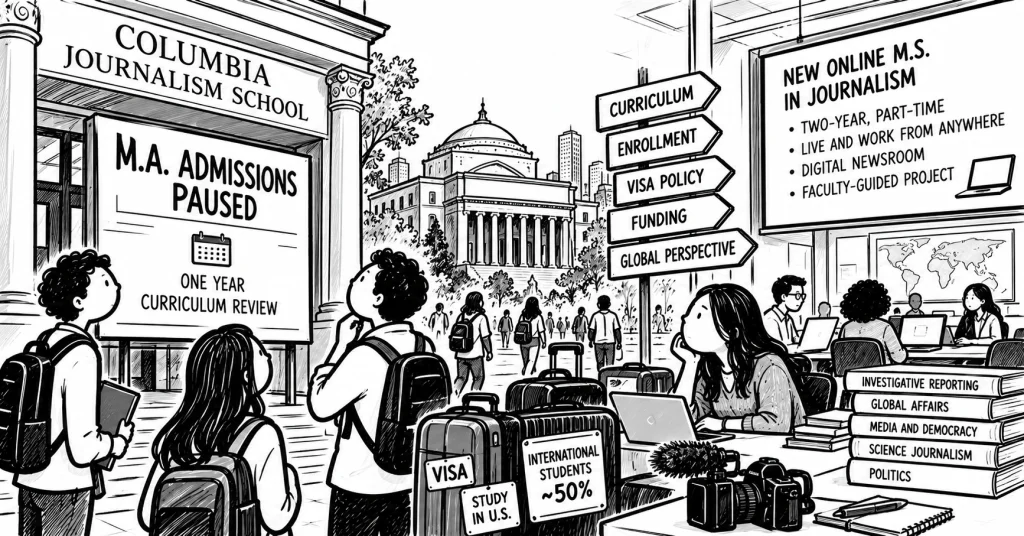
The school’s pause on M.A. admissions shows how uncertainty over international enrollment can reach the curriculum, financing and availability of a degree.
International students make up roughly half the enrollment in Columbia Journalism School’s Master of Arts program, according to people familiar with its admissions. Now, the school is pausing admissions for one year as it reassesses the degree. Reuters reporters Aditya Soni and Edmund Lee found that a sharp decline in international applications amid changing U.S. visa policies contributed to the decision. The exact decline was not disclosed, but the pause demonstrates how immigration uncertainty can affect an entire program’s future.
Columbia announced the pause October 1 as a curriculum review. Dean Jelani Cobb subsequently told Reuters that visa dynamics were among the considerations, alongside changes in journalism since the degree’s creation in 2005. The M.A. serves experienced journalists seeking subject expertise, while the school’s continuing Master of Science programs serve different needs. Current M.A. students will complete their studies without interruption, according to Sarah Scire’s reporting for Nieman Lab. The decision suspends an incoming class while administrators reconsider what comes next.
An Admissions Problem Reaches the Classroom
The institutional mechanism is straightforward, even though Columbia has not published a financial breakdown of the decision. A specialized program needs enough students to support faculty time, advising and separate courses. When a substantial source of applicants becomes less dependable, maintaining the same offerings becomes harder to plan. Reuters reported that lower enrollment had already prompted Columbia to combine science and politics seminars during the 2024–25 academic year. That earlier adjustment shows enrollment pressure reaching academic design before the admissions pause, although the reporting does not establish that visa policy caused those earlier changes.
For prospective students, the commitment is substantial. Columbia’s 2026–27 cost-of-attendance estimate puts the nine-month M.A. at $119,948 before financial aid, including $77,888 in tuition and $31,124 in estimated living expenses. Those figures describe the student budget, rather than the school’s revenue per enrollee. They nevertheless show why uncertainty about reaching campus can influence an applicant’s decision well before a visa is denied. Leaving work, arranging financing and relocating become harder commitments when the route into the country feels unpredictable.
Flexibility Changes the Educational Offer
Columbia also announced a two-year, part-time online M.S. in Journalism on October 1. Its official announcementemphasizes allowing students to continue living and working across the United States, with a digital newsroom, a set course sequence and a faculty-guided final project. Cobb told Reuters that the online launch was unrelated to the M.A. pause because the programs serve different students. Even so, the format illustrates another institutional choice: building a degree around students’ existing locations and employment, reducing the need to assemble everyone on one campus. That changes both access and the experience being offered.
The people affected extend beyond international applicants. Domestic journalists considering the M.A. also lose an admissions cycle, while faculty and administrators must reconsider the program’s structure. A classroom with fewer international participants could also offer fewer firsthand perspectives on different press systems, political conditions and reporting practices. That is a potential educational consequence, rather than a measured finding about Columbia’s current cohort. Immigration decisions made outside the university can therefore influence opportunities and classroom experiences for students who never need a visa themselves.
What Columbia Builds Next
The pause gives Columbia time to redesign, but its eventual response will show where the adjustment falls. A more flexible, financially supported M.A. could preserve access for experienced journalists facing constraints on travel or time away from work. A narrower offering could reduce the available paths into specialist training. If international applications remain uncertain, the school will need a design that can sustain its academic ambitions with less predictable enrollment. The test will be whether Columbia preserves the expertise and international exchange the program was built to provide while making participation more dependable.