
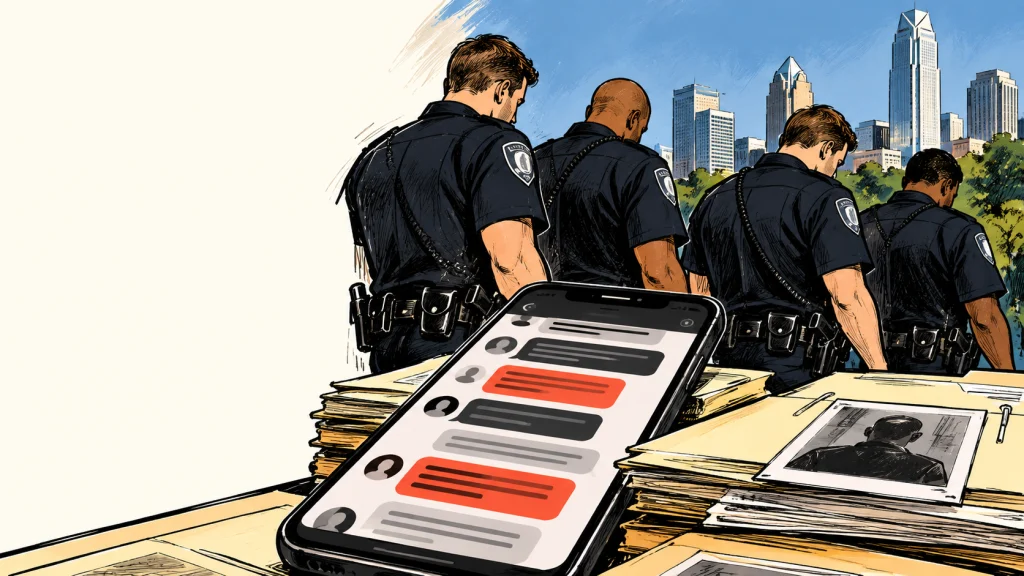
Three Charlotte-Mecklenburg officers have resigned and three more face termination after investigators found years of racist messages, including reported bragging about arresting Black residents. Prosecutors now have to decide whether those officers’ word can still carry a case.
Six Charlotte-Mecklenburg Police Department officers are leaving or being pushed out of the force after an internal investigation uncovered a private text thread filled with racist, sexual and religiously biased messages. Three officers have resigned. Chief Estella Patterson said Thursday that independent chain-of-command hearings unanimously recommended firing the other three, a decision the city’s Civil Service Board will make final. She called the conduct “serious” and “deeply troubling,” and said she was “especially pained and disheartened.” According to sources who spoke to WBTV, some of the messages showed officers competing and bragging about pulling over and arresting Black residents, and the messages reportedly stretch back years.
The department says it has contacted federal partners to review possible civil-rights violations and will seek to revoke the officers’ law-enforcement certifications. It is also auditing body-worn camera footage, traffic stops, arrest records and outside complaints to determine whether the conduct reached beyond the text thread and into how the officers did their jobs, according to a report carried by Fox stations nationwide. That audit is the part residents should watch most closely, because a text thread is evidence of attitude, while the stops and arrest records will show whether that attitude changed who got pulled over.
How a License-Plate Search Exposed the Thread
The messages surfaced almost by accident. Officer Seth Elliott came under investigation by the North Carolina State Bureau of Investigation over allegations that he used the Flock Safety license-plate reader system, along with other tools, to help someone connected to a drug investigation. Reason reported, citing the Watauga Democrat, that Elliott ran a plate that turned out to belong to an undercover officer and was charged with a misdemeanor for illegally accessing a government computer. Elliott, who has since resigned, admitted running the plate but denied knowing whose car it was. When state investigators downloaded his phone, they turned the data over to the department, and internal affairs found the group chat.
That chain of events matters beyond Charlotte. Automated license-plate readers like Flock have spread quickly through American police departments, often with little public debate about who can search them and why. The Institute for Justice, a libertarian public-interest law firm, has documented more than 200 cases of police misusing these systems since 2018, Reason reported, from personal grudges to tracking former partners. In this case, the misuse put an undercover officer at risk, and the investigation that followed exposed something the department says it had not known.
Every Case They Touched Is Now in Question
The fallout now moves to the courthouse. Under Giglio v. United States, the 1972 Supreme Court ruling, prosecutors must disclose information that could undermine the credibility of a government witness, including police officers. That means Mecklenburg County District Attorney Spencer Merriweather has to decide whether these officers can still be trusted on the witness stand. A spokesperson told WBTV that the district attorney “must make an independent decision” about whether a sustained violation undermines an officer’s credibility, without addressing the text thread directly. Depending on that decision, pending cases could be dropped and past convictions could face new challenges.
Defense attorney Tim Emery told WBTV that the officers’ “credibility is severely questioned and compromised” and that prosecutors should consider halting cases where the officers played a central role. No one has said yet how many cases are involved. For the people those officers stopped, searched or arrested, the question is no longer abstract: if an officer joked privately about targeting Black residents, every report he wrote about a Black resident deserves a second look.
This is what makes the story bigger than six resignations. A department can remove officers in a week, but the trust they spent takes much longer to rebuild, and it is paid back through case reviews, court time and the patience of communities that were told for years that their complaints were exaggerated. Charlotte’s audit and Merriweather’s decisions will show whether accountability stops at the personnel file or reaches the people who lived with the consequences.
Sources: WBTV, Oct. 13 and 15, 2026; Fox 26 Houston, Oct. 15, 2026; Reason, Oct. 15, 2026.