
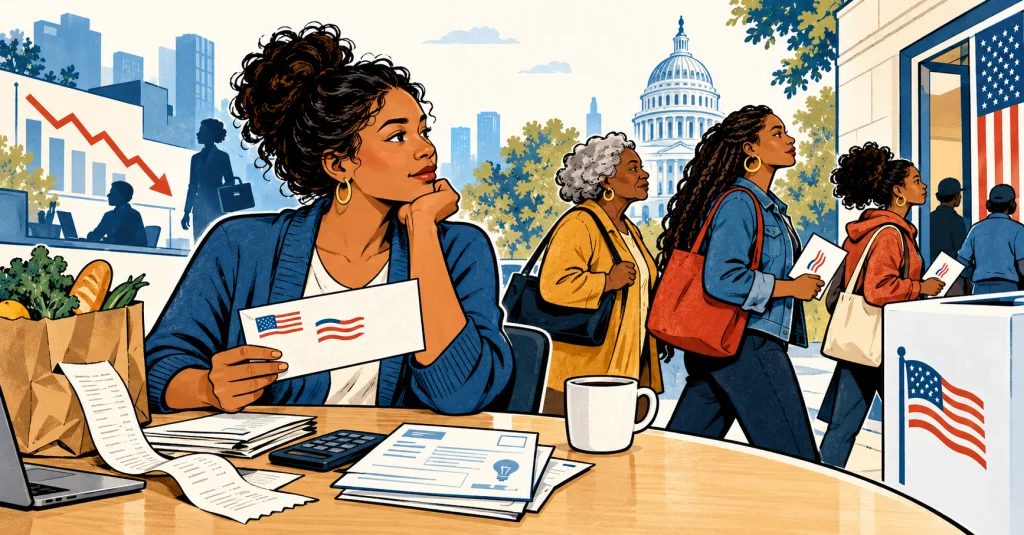
A new national survey finds 77% of Black women voters motivated to participate in the 2026 midterms. Labor data helps explain why economic security has become part of that urgency.
Black women are approaching the November midterms with unusually high motivation, but the sentiment being measured looks different from the optimism associated with earlier high-turnout elections. A national survey conducted by The Highland Project and brilliant corners Research & Strategies found that 77% of Black women voters said they were motivated to participate in the November 3 election, while 61% described this election as more important than previous ones. The survey, conducted from August 30 through September 10 among 700 Black women, also found 92% dissatisfied with the country’s direction. Pollster Cornell Belcher told theGrio that the level of engagement reminded him of the Obama elections, but said the motivation now is less about optimism than protecting families and communities. That interpretation belongs to the pollster, but the underlying survey results show economic conditions, leadership, voting rights and the cost of living appearing repeatedly among respondents’ concerns.
The Labor Numbers Add Context
The employment data provides a measurable backdrop to that sentiment. In August, the overall U.S. unemployment rate was 4.1%, while unemployment among Black Americans was 6.0%, compared with 3.7% among White Americans, according to the Bureau of Labor Statistics. Among adults 20 and older, the unemployment rate for Black women was 5.6%, compared with 3.0% for White women. Black women’s labor-force participation rate was 60.6%, down from 61.5% a year earlier, while their employment-to-population ratio stood at 57.2%. Those figures do not establish why individual workers lost jobs or prove that any single federal policy caused the gap, but they show that Black women were entering the final months before the election with materially different labor-market conditions from White women.
That distinction is useful when reading a separate Nation Africa article published October 1, which argues that federal downsizing and the rollback of diversity programs have disproportionately affected Black women. Some of the article’s specific job-loss totals and characterizations are not supported by the federal labor data reviewed by SSC and should not be treated as established national statistics. The broader federal workforce contraction, however, is well documented: Reuters reported in March that the civilian federal workforce had fallen 12% between September 2024 and January 2026, with approximately 386,000 fewer workers, through a combination of resignations, retirements and layoffs. The administration has described the reductions as an effort to make government more efficient, while affected workers, unions and civil-rights organizations have challenged some dismissals and argued that certain reductions disproportionately harmed women and workers of color.
The Poll Measures More Than Party Preference
The Highland Project survey suggests those employment concerns are landing alongside broader questions about financial security. TheGrio reported that 21% of respondents said they had been affected by federal layoffs, a self-reported survey finding rather than a government estimate of Black women nationally. Respondents most frequently cited the need for change, dissatisfaction with leadership, economic conditions, the cost of living and checks and balances when explaining why they viewed the midterms as important. The poll also asked about what makes a good life possible: 94% identified time to focus on mental health, 92% enough money, 91% loving relationships, 89% healthy food, 87% rewarding work and 81% time for hobbies as components of joy. Those answers broaden the economic story beyond employment alone. They describe financial security as the ability to have money, time, health and stability at the same time.
Voting rights are another part of the survey’s findings. TheGrio reported that 87% of respondents said changes to voting-rights protections made them more motivated to participate. Political and legal interpretations of recent voting-rights decisions are contested, and the consequences vary by state, so that result is best understood as a measure of how the women surveyed perceive the stakes rather than an independent assessment of election law. What is measurable is the intensity of the response: dissatisfaction with the country’s direction reached 92%, while more than three-quarters reported motivation to vote. The poll does not tell us how turnout will ultimately compare with previous elections, nor should it be treated as a prediction of the midterm outcome. It does show what one nationally fielded survey found respondents saying about why participation feels consequential now.
The Pressure Is Showing Up in More Than One Dataset
Taken together, the polling and labor statistics describe two different parts of the same environment. BLS measures a 5.6% unemployment rate for Black women, while the Highland Project measures high dissatisfaction, concern about affordability and strong motivation to participate politically. The Nation Africa piece places those developments inside a broader critique of federal employment and DEI policy, though several of its claims go beyond what official labor statistics can verify. Keeping those categories separate is important: government data can document employment conditions, polls can document attitudes, and commentary can offer an interpretation of why those conditions exist.
What emerges without collapsing those sources together is a clearer picture of the pressure respondents are describing. Black women are experiencing a labor market in which their unemployment rate remains substantially higher than that of White women, while a new survey finds many are also worried about household finances, employment security, voting rights and institutional performance. Their political motivation is therefore being measured alongside a concrete economic backdrop. The story heading into November is not simply whether Black women are enthusiastic about an election. It is what conditions have made participation feel urgent to so many of the women being surveyed.