
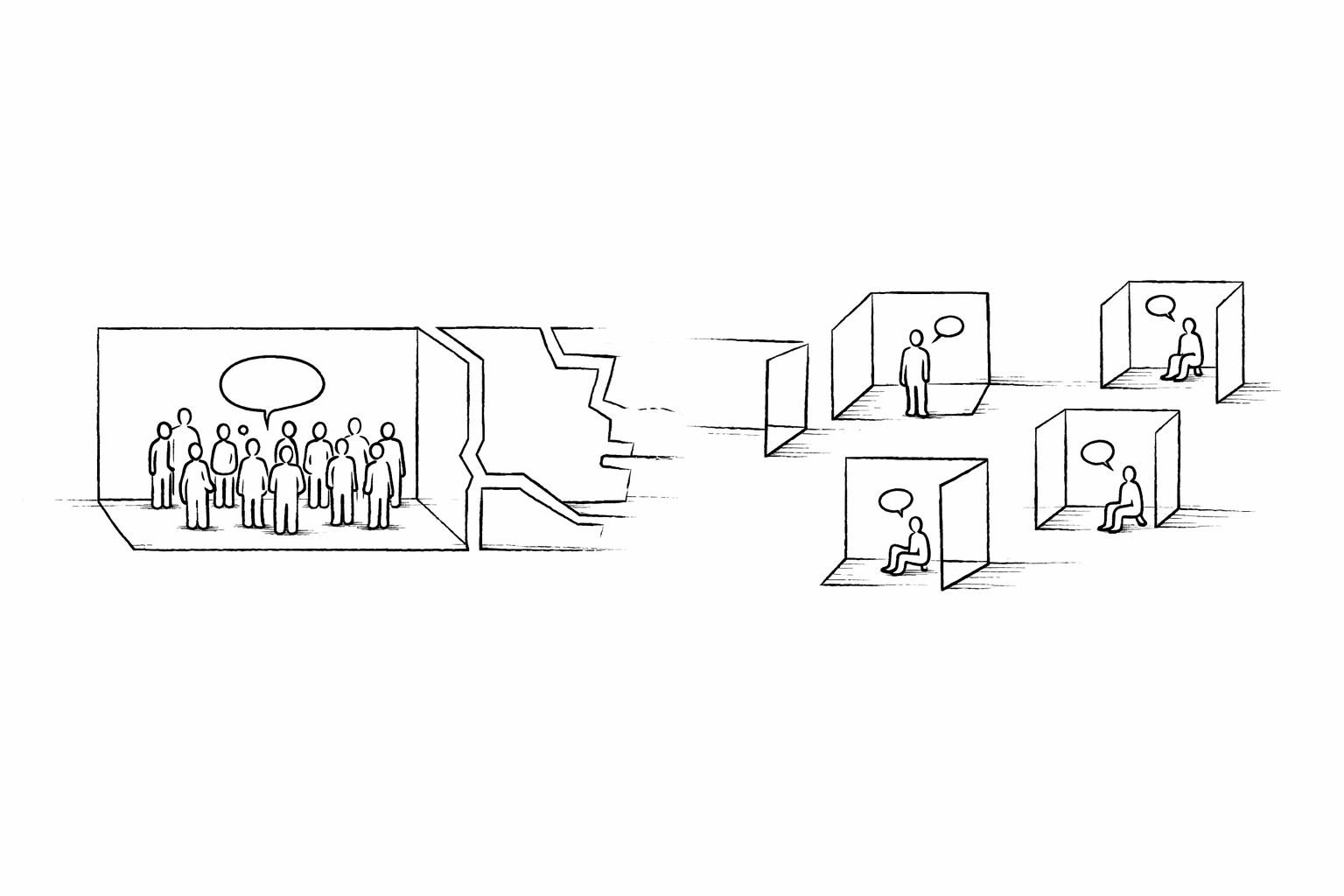
Culturally, politically, or socially—it would find you. It would move across your timeline with speed and clarity, shaped in real time by people who understood both the moment and the context around it. What people called “Black Twitter” wasn’t just a corner of the internet. It was a system. It surfaced information, translated it, and pushed it forward until it couldn’t be ignored.
That system worked because it was coherent. You could log on at any point in the day and tap into the same conversation as everyone else, watching it evolve in real time. Humor and critique didn’t compete—they built on each other. A joke could carry analysis. A thread could turn into a call to action. And when something needed attention, that attention could be coordinated, sustained, and directed. It didn’t feel fragmented. It felt shared. That’s what changed.
After Twitter shifted under Elon Musk, the experience of being on the platform became less predictable. The signals that once made it easy to find what mattered—who to trust, what was gaining traction, what needed attention—started to blur. Some people left. Others stayed but changed how often they posted, or how seriously they engaged. It didn’t happen all at once. It was more like watching a frequency drift — you’d tune in expecting the same signal and find something slightly off. The timeline still moved. The posts still came. But the sense that you were locked into the same feed as everyone else, that you were all reading the same room, quietly loosened. Over time, the feeling of one shared space gave way to something more scattered.
The voices didn’t disappear. They just moved—and not all in the same direction. Some found their way to Threads, others to Bluesky. A lot of the energy shifted toward Instagram or TikTok, where expression looks different and moves at a different pace. But the platforms people moved to weren’t neutral containers — they were built differently, and that changed what was possible. Bluesky preserved something of the text-based, timeline-driven structure that made Twitter legible. Threads borrowed the aesthetic without quite capturing the gravity. And TikTok, where a significant amount of Black creative and political energy now lives, operates on an algorithmic logic that has no social graph at its center. Content finds you based on behavior, not relationship. That’s a meaningful difference. On Black Twitter, you knew roughly who was in the room. On TikTok, the room is always changing, and you’re never sure who else is standing in it. You can still find smart commentary, sharp humor, and real insight on all of them. But you have to go looking. And even when you find it, there’s no guarantee everyone else is seeing the same thing at the same time. What’s missing isn’t conversation—it’s alignment.
Black Twitter made it possible for a large group of people to experience a moment together, respond to it together, and push it forward together. That kind of simultaneity created momentum. It gave stories weight. It allowed context to travel alongside content, so that what you were seeing made sense in a broader frame. And it created accountability, because once something reached a certain level of visibility, it couldn’t easily be ignored. That combination—speed, context, and coordination—is hard to replicate when everything is spread across platforms that don’t talk to each other.
You feel the difference in subtle ways at first. A story you think should be everywhere is only showing up in one place. A conversation that would have taken over your entire timeline now feels smaller, contained. Moments don’t land with the same force because they don’t arrive all at once. Over time, that adds up. The culture doesn’t stop moving — it just moves in pieces, and the pieces don’t always find each other.
That fragmentation has consequences. It changes how quickly information travels, how long attention holds, and how effectively people can organize around an issue. It makes it harder to build the kind of sustained pressure that once led to real responses. And it creates a quieter shift in how people relate to one another online. Without a shared space, the sense of a collective audience—of speaking and being heard at the same time—starts to fade.
Black Twitter didn’t disappear because people stopped showing up. It disappeared because the conditions that made it feel like one place no longer exist. What we have now is more distributed, more personalized, and in some ways more controlled by the platforms themselves. The voices are still there. The system that once connected them is not.
And that raises a bigger question — one worth sitting with rather than solving. If there’s no longer a space where the conversation can come together in real time, what happens to the idea of a shared public? Not a niche, not an audience, but a group of people moving through the same moment at once. And underneath that: were those conditions ever replicable, or were they the product of a specific convergence — a platform architecture, a cultural generation, a particular window of time — that has since closed? It’s not clear that anything has replaced what existed. It’s not clear that anything will. But the fact that we’re still looking for it suggests we understand, at least, what we lost.
The Access Shift
The gradual redefinition of who systems are designed to serve.
Across sectors—from public infrastructure to healthcare to everyday spaces—access is no longer assumed. As costs rise and systems face increasing pressure, services once built for broad reach are becoming more selective, more conditional, and less universal. The Access Shift explores how these changes are unfolding in real time—and what they reveal about who is included, who is left out, and how the structure of everyday life is quietly being reshaped.