
Baltimore’s homicide numbers are the most cited evidence of something working. The decline from more than 330 killings in 2020-2021 to roughly 130 in 2025 is significant, documented, and worth acknowledging without hedging. Mayor Brandon Scott’s sustained investment in community-based violence intervention, his administration’s commitment to treating gun violence as a public health crisis rather than solely a policing problem, and the Group Violence Reduction Strategy’s combination of accountability and social service support have produced results that deserve recognition on their own terms. That recognition was given in SSC’s prior reporting. What that reporting also flagged, and what the broader narrative consistently underweights, is that Baltimore’s safety story and Baltimore’s displacement story are happening simultaneously and are not in conversation with each other.
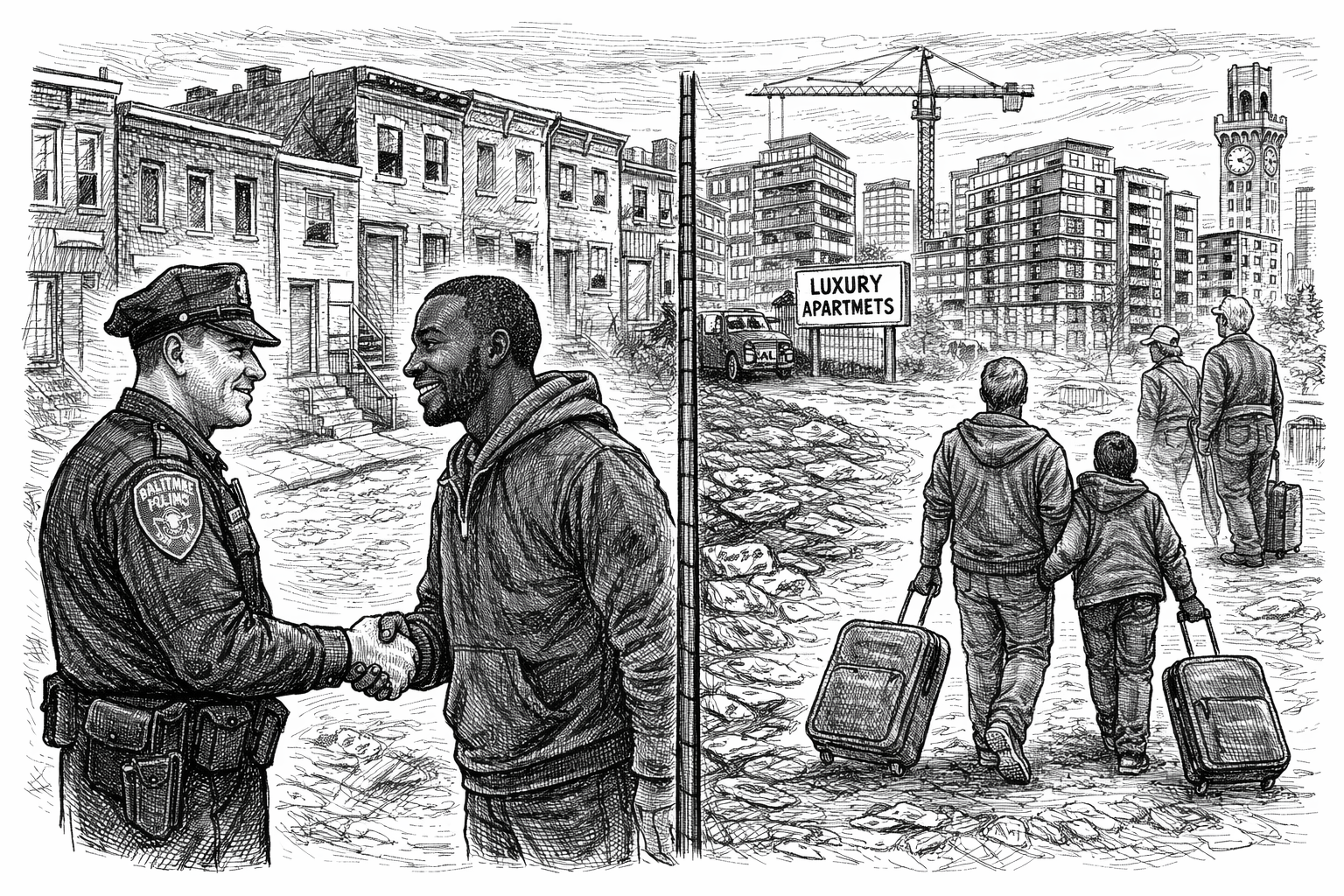
Baltimore is now one of the five fastest-gentrifying cities in the United States. Private investment is concentrating in the city’s whiter, wealthier neighborhoods — attracting the majority of building permits, renovation financing, and commercial development — while Black-majority communities like West Baltimore have been largely bypassed by the market forces reshaping the rest of the city. West Baltimore holds enormous assets: architectural history, cultural legacy, proximity to downtown, and some of the most generous greenspace of any Baltimore neighborhood. Those assets have not translated into investment. They have instead created conditions for the next wave of speculation — a neighborhood whose values are suppressed enough to attract developers once the conditions are right, meaning once the current community can be priced out efficiently. The 15,000 vacant buildings that define Baltimore’s landscape are not random. They are the physical record of decades of redlining, highway construction, and disinvestment in Black neighborhoods — and they function now as inventory for a market that did not create the value it is preparing to extract.
The human cost of that displacement pressure is increasingly being quantified as a health outcome, not just a housing outcome. New research finds that older Black adults experience significantly higher rates of displacement fear in gentrifying neighborhoods — even when they remain physically in place — and that those fears function as a measurable health stressor tied to rising costs, the loss of familiar institutions, and the cultural erosion that comes when longtime businesses and community anchors are replaced by establishments serving a new, wealthier, and predominantly white incoming population. A 64-year-old West Baltimore resident named in the research described the cost in terms that did not require quantification. A 62-year-old Baltimore County resident described moving repeatedly due to rising rents and changing community character, and said he had learned to accept changes he never wanted. That acceptance — that learned resignation to structural pressure — is itself a health outcome, and it does not appear in the homicide data.
The two stories are not in tension. They are in the same city, operating on different populations under different mechanisms, and they require different policy responses. Reducing violence and preventing displacement are not competing priorities — but allowing the success of one to obscure the urgency of the other is a political choice with real consequences. Parity Homes, a Baltimore-based nonprofit founded in 2022, is attempting to demonstrate that development without displacement is possible — acquiring and rehabilitating housing in West Baltimore before peak gentrification arrives, using shared equity structures to build homeownership pathways for existing residents. The model is promising and deliberately proactive. It is also operating against a market logic that moves faster than nonprofits can. What Baltimore needs is not just a violence intervention strategy and a community development model operating in parallel. It needs a policy framework that treats displacement prevention as a public safety issue with the same urgency as homicide reduction — because the slow erosion of Black community geography is also a form of harm, and it also leaves damage that is very difficult to reverse.