
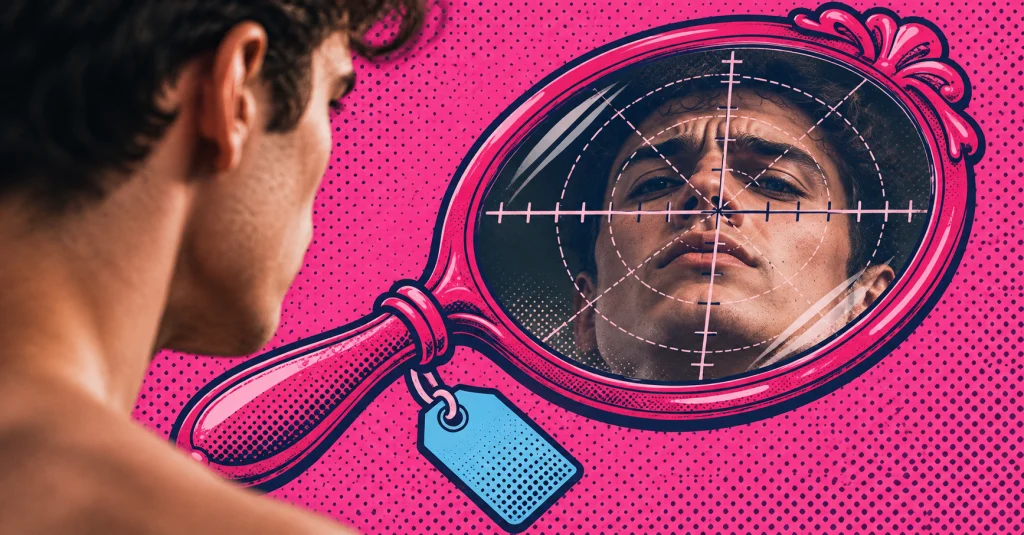
The manosphere sells young men confidence, looks and status, and its business model depends on convincing them something about them needs fixing.
By SSC News Desk | November 14, 2026 | Culture in Motion / Business | 4 min read
The online “manosphere” works less like a movement than a sales funnel, according to an 18-month investigation by the digital safety group Reset Tech and the nonprofit Equimundo. Their August report, The Grift Economy, maps a multibillion-dollar industry of creators, platforms, paid memberships and supplements built on young men’s loneliness and economic anxiety. Fortune’s Sasha Rogelberg reported that the industry sells courses and supplements to insecure Gen Z men under the banner of self-improvement. A young man who opens TikTok for workout tips can find his feed serving him facial-symmetry scores, testosterone plans and coaching offers within days.
The funnel has three stages
The researchers describe the same pipeline across platforms. It starts with recruitment through aspirational content: the gym, the money, the jawline. Next comes a grievance, an explanation of why the viewer’s life isn’t working and who’s to blame. The third stage is monetization: the trust the creator has built gets converted into recurring payments. Each stage feeds the next. A grievance that never gets resolved keeps a subscriber paying, so the business has no incentive to make its customers feel better. Kristina Wilfore, Reset Tech’s director of innovation, said platforms haven’t fixed it because “the business model was never built to.”
Looksmaxxing, the corner of the manosphere focused on appearance, shows the model most clearly. Attractiveness gets turned into a score that can always be raised, so there’s always another product to buy. The movement’s best-known figure, the streamer Clavicular, sells a $49-a-month coaching program with more than 1,000 subscribers, YPulse reported. The offerings run from ordinary skincare to steroids, unregulated peptides and cosmetic surgery.
The costs land on the customer
The harm goes beyond spending. A November commentary in the Journal of Adolescent Health by Kyle T. Ganson of the University of Toronto and colleagues warned that looksmaxxing spaces expose boys and young men to pseudoscientific health claims, unregulated products and extreme body-change practices. The authors were careful not to treat ordinary grooming or exercise as a problem. Their concern is the point where appearance monitoring turns obsessive and the practices turn unsafe. That’s also where the most money is made.
The money flows one way. Young men pay with their wallets and their attention, creators collect subscription revenue, and platforms collect the engagement that provocative content generates. The pitch is independence, yet the product is lasting dependence on a creator who profits as long as the customer stays insecure.
The Grift Economy report argues that the UK, EU, Australia and Brazil already have the legal tools to act, and that the gap is enforcement, not law. Expect the first serious crackdowns to target the plumbing, not the ideology: subscription traps, deceptive testimonials and unregulated supplements. Regulators can prove those are fraud. They can’t prove a worldview is.