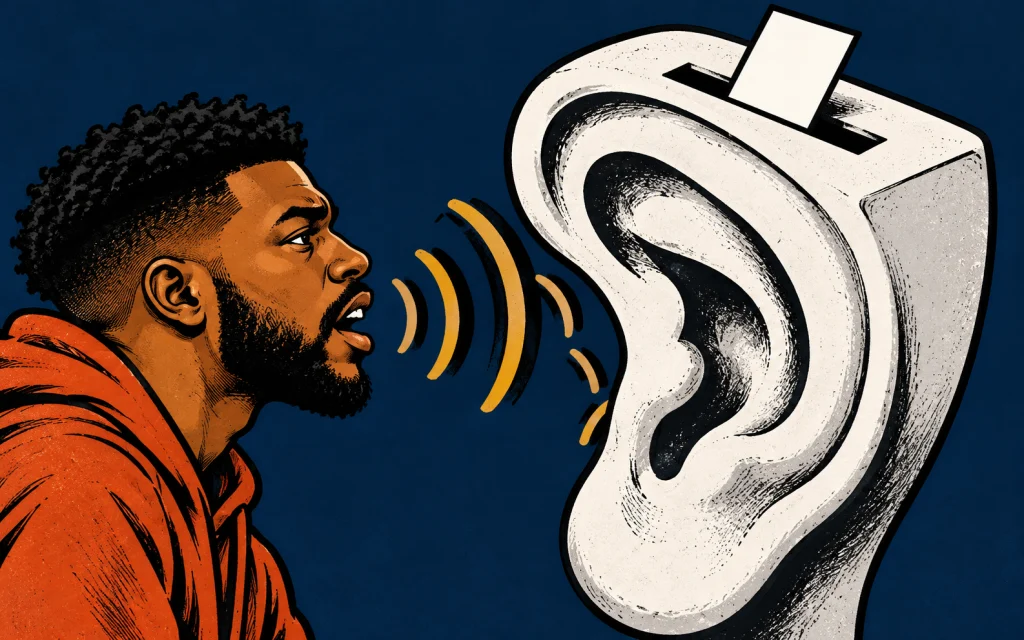
More than 600,000 eligible Black voters sat out Ohio’s 2022 midterms. New reporting suggests the problem is more complicated than apathy. It involves economic pressure, broken trust and a political system that shows up in Black communities mostly when it needs their votes.
Dwight Bullard spends his days delivering tires across Northeast Ohio, paying roughly $100 a day in gas to keep a rented box truck running. He has two young daughters, works some evenings at a restaurant and starts his mornings before most people are awake. At 34, he knows the price of just about everything it takes to keep his household moving. What he can’t clearly identify is how the politicians who represent him are making any of it better.
Bullard is not politically indifferent in the way that phrase is usually meant. He has opinions about Donald Trump, the economy and the rising cost of living, and he talks with his friends about rent, crumbling streets and the condition of their neighborhoods. But he has voted only once that he can remember, for Barack Obama in 2012. In his experience, the promises of politics have produced little he can recognize in his everyday life.
His story, documented by Eugene Daniels and Emily Berk in an Oct. 17 investigation for MS NOW, deserves more serious attention than another election-season lecture about civic duty. Thousands of Black men are living with the consequences of political decisions while remaining disconnected from the institutions and campaigns asking for their participation. Instead of asking why, we too often call their absence apathy.
The Numbers Show Who’s Missing. They Don’t Explain Why
A study released in June by the Ohio Legislative Black Caucus Foundation found that about 603,000 eligible Black voters did not cast ballots in the state’s 2022 midterms. That’s more than twice the margin in Ohio’s U.S. Senate race that year. A separate analysis by HIT Strategies identified more than 100,000 registered Black voters in Ohio who had skipped the previous three federal elections. The two figures measure different things, eligible nonvoters in one election versus registered voters with a sustained pattern of sitting out, but both point to a large population whose experiences deserve more than a campaign calculation.
Every election cycle, Black voters become the subject of intense analysis. Their turnout is measured, their enthusiasm debated and their influence discussed in terms of which candidate might benefit. Black men, especially younger Black men, are often treated as a demographic problem for campaigns to solve. But people are not voting blocs. They are workers, fathers, sons, entrepreneurs and neighbors navigating institutions that shape their daily lives, and their political behavior is hard to understand without first understanding their experiences with those institutions.
Disconnection Isn’t Ignorance
One of the most revealing moments in the MS NOW report involves a 29-year-old Cleveland man identified as Robert. He hadn’t voted in years and said he didn’t think the candidates deserved his support. Yet when reporters asked about his life, he spoke specifically about incarceration, marijuana laws and how people are treated in jail. He understood the problems. What he hadn’t connected was the line between those problems and the officials responsible for the policies behind them.
Someone can know housing is unaffordable without knowing which level of government shapes housing policy. A resident can see that the streets need repair without knowing how a city budget gets made. A worker can feel rising prices without tracing them to international events or economic policy. None of that reflects a lack of intelligence or concern. It reflects how opaque government looks when nobody has made its work relevant or accessible. We’ve built a political culture that expects people to understand the machinery of government without ever explaining how that machinery runs in their neighborhoods, and then offers the explanation only when an election is near.
Being Contacted Isn’t the Same as Being Heard
The investigation found civic organizers wrestling with a problem that conventional campaign outreach doesn’t solve: people who have grown used to political conversations that begin and end with a request for their vote. Cleveland VOTES, a nonpartisan civic group, has tried a different approach. Instead of opening with an election, its organizers start by asking residents what they want to change about their communities. It’s a basic principle of trust. People engage when they believe their concerns matter beyond the transaction.
Campaigns spend enormous sums on ads, polling, consultants and voter targeting. Yet several men in the MS NOW reporting described getting little meaningful outreach from either party. Campaigns do have to decide where limited resources go, and they usually prioritize people with established voting histories. But that creates a self-reinforcing cycle: people who rarely vote get less attention, and their continued absence becomes proof that they’re hard to reach. The result is a political system that is very good at talking to people who already participate and very bad at reaching the people who have walked away.
A Generation Wants Evidence, Not Another Speech
Shayla L. Davis, president and CEO of the Ohio Legislative Black Caucus Foundation, described her own 28-year-old son’s disengagement from electoral politics. His mother has served in elected office. He grew up around campaigns and felt the excitement of Obama’s 2008 victory. Yet he no longer believes political leaders represent his concerns. If growing up that close to politics doesn’t guarantee lasting engagement, then proximity alone isn’t the answer.
For older generations of Black Americans, voting carries the history of exclusion, disenfranchisement and the long fight for equal participation. That history remains essential. But younger adults who didn’t live through those struggles often judge politics by a different standard: whether wages keep up with bills, whether their neighborhoods are improving, whether public institutions treat them fairly and whether promises produce visible results. The two perspectives don’t have to compete, and history and accountability can reinforce each other. But a conversation grounded only in historical obligation won’t answer a young voter’s questions about what government is delivering right now.
There’s also a difference between explaining the consequences of disengagement and dismissing the reasons for it. Voting doesn’t guarantee immediate change. Elected officials work within competing jurisdictions, divided government, budget limits and legal constraints. Those realities deserve honest explanation, not campaign promises implying that every election will transform people’s lives. When expectations keep rising without that honesty, disappointment becomes one more reason to withdraw.
The Barbershop Has Always Been Political
One detail from Bullard’s story deserves particular attention. He told reporters that he and his friends talk about rent, road conditions and neighborhood problems at the barbershop. They just don’t call those conversations politics. That challenges how we define civic engagement. Political life doesn’t begin when someone joins a party or follows a campaign. It begins when people recognize shared problems, talk about solutions and ask who has the power to act.
Black barbershops, churches, neighborhood groups and workplaces have long been where those conversations happen, where people compare experiences, challenge assumptions and trade information about decisions affecting their communities. The problem may not be a lack of political conversation at all. It may be a lack of clear connections between those conversations and the institutions capable of responding. For Bullard, it was a discussion about a troublesome tree in his mother’s yard that showed how city government touched something directly connected to his family. It took no slogan, just an explanation of who’s responsible in terms he immediately recognized. That’s a model worth studying for civic groups, educators, local journalists and public institutions alike.
The Responsibility Can’t Rest on Voters Alone
Individual citizens are responsible for their own choices, and the right to vote includes the freedom not to. People abstain out of dissatisfaction, competing obligations, limited information, principle or some combination of all four. But institutions have responsibilities too. Parties can communicate outside election season. Government agencies can make their services and decisions easier to understand. Schools can teach the practical workings of local and state government. Community organizations can build engagement that isn’t tied to a single candidate.
News organizations have a role as well. We can do more than report turnout numbers and quote strategists about demographic performance. We can examine the everyday experiences behind participation and nonparticipation, explain who controls which decisions and hold institutions accountable for what they promise. Social Storytellers Collective recently examined one national organizing push in Civil Rights Groups Want 100,000 Black Men at the Polls on Oct. 24. The Bigger Target Is the Men Who Might Stay Home. That effort draws attention to a real issue, but turnout on a single day is only one measure of civic life. The more durable work is understanding why the relationship between citizens and political institutions has weakened, and what would make it real again. That requires listening to people whose experiences challenge familiar assumptions about loyalty, participation and representation.
Democracy Needs More Than an Election-Year Relationship
The 603,000 Black Ohioans who didn’t vote in 2022 don’t represent one identity, one explanation or one collective decision. Some are disconnected from politics. Others are deeply informed but unhappy with their choices. Some face practical barriers that have nothing to do with their opinions about government. Treating them as a single electoral problem erases those differences. What the MS NOW reporting shows is the value of asking people about their lives instead of reading their absence only through turnout models and campaign strategy.
Bullard’s life didn’t become politically relevant when a reporter climbed into his truck. His work, his family obligations, his neighborhood and the money he spends on gas were already shaped by public policy. What changed was the chance to connect those experiences to the decisions and institutions behind them. People need information, room to ask questions and real ways to hold officials accountable between elections. They also need room to express dissatisfaction without being labeled uninformed or irresponsible.
The conversation about why Black men don’t vote can start with turnout figures, but it can’t end there. It has to examine the quality of representation, the state of civic education, the accessibility of government and whether communities believe anyone is paying attention between elections. Democracy depends on participation, and it depends just as much on institutions making participation understandable, meaningful and worth trusting. If we want to know why people stopped showing up, we should start by hearing what they’ve been saying all along.