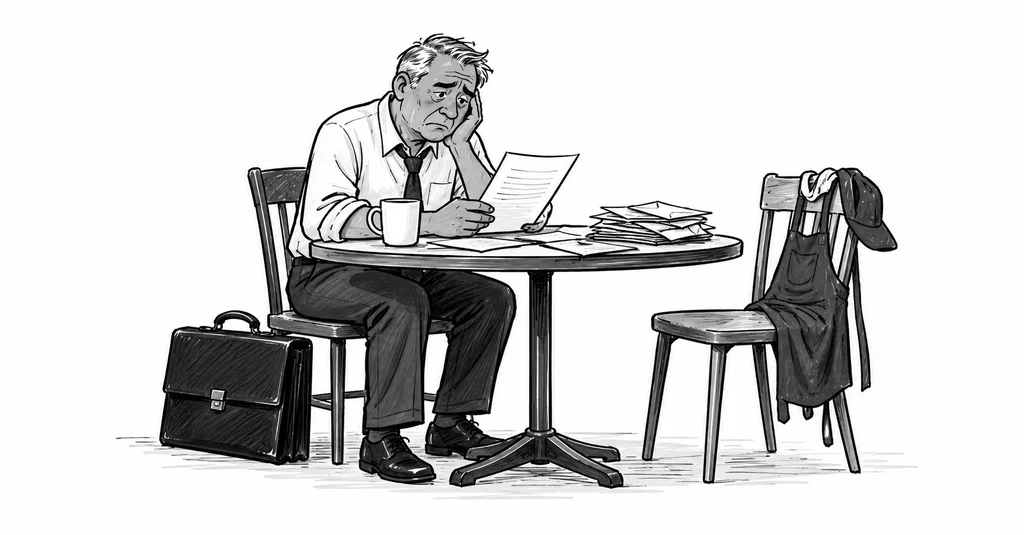
Older workers often have lower unemployment rates than younger workers. But when they lose long-held jobs, getting back to comparable work is much harder — and the financial damage can be severe.
Losing a job after 50 increasingly looks less like a temporary interruption and more like a potential career break. Business Insider reports that workers in their 50s and 60s who lose established positions are spending months or years trying to get back into comparable roles, with some eventually accepting work far below their previous salary and skill level. One 61-year-old former transformation lead told the publication that after three years of searching, she now works as a prep cook and earns about one-eighth of her former salary. Another older worker filed for bankruptcy after more than a year without full-time work. Those stories are anecdotal, but federal data supports the broader concern: workers ages 55 to 64 who lose long-held jobs are substantially less likely than prime-age workers to become reemployed.
The Bureau of Labor Statistics found that among workers who lost jobs they had held for at least three years between 2023 and 2025, only 57.3% of those ages 55 to 64 were reemployed by January 2026. Among workers ages 25 to 54, the reemployment rate was 72.9%. More than one in five displaced workers ages 55 to 64 remained unemployed, while another 20.8% had left the labor force entirely. For workers 65 and older, the reemployment rate fell to just 38.6%. The labor market therefore looks very different depending on whether someone is measuring unemployment broadly or asking a narrower question: what happens after an experienced worker loses the job that anchored the later part of a career?
Experience Can Start Working Against You
Part of the problem is that the qualities that should make older workers attractive can also make employers hesitate. A worker with 25 or 30 years of experience may arrive with a higher previous salary, a more senior title and expectations shaped by an established career. Employers trying to control payroll costs may see a younger candidate as cheaper. Hiring managers may also assume, fairly or unfairly, that an older applicant is closer to retirement, less adaptable to new technology or less willing to report to younger managers.
Age discrimination is illegal under federal law for workers 40 and older, but proving it in an individual hiring decision is difficult. Employers rarely tell applicants that age caused a rejection. A candidate instead sees an application disappear into a recruiting system or receives a generic notice that another person was selected. The result is a problem that can be widely suspected and difficult to document at the same time. Business Insider’s reporting captures that frustration: several workers said they believed age was affecting their searches but had no clear mechanism for proving it.
Salary compression adds another obstacle. An experienced software engineer, operations executive or corporate manager may have spent decades building toward a six-figure salary. After a layoff, that compensation history can make it harder to compete for midlevel openings even when the worker is willing to accept less. Employers may assume the candidate will leave as soon as a better-paying opportunity appears. The worker then becomes caught between being considered too senior for one job and unable to land another position at the previous level.
That is how experience can become a paradox. The labor market tells people to spend decades building expertise, but after a late-career layoff, the same experience can signal expense, seniority and limited remaining tenure to an employer.
The Longer Search Creates a Different Kind of Financial Damage
The financial consequences are also more severe later in life because the recovery window is shorter. A 28-year-old who loses a job can still have decades to rebuild savings and retirement contributions. Someone laid off at 58 may have been entering the period when earnings are typically highest and retirement savings are supposed to accelerate.
A prolonged job search can reverse that trajectory quickly. Workers may tap emergency funds, stop contributing to retirement accounts, withdraw investments, accumulate credit-card debt or claim Social Security earlier than planned. Some accept part-time or hourly work simply to restore cash flow. Even when they eventually return to employment, they may never regain the earnings path they were on before the layoff.
BLS data shows that this is not a marginal group. Among all workers displaced between 2023 and 2025, 1.25 million were ages 55 to 64. Only 61% were employed when surveyed in January 2026, compared with 71.1% of displaced workers ages 25 to 54. Another 16.6% of the older group had left the labor force.
That departure is especially important because it can make the labor market look healthier than the lived reality. Someone who gives up searching and retires early is no longer counted as unemployed. Their disappearance can improve the unemployment rate without improving their financial situation.
This Connects to the Broader Reentry Problem
SSC has already been tracking another feature of the 2026 labor market: people are not being laid off at recession-level rates, but those who lose jobs are taking longer to find new ones. Older workers appear to be experiencing the harshest version of that problem.
The broader economy has increasingly been described as low-hire and low-fire. Businesses are reluctant to let existing employees go, but they are also cautious about adding staff. That works reasonably well for someone already inside a company. It becomes much more dangerous for someone pushed outside, especially if the worker has a senior résumé and compensation history that narrow the number of realistic openings.
This dynamic also overlaps with the structural changes affecting white-collar work. Business Insider separately reported that employment in several white-collar sectors has fallen even while economic output has increased, as companies use software, cloud systems and AI to produce more with fewer workers. A senior employee losing a corporate job today may therefore be competing not only against younger applicants, but against an organization deciding whether the position needs to be replaced at all.
A Late-Career Layoff Can Become Forced Downward Mobility
The usual labor-market framing treats reemployment as success. But for older workers, simply finding another job can obscure the scale of the loss.
A former executive becoming a cashier is employed. A former technology worker driving for a delivery app is employed. Someone earning half of a previous salary is employed. Those outcomes improve the topline numbers while potentially representing dramatic downward mobility for the individual household.
That is what makes late-career displacement different from a normal job transition. The risk is not just spending six months unemployed. It is losing the professional position, salary trajectory and retirement plan built over decades — then discovering that the market will not let you back in at the same level.
The 2026 labor market is giving employers reasons to value efficiency, flexibility and lower costs. For older workers, that can make a long résumé surprisingly fragile. The danger of losing a job after 50 is no longer simply unemployment. It is that the next job may reset the value of an entire career.