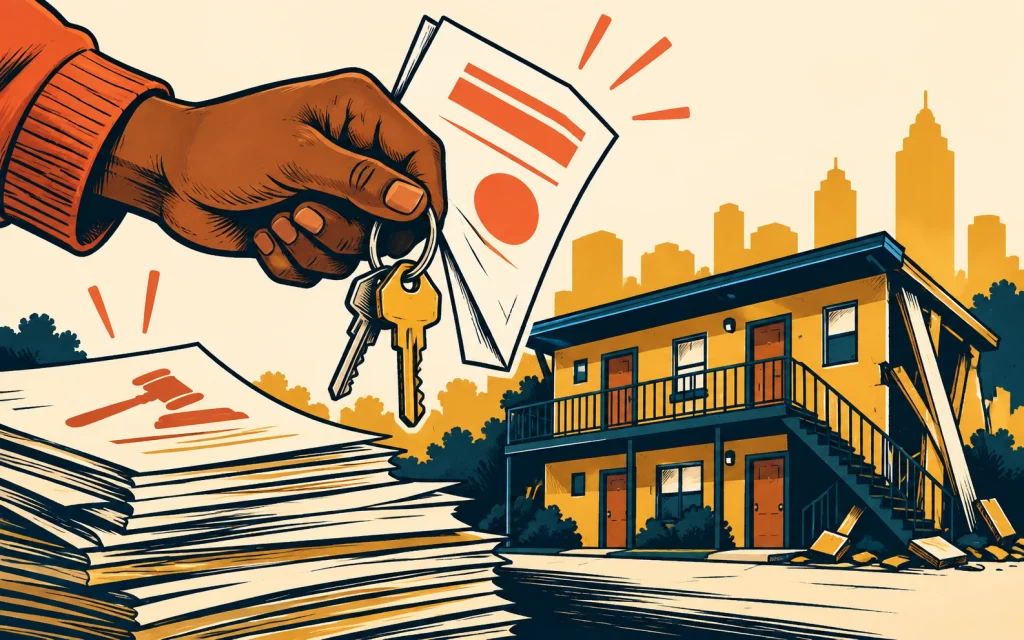
More than 142,000 eviction filings across five metro Atlanta counties expose persistent affordability pressures and a disproportionate burden on Black renters.
BY SOCIAL STORYTELLERS COLLECTIVE NEWS DESK
OCTOBER 10, 2026
Metro Atlanta recorded approximately 142,047 eviction filings from June 2025 through May 2026, according to figures reported from Princeton University’s Eviction Lab. The data cover five core counties—Cobb, Clayton, DeKalb, Fulton and Gwinnett—and roughly 592,742 renter households, according to the Atlanta Regional Commission. The scale of the filings underscores the pressure facing tenants across one of the South’s largest metropolitan areas. A court filing is not the same as a completed eviction, and a household may receive more than one filing.
The Cost of Staying
At a reported average monthly rent of $1,795, a household would need approximately $71,800 in annual gross income to keep rent at 30% of income, a commonly used affordability benchmark. That calculation excludes utilities, transportation, childcare and other essentials. Even a short disruption in wages can leave households struggling to catch up on rent, fees and other bills.
The figures circulated by The Shade Room report approximately 10,218 eviction filings in the most recent month of the study period. Atlanta’s housing pressures long predate COVID-19, and the persistence of filings points to structural problems rather than a single temporary shock. The reported 24% annual filing rate should be understood as a measure of court activity, not the proportion of renters physically displaced.
Black Renters Face Disproportionate Exposure
Black renters reportedly account for 53% of renters but 69% of eviction filings in the area studied. The reported total associated with Black renters is 74,998 filings. These are filing counts rather than a count of distinct individuals or families, and racial categories and denominators should be compared using the original research methodology.
Eviction proceedings can impose costs and instability even when a tenant remains in a home. Repeated filings, legal expenses and uncertainty can make it harder for renters to stabilize household finances. Landlord filing practices, access to counsel and the availability of emergency assistance all shape how those pressures translate into displacement.
What Happens When Staying Becomes Unsustainable?
Atlanta’s reported 24% annual filing rate was described as the highest within Eviction Lab’s monitored jurisdictions, not necessarily every jurisdiction in the United States. The five-county study area is also not the full Atlanta metropolitan region. Both limitations are important when interpreting national rankings and the reach of the findings.
The policy test is whether metro Atlanta can reduce the number of renters entering eviction court in the first place. Preserving affordable homes, improving access to legal representation, examining repeat-filing practices and strengthening emergency rental assistance offer potential responses. The filing data provide a measure against which future interventions can be evaluated.
Sources: Eviction Lab; Atlanta Regional Commission.