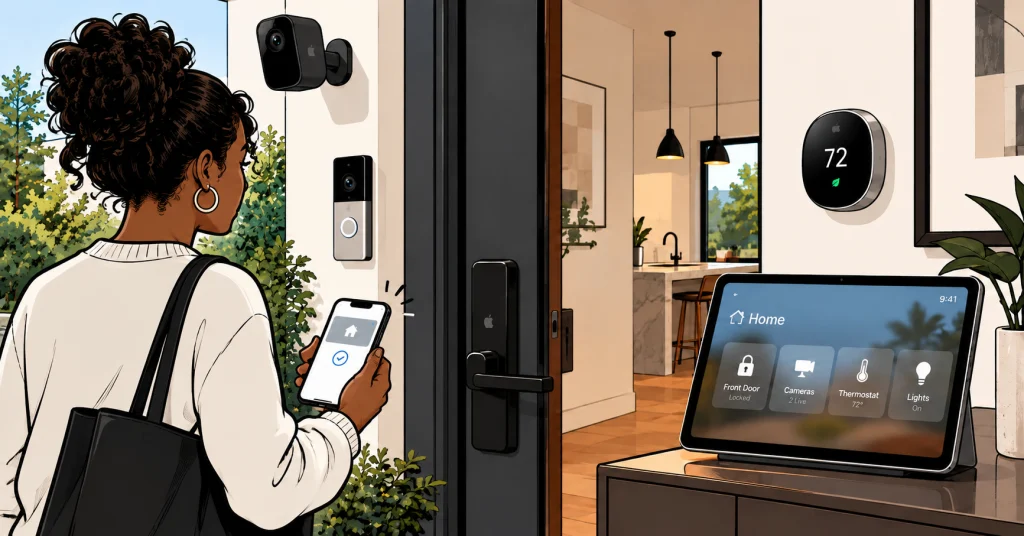
Apple is reportedly developing a smart lock, doorbell, thermostat and security cameras with LG, turning its coming home hub into the center of a much broader push into the connected home.
Apple’s next hardware expansion may be aimed less at something consumers carry than at the devices already attached to their homes. The company is working with LG on a smart lock, video doorbell and thermostat, according to Bloomberg reporting cited by TechCrunch on Tuesday. The companies are also reportedly developing indoor, outdoor and floodlight security cameras. The devices would integrate with Apple’s forthcoming smart-home hub, a roughly 6-inch square display expected to be introduced October 13.
Apple Is Building Around the Hub
The individual products are familiar. Amazon’s Ring already sells doorbells and security cameras, Google has Nest cameras, doorbells and thermostats, and numerous manufacturers sell locks compatible with Apple’s Home platform. What would change with the reported LG partnership is Apple’s position inside that market. Instead of primarily providing the software that connects devices made by other companies, Apple would have a hand in developing more of the hardware surrounding its home platform.
Bloomberg reports that the products are expected to carry LG branding even though Apple and LG are developing them together. That arrangement would allow Apple to expand its smart-home hardware footprint without necessarily turning every device into a new Apple-branded product. Some of the LG devices could be announced as early as next week. TechCrunch’s report
The hub gives those products a center. Bloomberg previously reported that Apple’s upcoming device will use a square touchscreen that can sit on a countertop or mount to a wall. From there, users could control connected devices and access other Apple services. A lock, thermostat, doorbell and cameras would turn that screen from another display into something closer to a household control panel.
Amazon and Google Already Built This Model
That puts Apple more directly against two companies that have spent years assembling smart-home ecosystems through hardware. Amazon acquired Ring in 2018 and has built its Alexa ecosystem around speakers, displays, cameras, doorbells and other connected devices. Google’s Nest portfolio similarly stretches across thermostats, cameras, doorbells, speakers and displays.
Apple took a different route. HomeKit, now incorporated into the broader Apple Home platform, established the software infrastructure while much of the physical hardware came from outside manufacturers. Apple sells products including the HomePod and Apple TV, but it has never offered the same breadth of household devices under its ecosystem that Amazon and Google do.
The reported LG partnership begins filling those gaps without requiring Apple to manufacture every category itself. It also gives the company something its competitors already understand: an ecosystem becomes harder to leave as more everyday functions depend on it. Switching phones is one decision. Replacing the phone, speakers, cameras, thermostat, doorbell, locks and household control system is considerably more complicated.
The Front Door Could Become Another Apple Interface
Apple’s advantage is the enormous installed base it can connect to these products. An iPhone already handles authentication, payments, passwords, location information and digital keys. Apple Watch extends many of those functions to the wrist. The company’s Home Key technology already allows compatible locks to be opened using an iPhone or Apple Watch.
A deeper hardware ecosystem could connect those capabilities more tightly. A person approaching the house could potentially move through an Apple-controlled sequence involving identity, the doorbell, lock, cameras and home automation. Temperature, security and household controls could then move through the same platform.
That also raises the stakes around privacy and platform dependence. Cameras and smart locks handle information considerably more sensitive than a playlist or streaming preference. They can reveal when someone enters a house, who appears at the door and what happens around a property. Apple’s privacy positioning could become an important competitive argument, but expanding deeper into the physical home also gives the company responsibility for protecting a much more consequential category of data.
The Ecosystem Is Moving From Screens to Spaces
Apple has spent decades building an ecosystem around personal devices: Mac, iPod, iPhone, Apple Watch, AirPods and services that work increasingly well together. The reported LG products suggest another direction. Instead of asking consumers to add another Apple device to their collection, the company can make the environment around those devices part of the system.
The October 13 introduction of the reported home hub should provide a clearer indication of how ambitious that strategy is. A display by itself would be another entrant in an established category. A display connected to Apple-influenced locks, cameras, doorbells and climate controls represents something more substantial.
Apple would no longer be competing only for the screen sitting on the kitchen counter. It would be competing for the infrastructure around it—the front door, the thermostat, the security camera and, increasingly, the operating system of the house.