
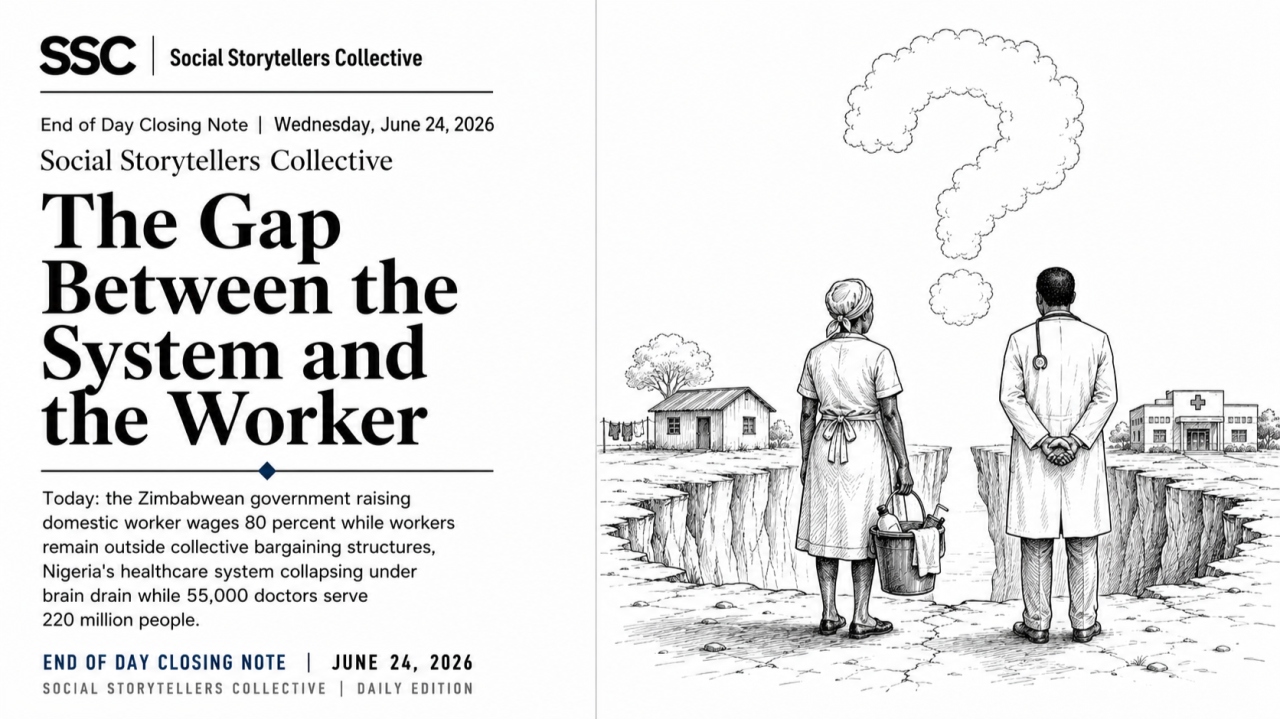
End of Day Closing Note | Wednesday, June 24, 2026
Social Storytellers Collective
The Gap Between the System and the Worker
Today: the Zimbabwean government raising domestic worker wages 80 percent while workers remain outside collective bargaining structures, Nigeria’s healthcare system collapsing under brain drain while 55,000 doctors serve 220 million people, Baltimore losing 5.7 percent of its population while $3 billion floods waterfront development, tech platforms fragmenting regulation across jurisdictions to avoid oversight, Meta normalizing surveillance through celebrity partnerships while training replacement workers on extracted employee data, Microsoft and Salesforce automating labor instead of deploying it, Lucid Motors laying off workers after burning through capital on a vision that market demand never supported, and young people watching homeownership move further out of reach.
We are observing: A wage increase that leaves workers dependent on government discretion. A shortage that reflects rational incentives (emigrate for higher wages) with no policy intervention to address the wage gap. Development that concentrates in zones while neighborhoods are systematically abandoned. Regulations that soften under federal preemption threats. Technology that extracts worker data to build the systems replacing them. Automation that reduces labor costs while eliminating livelihoods. Market forces that reward vision over viability. Access that moves from difficult to impossible.
The throughline isn’t malice. It’s structural logic—each decision makes sense within the system that produces it. The problem is the system itself.
Global Labor & Economic Constraint

The Zimbabwean government approved an 80 percent wage increase for unclassified sector workers, raising compensation from $150 to $270 monthly, and introduced a graded wage structure for domestic workers earning $90–$117 monthly depending on skills. The increase was tied to economic improvements following the gold-backed ZiG currency introduction. On the surface, this appears to signal wage recovery—but when you examine the mechanism, domestic workers remain outside sector-specific collective bargaining structures, meaning they have no institutionalized mechanism to negotiate or defend their wages. Instead, they depend entirely on periodic government reviews, a dependency that leaves them perpetually vulnerable to state discretion rather than worker power. The structural reality is that even an 80 percent increase leaves Zimbabwe’s domestic workers earning below comparable wage floors in South Africa ($364), Kenya ($124), and Egypt ($135)—a gap that will likely accelerate brain drain as skilled workers migrate for higher-wage countries. This wage structure reveals how government wage increases without collective bargaining mean workers remain dependent on state discretion rather than negotiating power.
Nigeria has approximately 55,000 doctors serving a population of 220 million people—roughly one doctor per 4,000 residents—a ratio representing critical healthcare infrastructure collapse. The shortage reflects decades of public healthcare underfunding paired with rational incentive structures: Nigerian-trained doctors can emigrate to higher-wage countries (the U.S., the UK, Canada) where they earn multiples of what public systems at home can offer. The result is not a capacity problem solvable through more medical schools, but a structural incentive problem—underfunded public systems cannot retain talent against global wage inequality. The mechanism is straightforward: Nigeria’s healthcare will continue to collapse proportionally as its population grows because the wage gap that makes emigration rational remains unaddressed. This creates a two-tier system where wealthy Nigerians access private care (often abroad) while poor Nigerians face effectively no healthcare access.
Baltimore Housing & Displacement

Baltimore experienced a 5.7 percent population loss in the 2020 census—the only major East Coast city to lose population while New York grew 7.7 percent and Philadelphia grew 5.1 percent. Simultaneously, public and private entities are investing approximately $3 billion to transform 230 acres of Baltimore’s waterfront into a mixed-use district. The disconnect reveals the mechanism: capital flows to highest-return opportunities (waterfront, dense development), leaving historically Black working-class neighborhoods structurally underinvested. The result is a shrinking city where economic activity concentrates in new development zones while older neighborhoods become less viable for their historical residents. This is not market failure—it’s market function. Baltimore has 12,000+ vacant homes and 21,000+ vacant lots while waterfront development attracts billions. The city isn’t being abandoned; it’s being rebuilt for a different population.
AI Regulatory Fragmentation
Colorado, which passed SB 24-205—the most comprehensive state AI governance law requiring developers and deployers of high-risk AI systems to use “reasonable care” to protect against algorithmic discrimination in education, employment, housing, and healthcare—repealed and replaced the law in May 2026 after Trump administration pressure. The new law, SB 26-189, takes effect January 1, 2027, and narrows requirements to “automated decision-making technology” with pre-use consumer notices and meaningful human review rights, eliminating the original law’s risk management programs and impact assessments. The Trump administration’s December 2025 executive order threatened to challenge state AI laws as unconstitutional burdens on commerce—and the threat alone was sufficient to cause Colorado to preemptively weaken its own law.

Meanwhile, UK regulators are signaling a lighter regulatory touch toward AI compared to EU approaches (which emphasize risk-based classification and duty of care) and US approaches (which vary by state but include algorithmic bias auditing requirements). The UK is emphasizing “principles-based” regulation and industry self-governance rather than prescriptive rules. When AI governance fragments across jurisdictions, companies naturally migrate toward the softest regulatory environment. The UK’s lighter touch—intended to foster innovation—may actually enable regulatory arbitrage where companies optimize for compliance in the most permissive jurisdiction. The pattern is clear: federal preemption threats—without litigation—effectively veto state regulatory ambition. In a fragmented landscape, the least-protective standard becomes the de facto global baseline.
Technology & Market Reality
Microsoft is positioning itself for a fundamental shift in how computing happens: away from discrete applications toward integrated AI systems that handle tasks fluidly. The company is betting that traditional app-based architecture is becoming obsolete—and that the firms controlling AI infrastructure will control how work happens downstream.
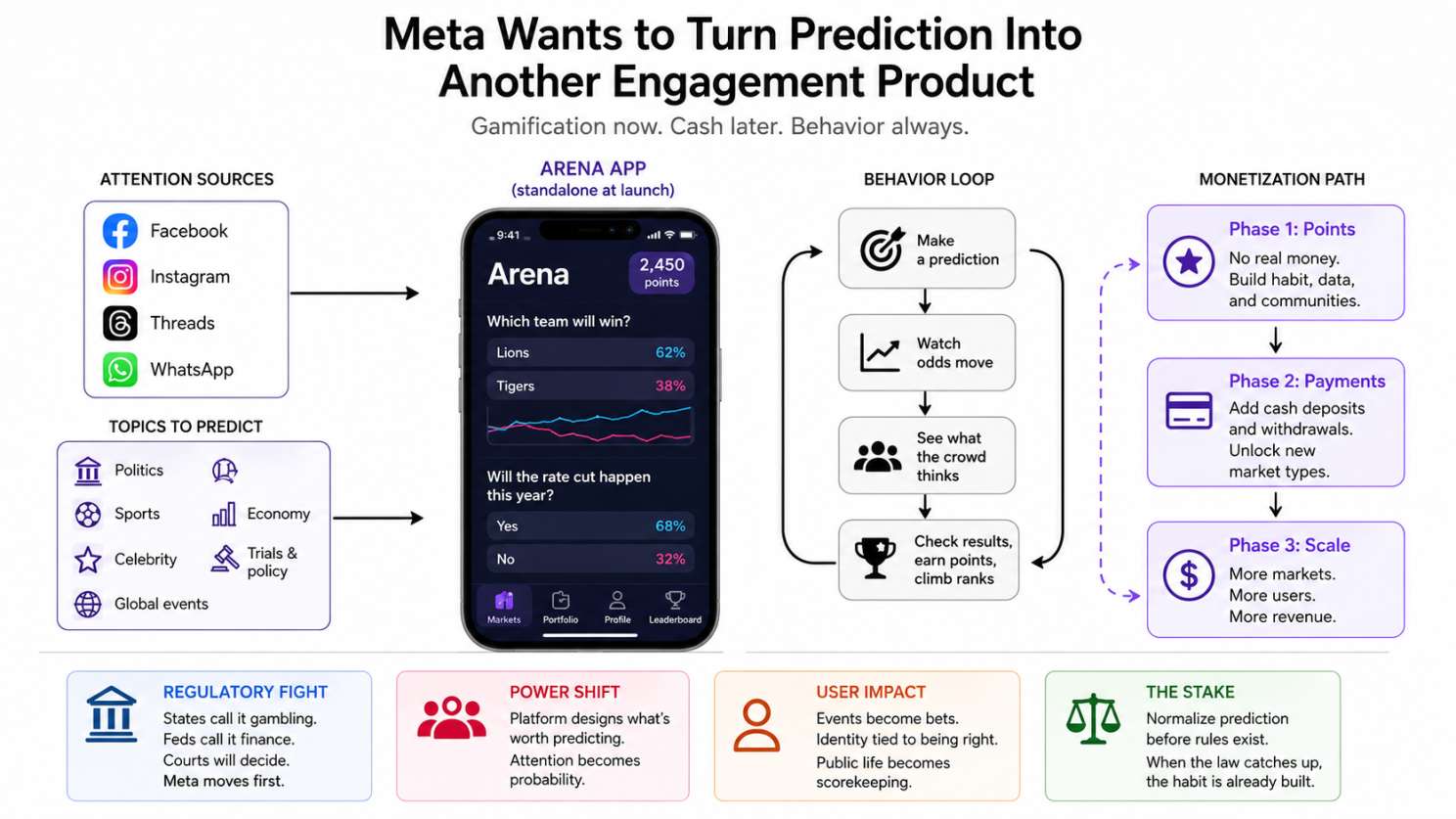
Meta is simultaneously pursuing two strategies to embed AI deeper into daily life: normalizing wearable surveillance through celebrity partnerships (making invasive tracking seem aspirational) and turning algorithmic prediction into a standalone engagement product—essentially monetizing the act of anticipating user behavior before users themselves recognize the pattern. The structural mechanism is that Meta extracts behavioral data at scale, builds prediction models on that data, then sells the predictions back to advertisers and users as products.

Salesforce is consolidating its workforce while expanding automation capacity—a direct statement that the company’s growth strategy prioritizes labor replacement over labor expansion. Rather than scale the workforce to handle increased demand, Salesforce is acquiring automation tools to do the same work with fewer people.

Lucid Motors is laying off workers after burning through capital on a vision that market demand never supported. The company bet that premium electric vehicles with cutting-edge design would command the market; the market has instead moved toward affordability and practicality. Lucid’s layoffs signal a broader reckoning in the EV sector: vision alone—no matter how well-funded—cannot overcome the gap between what capital wants to build and what consumers actually need.
Structural Economic Barriers

Homeownership—once positioned as the path to wealth-building—is becoming increasingly impossible for young people, particularly Black Americans. Black Gen Zers’ homeownership rate fell from 16.3% in 2023 to 14.2%, while the white Gen Z rate rose from 29.7% to 31.6%. The gap reflects deeper structural inequality: for every $100 in wealth held by white households, Black households hold $15—a gap that shows up directly at the down payment. Only 9% of recent Black homebuyers used a family cash gift, compared to 15% of white homebuyers. As housing prices outpace wage growth, the down payment itself becomes the gatekeeping mechanism, and intergenerational wealth becomes the determining factor in who gets to build equity.
What We’re Reading
Over 8,400 tech workers across the University of California system voted to unionize through UPTE, making it the nation’s largest tech worker union. The contract includes a direct mechanism: workers can collectively bargain over the introduction of new AI tools in the workplace, offering workers voice in how AI will be used. UPTE president Dan Russell argues the structural point: “When you try to make quick, dirty decisions to cut labor through AI, you’re actually creating a more vulnerable system.”
What We’re Watching Next
The labor movement just figured out something crucial: you don’t fight automation after it happens. You negotiate governance before deployment.
8,400 tech workers at the University of California won binding rights to collectively bargain over how new AI gets used in their workplaces. The Culinary Union in Las Vegas extracted contingency language that forces renegotiation the moment AI changes working conditions. These aren’t holdouts against technology. They’re mechanisms that give workers a seat at the table before decisions are made.
Every other story in today’s edition shows what happens without that seat. Zimbabwe raises wages 80 percent but keeps workers outside collective bargaining—dependent on state discretion instead of negotiating power. Nigeria’s healthcare doesn’t collapse from lack of doctors. It collapses because individual doctors rationally leave for higher wages and no system exists to stop the exodus. Baltimore loses population while waterfront development attracts billions because residents had no mechanism to shape those decisions. Meta and Salesforce automated labor without asking anyone affected. Lucid burned billions on a vision because no workers with actual stake in the outcome had input.
The through-line: decisions made unilaterally produce different outcomes than decisions made with worker participation.
Watch whether this governance model spreads beyond tech and hospitality—the sectors already organized enough to demand it. Retail is where the real test happens. The UFCW lost 3,900 members across 110 Kroger stores in Dallasafter Kroger deployed AI to track shopper movements and cut hours. Kroger made that unilaterally. If the UFCW moves to demand governance rights in its next contract—”we don’t deploy without your consent” rather than just “we’ll tell you six months before”—that’s a strategic shift.
Watch for management resistance, especially in tech. Microsoft fights organizing hard. Amazon systematically resists worker organizing around surveillance. They may accept notification timelines but resist binding governance rights. The difference between those two is everything.
The real argument: automation decisions are power decisions. When workers secure binding rights to shape deployment, they’re not blocking innovation. They’re demanding that productivity gains don’t flow entirely to shareholders while displacement flows entirely to workers. They’re demanding the math change.
If unions make AI governance contractual—a non-negotiable operating condition—labor regains leverage it’s lost for four decades. Not by saying no to technology. By saying yes, but on terms that include workers in the gains.
Eighteen months will tell if this becomes standard across sectors or stays isolated to workers already organized. Watch retail and transportation negotiations. They’ll show whether this actually scales.
Daily Visual Signal

The Access Shift: This image visualizes the structural paradox of institutional gatekeeping—two identical buildings representing systems that maintain an appearance of openness while functionally restricting entry. The open door signals promise and democratic access; the sealed wall beside it reveals the lived experience of exclusion.
Free, daily structural analysis lands in your inbox every weekday morning. Subscribe: Form