
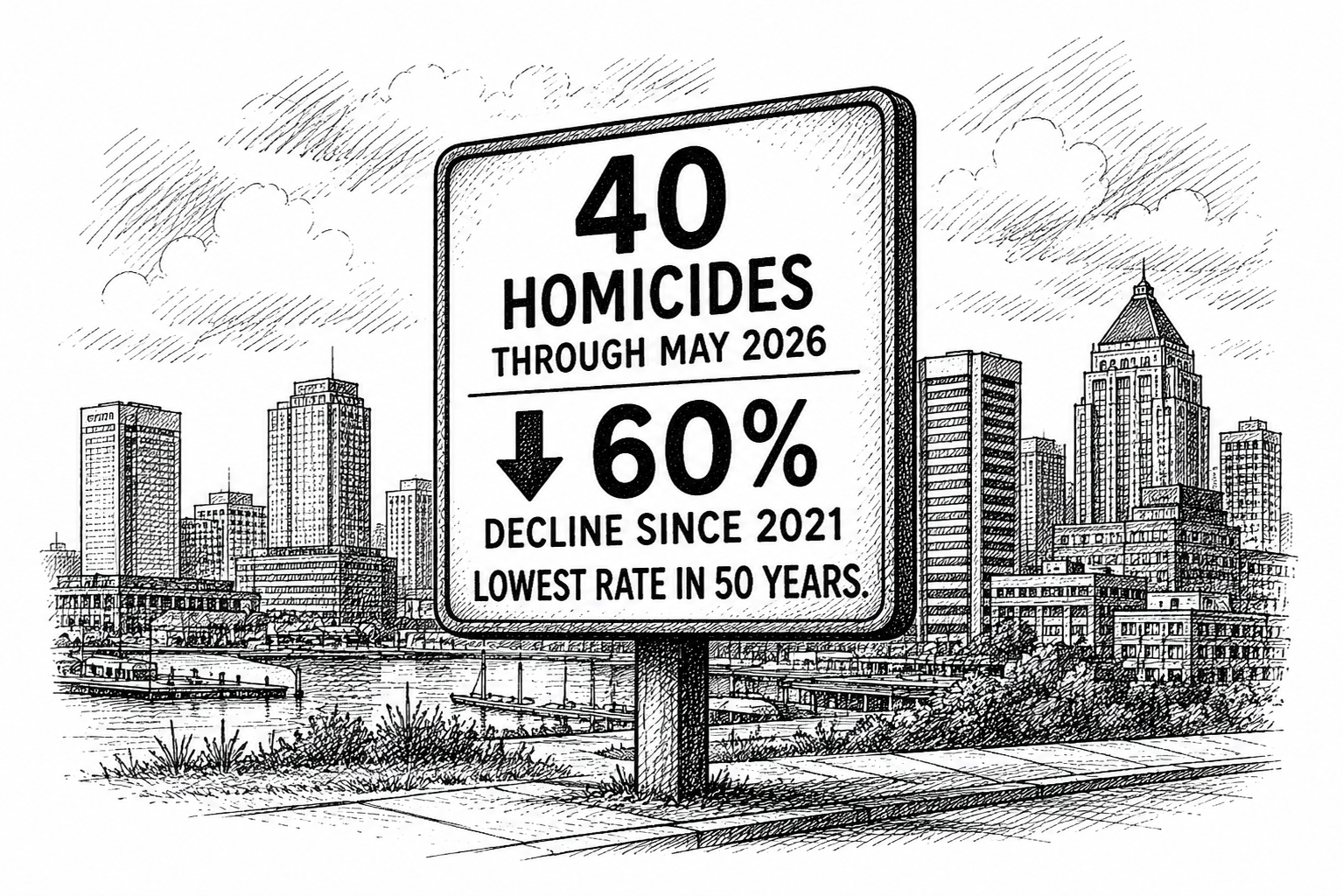
Baltimore recorded 40 homicides through the end of May 2026. In the same period last year, the number was 52. In 2025, the city ended the year with 133 total homicides — a nearly 60% decline from 2021, and the lowest rate per 100,000 residents in half a century. Maryland, statewide, is on pace for its lowest homicide rate in more than 40 years. This is not a contested data point. It is a documented public safety achievement. The question worth asking is why it has been so difficult to discuss.
The reductions are happening under a specific leadership structure. Governor Wes Moore, Baltimore Mayor Brandon Scott, and State’s Attorney Ivan Bates — all Black — have presided over a crime decline that is measurable, sustained, and historically significant. When the numbers move this far in this direction, it typically generates a consensus narrative: the model worked, the approach should be studied, credit should be assigned. That consensus has not materialized in any simple way. The comment sections and social media debates around these numbers reveal something more complicated: a public that has been handed good news and does not quite know what to do with it.
Part of what is happening is structural to how we consume public safety information. Baltimore’s homicide rate has been a fixture of national media for decades — the city has served as shorthand for urban crisis, most visibly through the decade-long cultural imprint of The Wire, which aired its final season in 2008 but continues to shape how people outside the city imagine it. Crisis narratives build audiences and establish interpretive frames. A city that has been positioned as a cautionary tale for forty years does not easily become a case study in successful governance. The template is set, and new data has to compete with it.
There is also a more direct epistemological problem. The public debate around crime and public safety has become so saturated with political identity that data no longer settles arguments — it enters them. People who distrust the governance model that produced the results tend to question the numbers: the methodology changed, the categories shifted, crime is just being undercounted. People who support the model tend to overclaim, attributing to a single administration what is partly a longer trend. Neither response is interested in the data on its own terms. Both are using the data to confirm what they already believe about who deserves credit for what.
This is not purely a Baltimore problem, but Baltimore makes it legible in a particular way. When a Black mayor and a Black governor produce measurable reductions in violence in a majority-Black city, the achievement requires a public capable of receiving it — capable of separating the evidence from the identity of the people who generated it. That capacity is being tested. The same political environment that struggles to credit Black-led governance for public safety gains is the environment in which the governance decisions that produced those gains were made, often against significant skepticism. Brandon Scott has been mayor since 2020. His administration’s approach — emphasizing violence interruption programs, focused deterrence, and coordinated community investment alongside law enforcement — was debated, contested, and underfunded at various points. The results exist anyway.
The structural argument here is about what it costs when evidence of progress cannot be processed cleanly. It is not only that a city does not receive the recognition it has earned. It is that the policy choices that produced the results cannot be replicated if they cannot first be identified as causes. If the conversation about Baltimore’s homicide decline is perpetually hijacked by debates about whether the numbers are real, or who gets to claim them, or what they say about political identities that predate the data — then the city’s achievement becomes analytically inaccessible. Other cities with similar challenges cannot learn from it. The model cannot travel.
Data that enters a debate rather than settling it is not neutral. It is losing ground to the narratives that were already there before anyone looked at the numbers. Baltimore’s numbers are extraordinary. The test is whether the public has developed any tools for receiving them.
Sources: Baltimore City Mayor’s Office, monthly homicide and nonfatal shooting statements, February–June 2026. Governor Wes Moore Office, press release on violent crime reductions. Johns Hopkins Bloomberg Public Health Magazine, “A Contagious Peace: Behind Baltimore’s Historic Homicide Reduction,” 2026.