
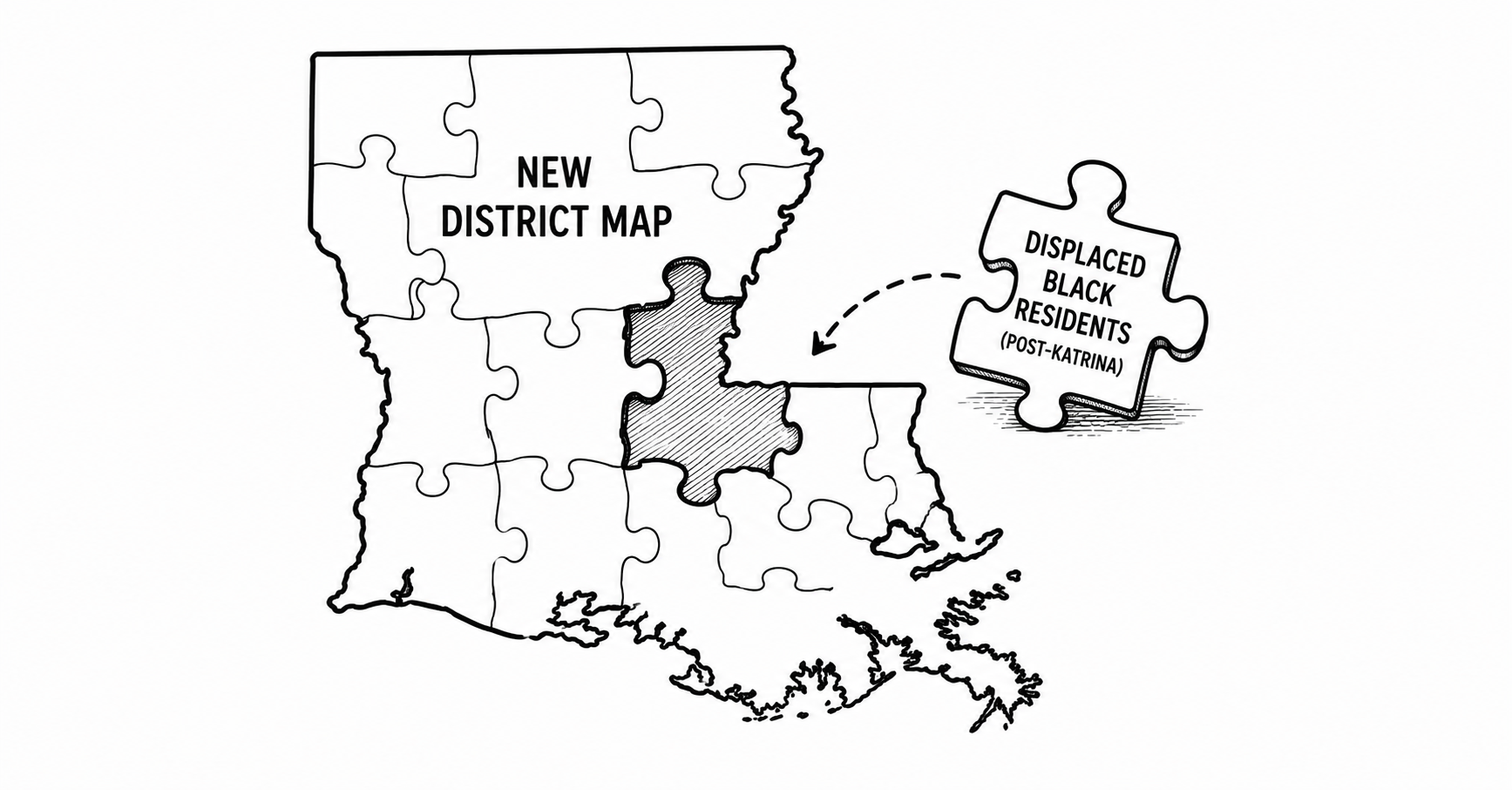
Louisiana Republicans approved a new congressional map on May 29, 2026, eliminating one of the state’s two majority-Black congressional districts — reported by NBC News correspondent David Gutman and OPB — just days before early voting began, with tens of thousands of voters having already returned mail ballots. The map passed after the U.S. Supreme Court issued a ruling that severely weakened Section 2 of the Voting Rights Act of 1965, removing the legal foundation that had required the second majority-Black district’s existence in the first place. Under the new map, Louisiana will have one majority-Black district stretching from New Orleans to Baton Rouge. The 6th Congressional District, currently held by Democrat Cleo Fields, will almost certainly flip Republican.
The map is the latest chapter in a story that did not begin in 2026. It began in 2005.
When Hurricane Katrina’s floodwaters receded, New Orleans had lost nearly 100,000 Black residents — people who left during the storm and did not return. The population that once anchored Louisiana’s congressional geography was gone. What came back was whiter and wealthier. The post-Katrina reconstruction did not rebuild the Black middle class that left. It rebuilt the city around a different population — and the political maps that followed were drawn against that changed demographic reality.
The mechanism connecting Katrina to the 2026 redistricting is not coincidental. Disaster displacement changed who was present to be counted in the census. The census determined the population base against which district lines were drawn. The district lines determined whose votes would carry weight in Congress. When a natural disaster disproportionately displaces a population that is disproportionately Black — and when the recovery does not bring them back — the political consequences are structural and compounding. The geography of who is absent from the count becomes the geography of who is absent from representation.
Sen. Royce Duplessis, Democrat of New Orleans, said on the Senate floor: “You can’t bring a map like this, that’s gonna reduce representation and think we’re just supposed to take it.” Sen. Katrina Jackson-Andrews, Democrat of Monroe, named the pattern directly: “For generations, many citizens of this state were excluded. They were systematically deprived of their right to vote.” Louisiana is approximately one-third Black. Under the new map, one of six congressional districts will be majority-Black. The math does not require interpretation.
Republican Sen. Jay Morris, the map’s sponsor, presented the bill without the usual racial demographic data that accompanies redistricting legislation — providing only party affiliation breakdowns. Sen. Sidney Barthelemy, Democrat of New Orleans, pointed out the obvious: “If 80% of the Republican party is white… this bill does use race as a predominant factor.” The absence of the racial data in the bill did not change what the racial data shows.
The Power Coalition for Equity and Justice, a Louisiana voting rights organization, responded to the map’s passage directly: “Louisiana’s congressional districts must reflect the people who live here. For too long, Black voters in Louisiana and across the country have faced barriers to full and fair representation.” Litigation is expected. It will likely take years.
Disaster displacement became political displacement. The people who left after Katrina were not counted in the districts where they had lived. The districts were redrawn around the population that remained. The political map that resulted reflected a Louisiana shaped by a disaster that the recovery never corrected — and that a redistricting process just made permanent.
Get SSC analysis delivered to your inbox every day. Subscribe free on Beehiiv: socialstorytellerscollective.beehiiv.com