
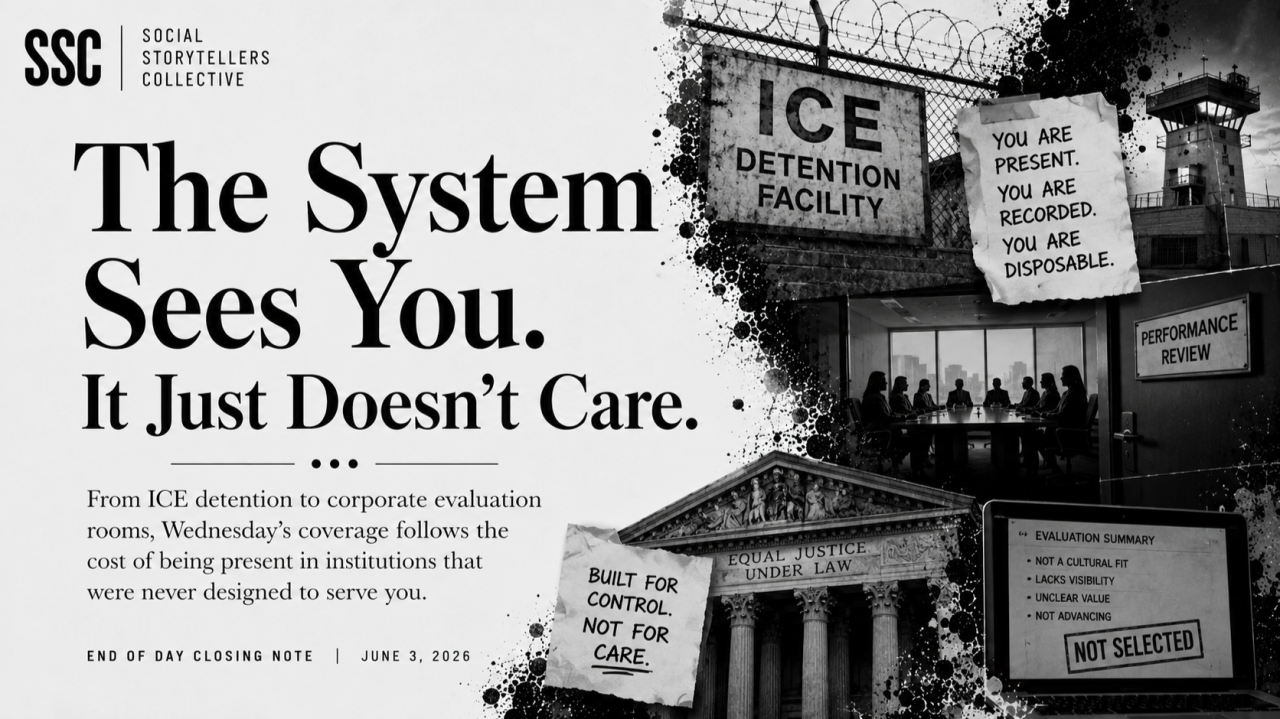
From ICE detention to corporate evaluation rooms, a pope whose lineage rewrote the headline, and a knighthood that finally recognized the right thing — Wednesday’s coverage follows the cost of being present in institutions that were never designed to serve you, and the rare moments when they get it right.
End of Day Closing Note | June 3, 2026
Some days the news gives you room to think. Wednesday did not. But before we get into what SSC tracked today, there is a story running underneath all of it that did not make our publication — and it is worth naming.
Gen Z is going back to the mall. Not to shop. To exist somewhere together.
Mall traffic among shoppers aged 14 to 29 has risen sharply over the past year, according to Good Morning America. The foot traffic is not translating into comparable sales. Younger visitors are browsing, meeting friends, grabbing food, creating content, and spending hours in a space without making significant purchases. Some mall operators have gone so far as to establish Gen Z advisory committees to understand what is actually happening. What they are finding is that the mall is no longer primarily a retail destination. It is filling a gap that used to be filled by libraries, community centers, and public gathering spaces — what sociologists call the third place, the location outside home and work where people can be together without a membership, reservation, or admission fee. As those spaces face budget cuts and commercialization, the mall — climate-controlled, free to enter, anchored by food — may be one of the last places left where young people can show up without a reason and stay without a cost.
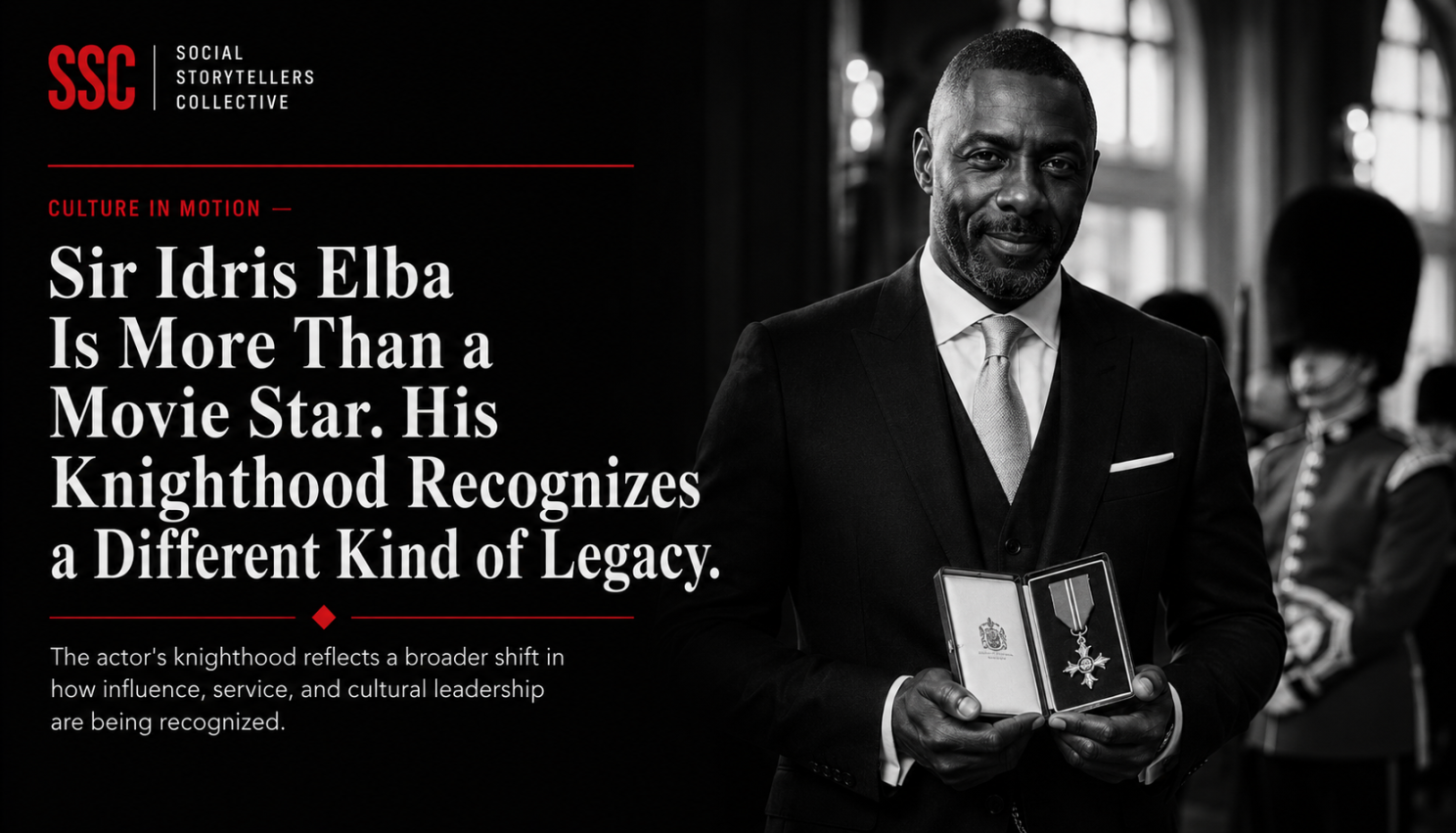
Wednesday also carried two stories about recognition — and what it actually means when institutions finally get it right. King Charles III knighted Idris Elba at Windsor Castle for services to young people, tied to years of advocacy through the Elba Hope Foundation and anti-knife crime work that long predated his Hollywood franchise career. From Brandon Crenshaw: Sir Idris Elba is more than a movie star — and the recognition finally reflects it. And the genealogists kept working on the lineage of the first American pope. Both stories ask the same question from different directions: who gets recognized, by whom, and what does the recognition actually say about what the institution values. The rest of Wednesday’s record is heavier. It starts in a detention facility.
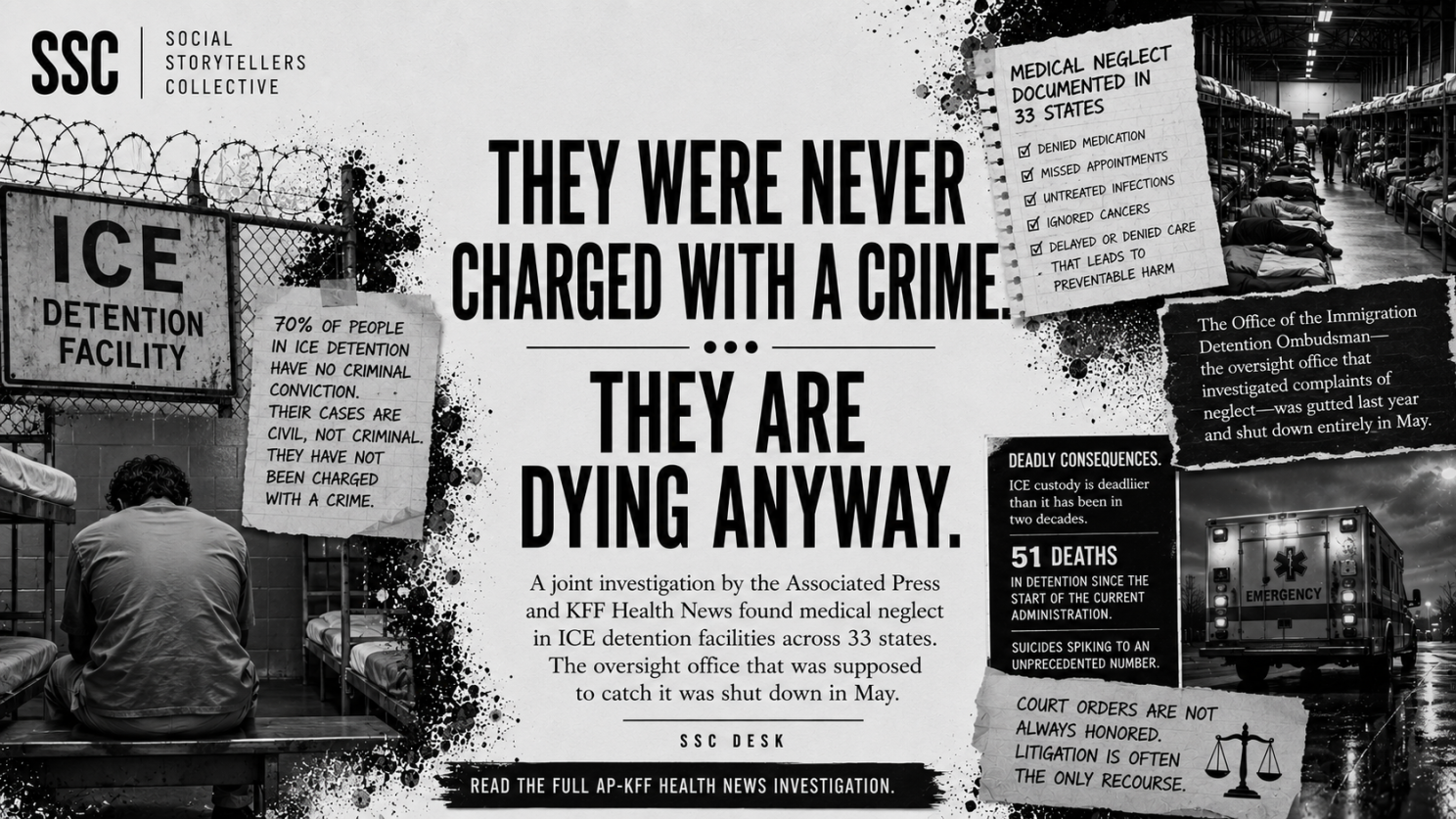
Seventy percent of the people currently held in ICE detention have no criminal conviction. They are not awaiting trial for a crime. They are held in civil proceedings — immigration cases that can stretch for months, sometimes years — while the government is legally obligated to provide them medical care. They were never charged with a crime. They are dying anyway. An Albanian man pulled out his own tooth after months of untreated dental pain. A Romanian man had a stroke on a video call with his daughter after a detention facility repeatedly failed to give him his post-cardiac surgery medications. A California judge ordered the government to take a man showing signs of prostate cancer to a specialist. Records show they did not take him. The Office of the Immigration Detention Ombudsman — the oversight body that was supposed to catch these failures — was shut down entirely in May. There is now no one to call. That is not a breakdown. That is a design.
That argument — the gap between what institutions are supposed to do and what they are built to deliver — runs through everything SSC published today.
SSC Featured Series | The Credentialing Class

A 4-part series examining what happens when the platform economy absorbs the credential economy — and who gets left holding a certificate the market hasn’t agreed to honor.
Part I · Not All Credentials Are Created Equal · June 1 Part II · The Platform Promise · June 2 Part III · The Short Runway That Actually Works · June 3 Part IV · The Treadmill Problem · June 4
Not every credential takes two years and $15,000. Some of the most effective ones take weeks — if you know which ones the labor market has actually agreed to honor. The Short Runway That Actually Works — Part III of The Credentialing Class — makes a precise argument: the credentials delivering real returns are employer-validated, stackable, and sector-specific in industries with documented shortages. The ones that don’t are certificates that look identical on paper and land completely differently in a hiring manager’s inbox. The workers with the least margin to absorb a credential that doesn’t deliver are the ones taking the most risk on a market that profits from issuance regardless of outcome. Part IV — The Treadmill Problem — publishes tomorrow.
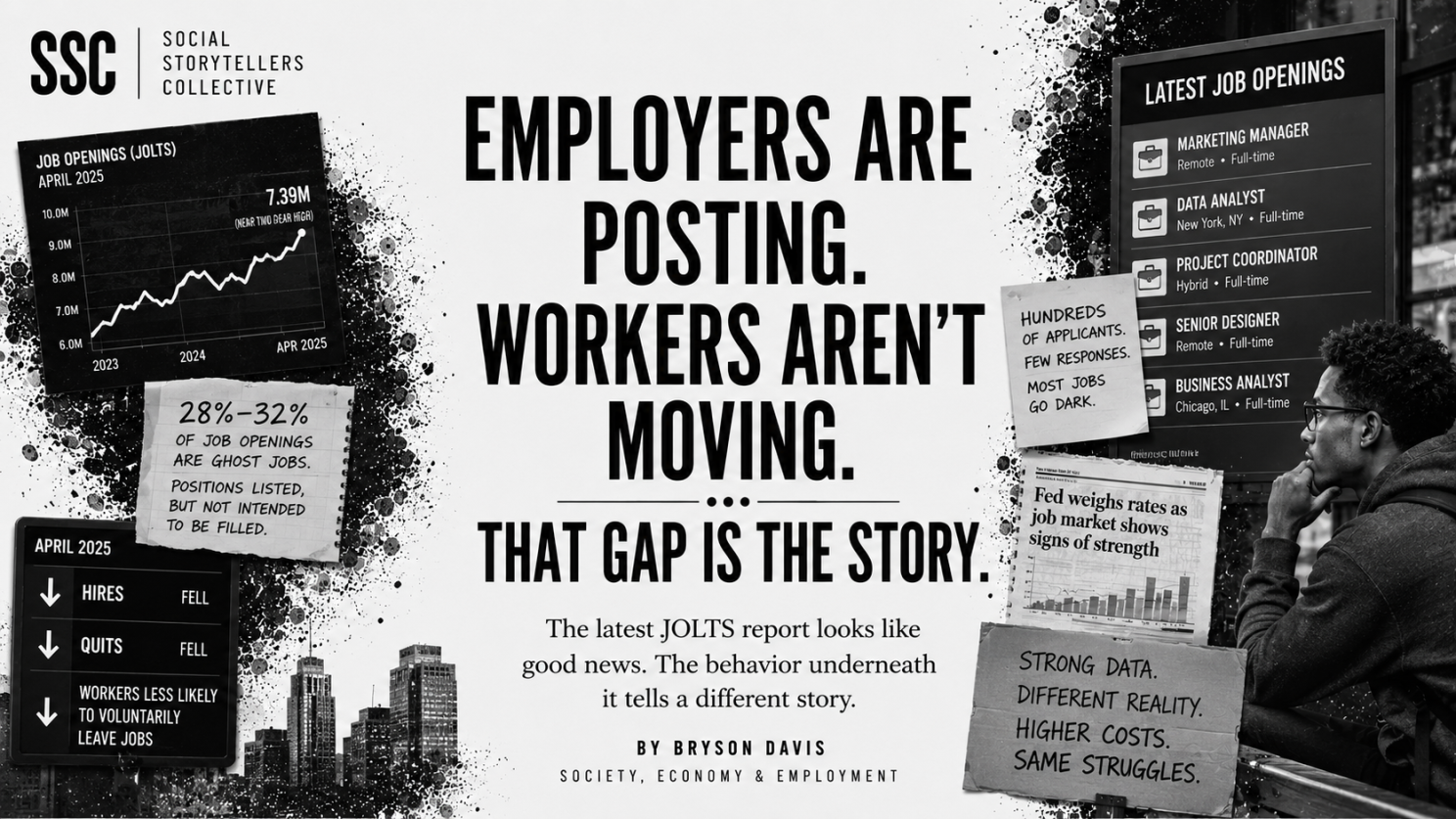
The hiring market itself is telling a story the headline numbers keep obscuring. In April, hires fell. Quits fell. Workers became less likely to voluntarily leave their jobs — not more. Those three data points landed in the same Bureau of Labor Statistics report as a near two-year high in posted job openings, and almost nobody is talking about the contradiction. From Bryson Davis : between 28 and 32 percent of posted openings are estimated to be ghost jobs — positions that exist to collect resumes, satisfy HR requirements, or create the appearance of growth. The Bureau of Labor Statistics measures what employers report as actively trying to fill. It does not measure whether anyone is actually interviewing. The posted number and the lived experience of job seekers are measuring different things.
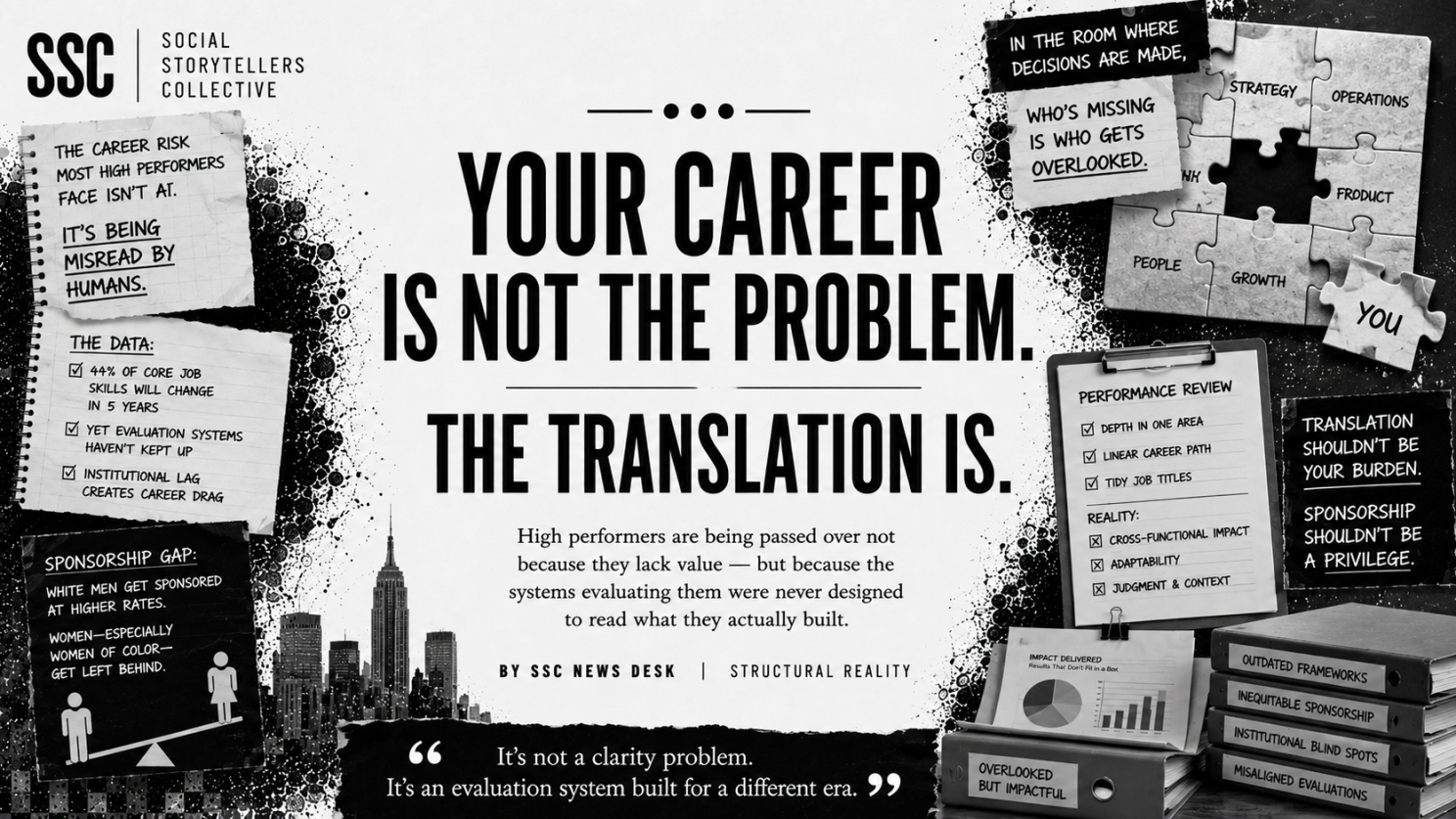
And the workers absorbing the cost of that gap are increasingly being told the problem is how they talk about themselves. Writing in Fast Company , Tony Martignetti, MBA, PCC and Tobin Trevarthen identify what they call Narrative Worth — the ability to connect what you’ve built into something the world can understand. SSC pushes that argument further: the translation problem is not a communication failure. It is a structural one. The performance review systems organizations use were built for linear careers in stable role categories — not for the workers who moved laterally out of necessity, expanded their scope without title changes, or developed judgment across functions rather than depth within one. Sponsorship — not narrative — is the variable that most consistently determines who advances. The consulting partner who got passed over didn’t need a better story. She needed someone in that room who understood what she had built and was invested enough in her advancement to say so.
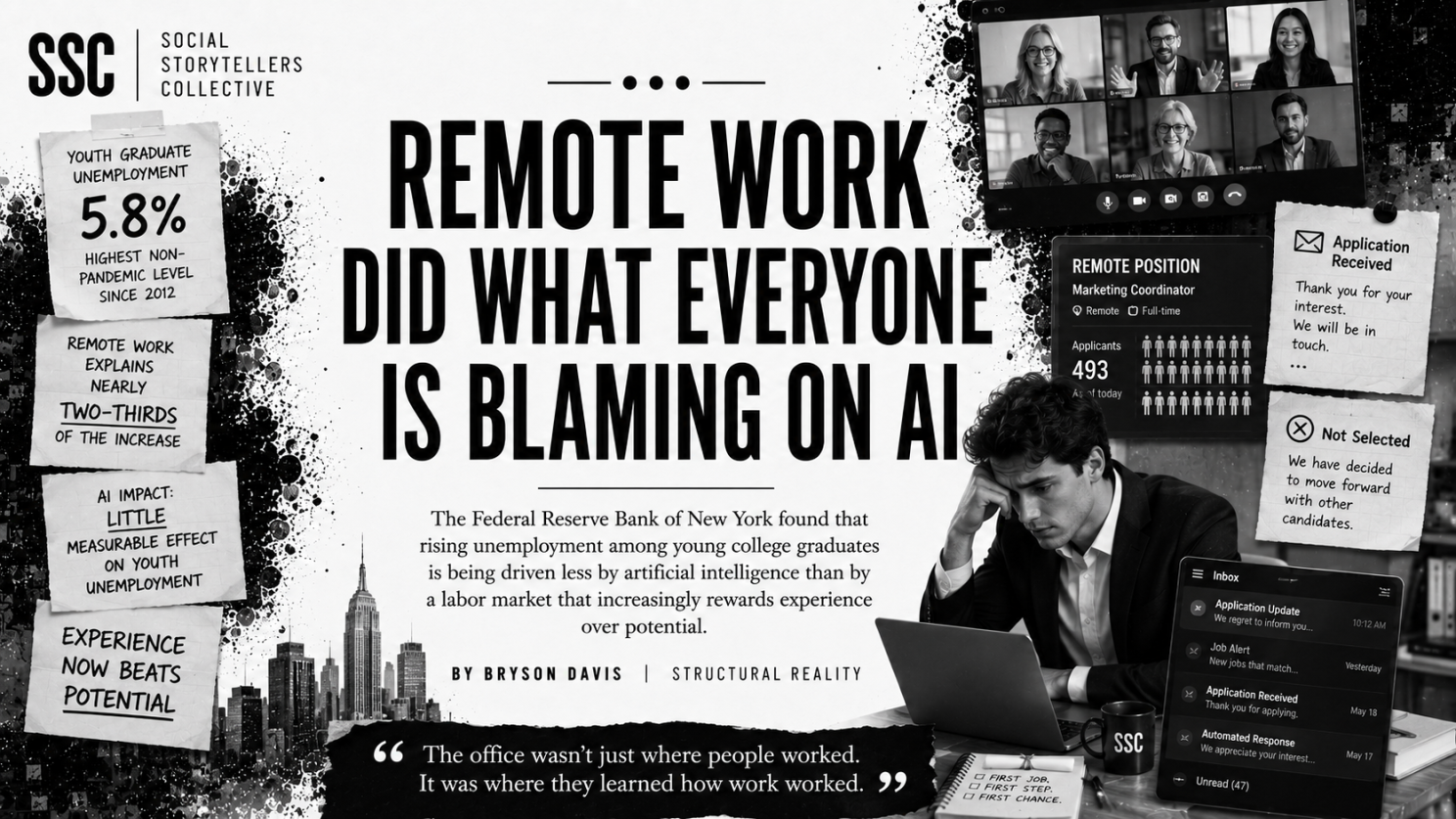
Remote work made that problem worse in ways that are only now being measured. A Federal Reserve Bank of New York study released this week finds that remote work is responsible for nearly two-thirds of the rise in unemployment among young college graduates since the pandemic — not artificial intelligence, which the study found had little measurable impact on youth unemployment. The unemployment rate for graduates between 22 and 27 reached 5.8 percent last year — the highest outside of the pandemic since 2012. The mechanism is mentorship. Employers are reluctant to hire inexperienced workers onto distributed teams because training them from a distance is harder. The office was not just a place to work. For entry-level workers it was the primary mechanism through which professional knowledge, institutional relationships, and career capital transferred. Remote work didn’t simply change where people worked. It privatized that transfer — making it available only to workers who already had networks, sponsors, and access to informal guidance outside the office.
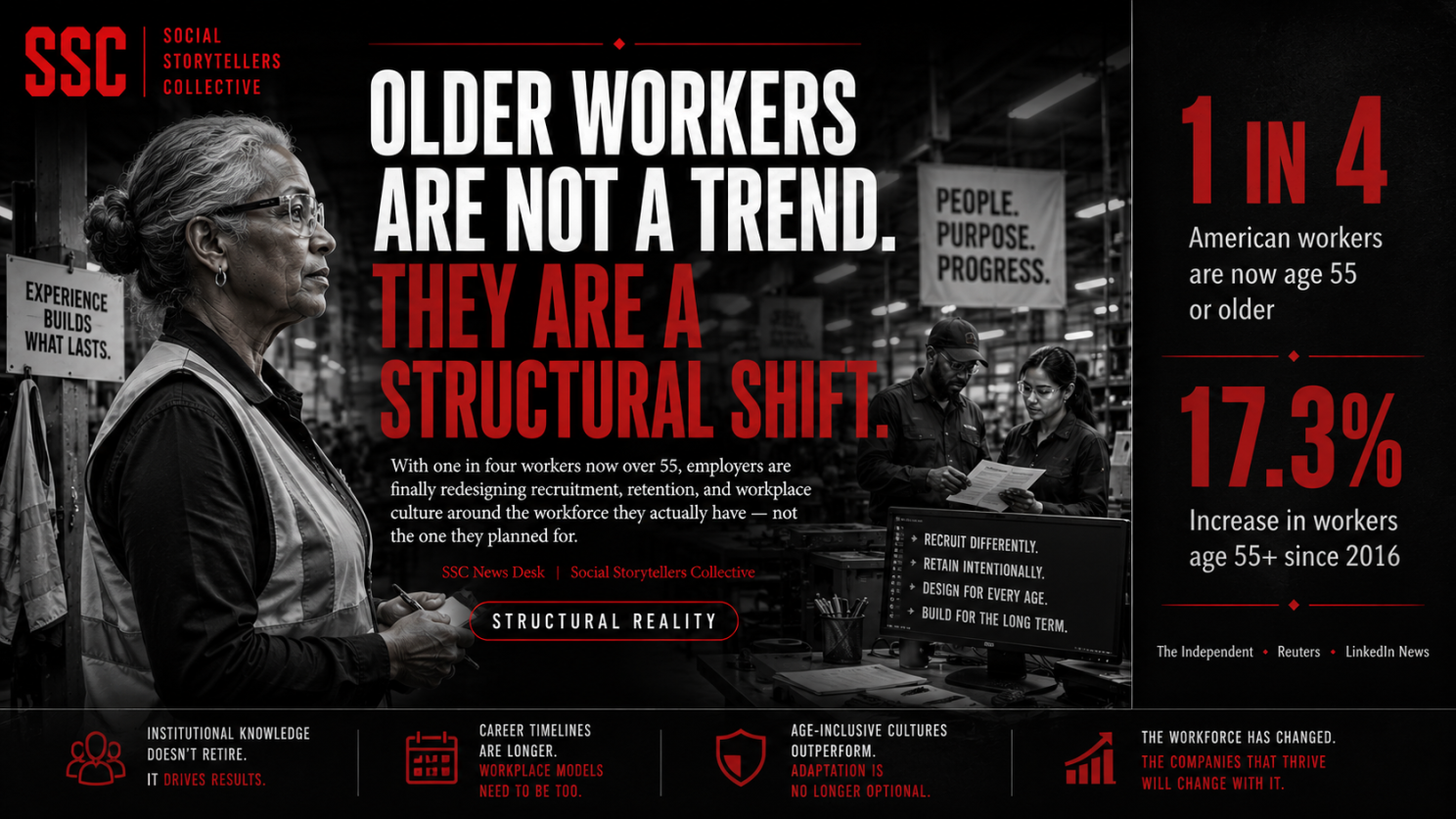
From Bryson Davis: older workers are not a trend. 1 in 4 American workers is now 55 or older — a figure that has grown 17.3 percent since 2016. Deloitte and BMW are adjusting their recruitment and retention strategies in response. But the adaptation is uneven in ways the coverage isn’t naming. A 57-year-old white-collar professional with portable skills can negotiate flexibility. A 57-year-old in a physical labor role, or one whose industry was restructured out from under them, is navigating a labor market that still has age bias baked into its hiring algorithms. The employers making headline adjustments are largely large corporations with the margin to do so. The workers who most need the accommodation are the least likely to work somewhere with a formal aging workforce strategy.
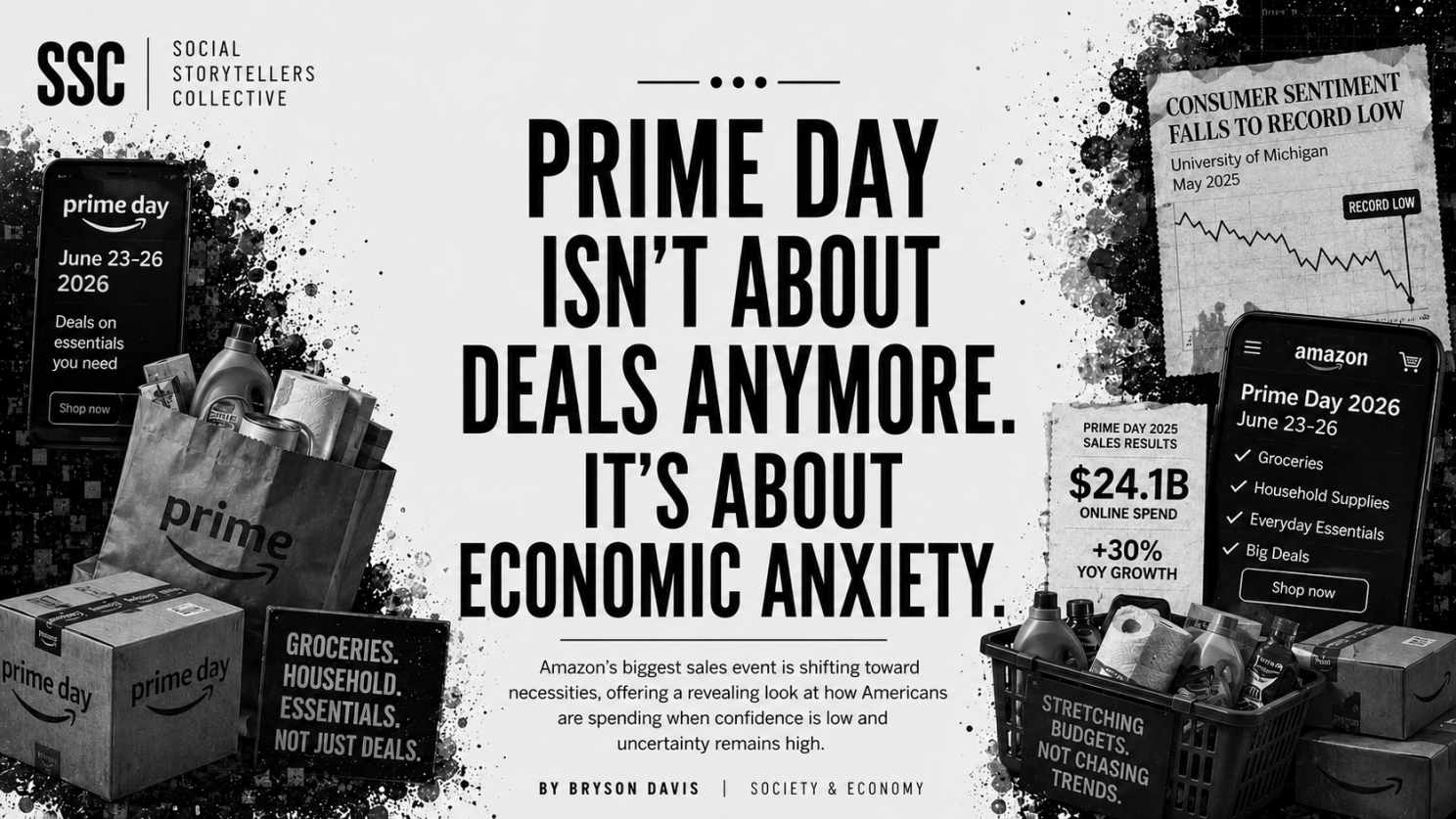
The consumer economy is reorganizing around the same pressure. Amazon says Prime Day 2026, scheduled for June 23–26, will lead with groceries, household supplies, and everyday essentials — a significant departure from the discretionary spending celebration the event was built on. Consumer sentiment fell to a record low in May. When people feel uncertain about their financial future, the shopping cart becomes less aspirational and more practical. A discounted television can wait. Laundry detergent cannot. Amazon is not creating that shift. It is responding to it.
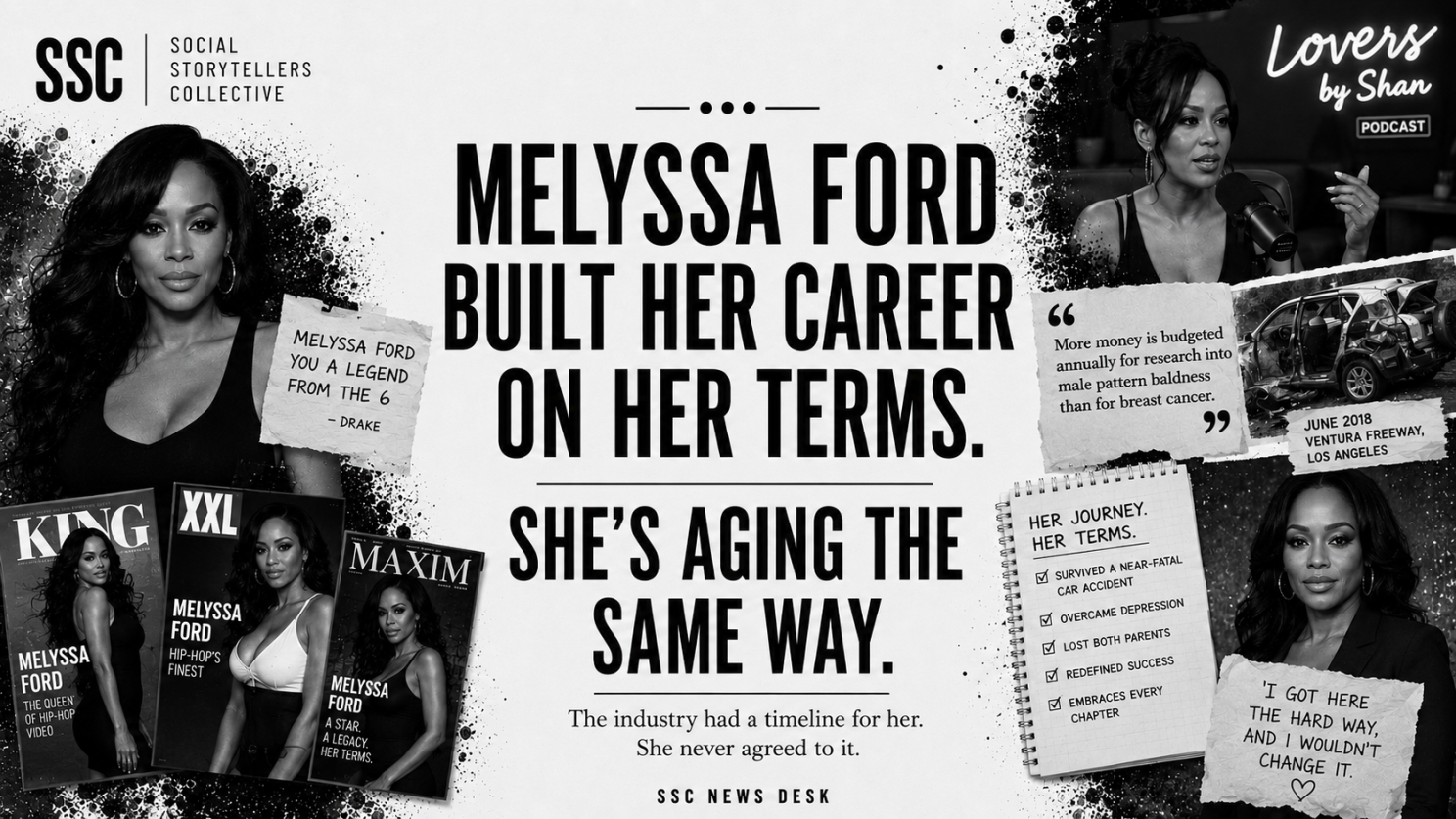
From Leena Alridge: the gym was never just about the workout. Former NFL player Ryan Clark posted what he called a “quick gym etiquette meeting” and generated thousands of responses — not because people care deeply about rest periods between sets, but because the gym has become a microcosm of a broader negotiation about shared public space. Everyone believes they are behaving reasonably. Everyone believes someone else is the problem. The argument underneath is about who gets to define the rules in spaces that theoretically belong to everyone. Also from Leena: Melyssa Ford is turning 50 this year and she got here the hard way. A near-fatal car crash on the Ventura Freeway in 2018. A skull fracture, bleeding on the brain, a 10-inch wound surgically closed with staples. Then the loss of both parents. What those experiences did, collectively, was reorder her sense of what matters. The industry had a timeline for her. She never agreed to it.
Also in today’s edition: attorney and NewsNation contributor A. Scott Bolden framed in The Hill on June 2 that the Republican Party has institutionalized anti-Black politics under its current leadership — moving from isolated rhetoric into coordinated policy. The op-ed is opinion. The structural mechanics it points to are not.
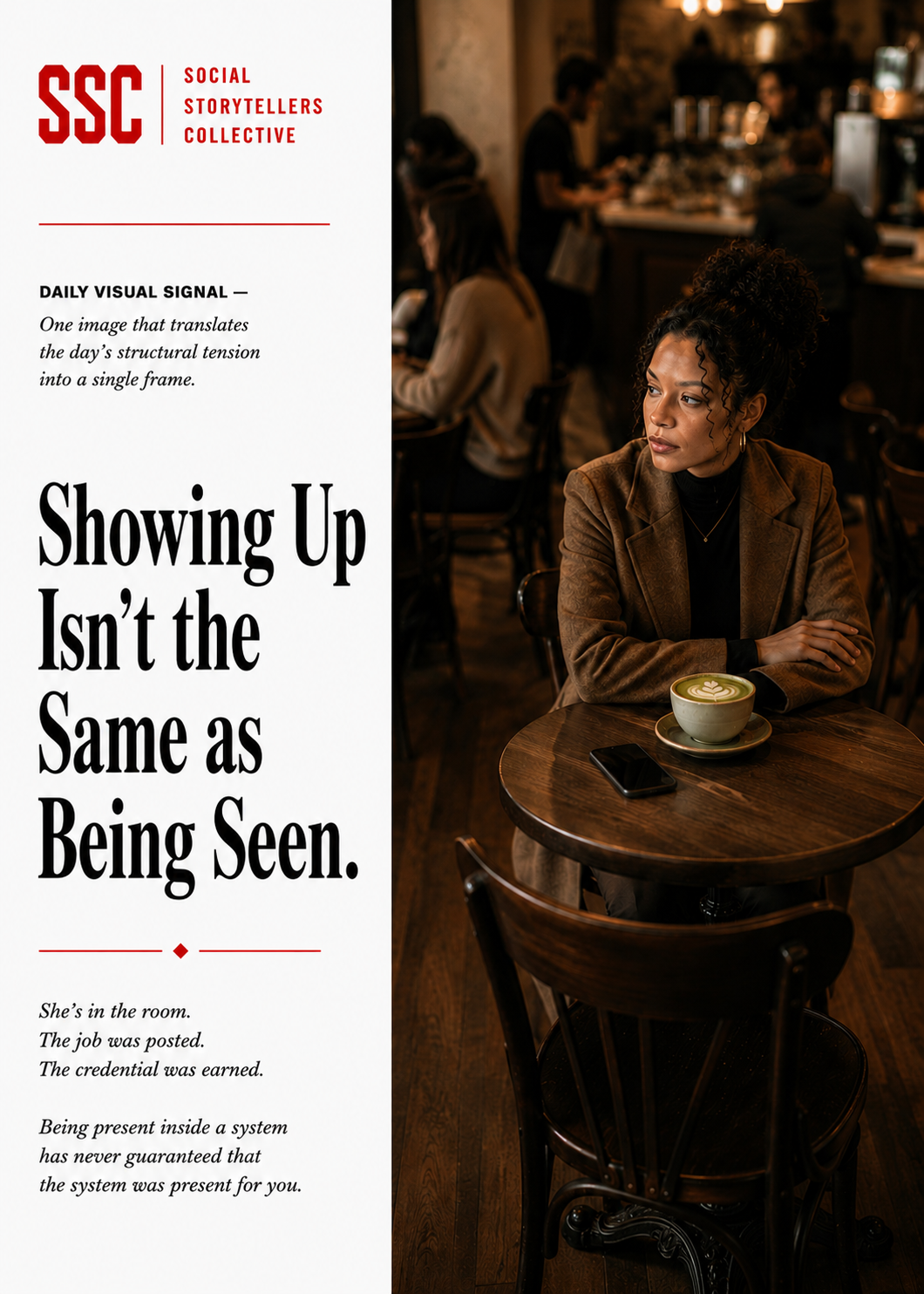
Daily Visual Signal
A visual interpretation of the deeper systems, tensions, and structural shifts shaping the current moment — designed to translate complex societal changes into a single frame.
Featured Story | McDonald’s Next Is a Growth Strategy. It’s Also a Confession.
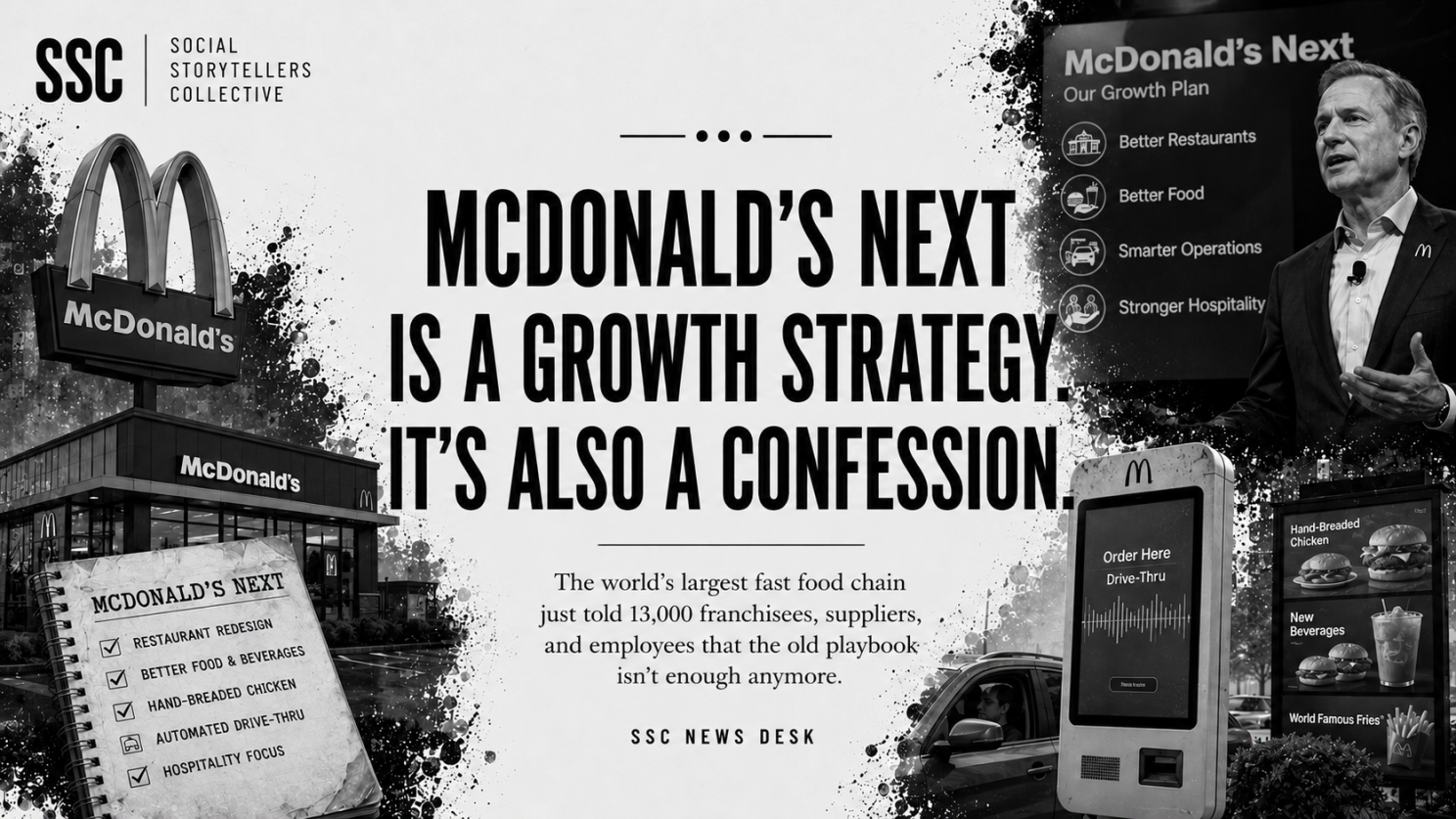
McDonald’s did not unveil a menu update on Monday. It unveiled an identity crisis with a press strategy. The company’s “McDonald’s Next” global growth plan — announced to more than 13,000 franchisees, suppliers, and employees — calls for redesigned restaurants, upgraded food and beverages, hand-breaded chicken items, automated drive-thru ordering, and a renewed focus on hospitality. CEO Chris Kempczinski framed the moment plainly: traditional competitors are upgrading their menus, and a new wave of specialists are emerging. For the largest restaurant chain in the United States, that is a significant thing to say out loud. McDonald’s spent the better part of the last decade competing on price, speed, and ubiquity — a strategy that worked until it didn’t. The “McDonald’s Next” framing is the company acknowledging that the floor of the market is no longer a defensible position by itself. Ray Kroc built the company on value. McDonald’s Next is a bet that value alone is no longer enough to win. The automated drive-thru pilot — five locations, AI-powered ordering — is the detail that lands differently in the parking lot than it does on the earnings call. Read the full piece.
Wednesday’s record is heavier than most. The institutions documented today — detention facilities, hiring systems, performance review structures, fast food labor models — are not failing accidentally. They are producing exactly the outcomes they were built to produce. The communities absorbing those outcomes are the ones who were never centered in the design. We will be watching.
We will be back Thursday. — SSC
All of today’s coverage lives at socialstorytellerscollective.substack.com. The full archive, beat navigation, and every linked piece are best experienced on a computer. If you have been reading and have not yet subscribed, we would be glad to have you with us.