
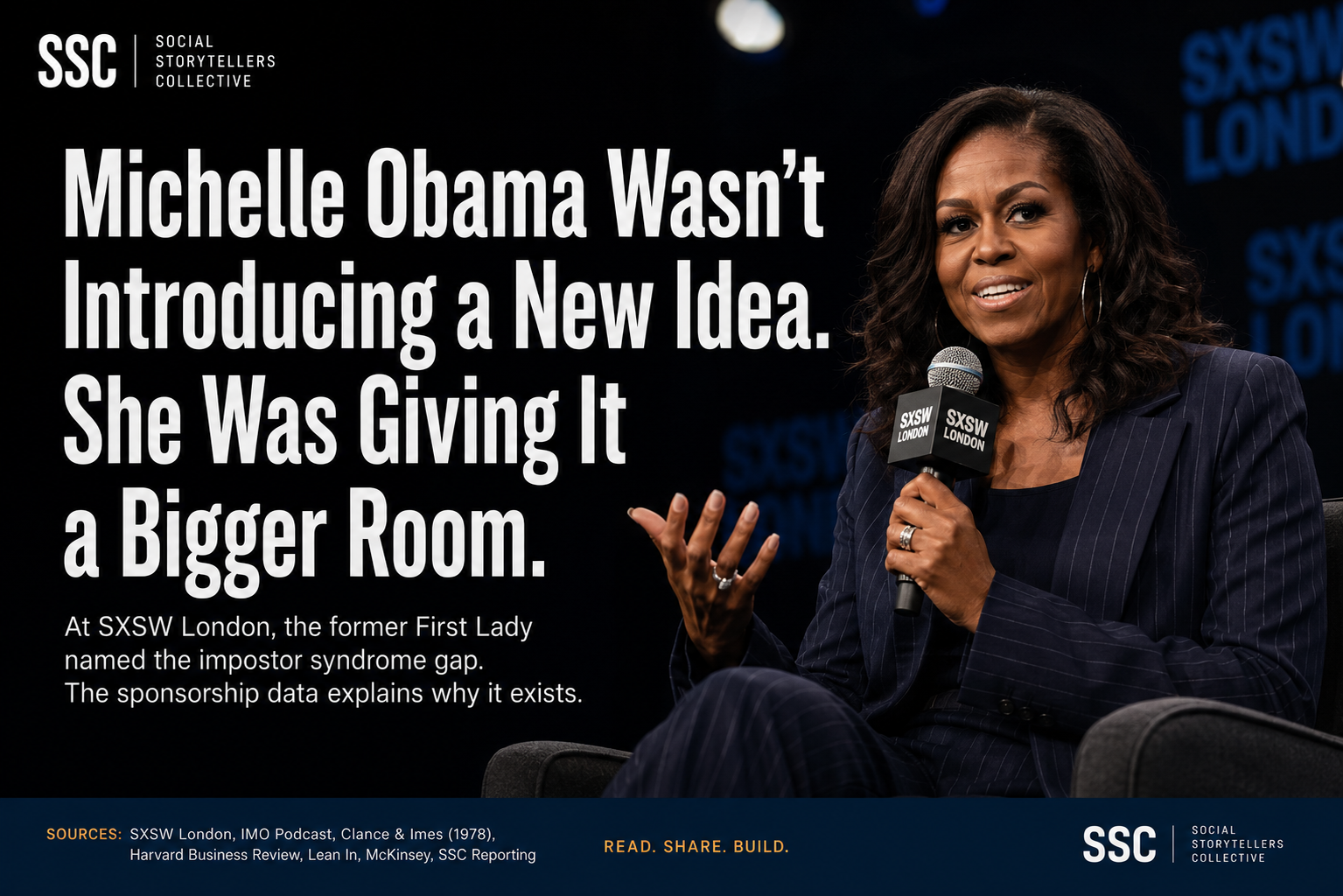
Michelle Obama was not delivering a research paper at SXSW London this week. She was having a conversation with her brother Craig Robinson during a live recording of her IMO podcast. But the observation she made — delivered without hesitation and with the weight of someone who has spent decades in the most consequential rooms in the world — landed with the precision of a well-sourced argument.
“I’ve never heard a white man talk about impostor syndrome,” she said. “I haven’t met one.”
The comment spread immediately. The reaction it generated was predictable — some pushed back, some celebrated, some called it reductive. What was less discussed is why the observation is structurally accurate, and what the evidence behind it actually says about who gets to feel like they belong.
Impostor syndrome — the persistent internal experience of being a fraud despite demonstrated competence — was first documented in 1978 by psychologists Pauline Clance and Suzanne Imes, who studied high-achieving women. Decades of subsequent work have consistently found that it is more prevalent among women, people of color, and first-generation professionals navigating institutions that were not built around their presence. It is less a psychological quirk and more a rational response to environments where the signals of belonging — representation, sponsorship, informal affirmation, cultural familiarity — are unevenly distributed.
That is the part Obama was naming. Not that any individual man lacks self-doubt. But that the architecture of elite institutions was built to make certain people feel like they already belong — and that architecture is not neutral. It is the product of who built those rooms, who was invited into them first, and whose image was hung on the walls. Walking into a space where everyone who came before you looks like you is a form of structural confidence that has never been named as such because it has never needed to be.
SSC made a connected argument this week in Your Career Is Not the Problem. The Translation Is. — that the workers who get translated into opportunity are rarely the ones who got better at articulating their value. They are the ones who had someone in the room advocating for them. Sponsorship — not narrative — is the variable that most consistently determines who advances. The consulting partner who gets passed over for a role she is clearly qualified for does not have an impostor syndrome problem. She has a sponsorship gap — and the institution has an evaluation architecture problem. Obama’s observation and the sponsorship argument are describing the same structural reality from different entry points.
Obama also addressed parenting at SXSW London — arguing that overly involved parenting styles can signal to children that they cannot solve problems independently, undermining the confidence that comes from navigating challenges on their own. The through line between that observation and the impostor syndrome argument is the same: confidence is not a personality trait. It is an infrastructure. It is built by environments that signal belonging, by institutions that invest in people before they have proven themselves, and by the presence of people in power who are willing to say “she is ready” before the evidence is unambiguous.
The comment that went viral this week was seven words. The argument behind it has been documented for nearly fifty years. Michelle Obama did not introduce a new idea at SXSW London. She gave it a room large enough to finally be heard.