
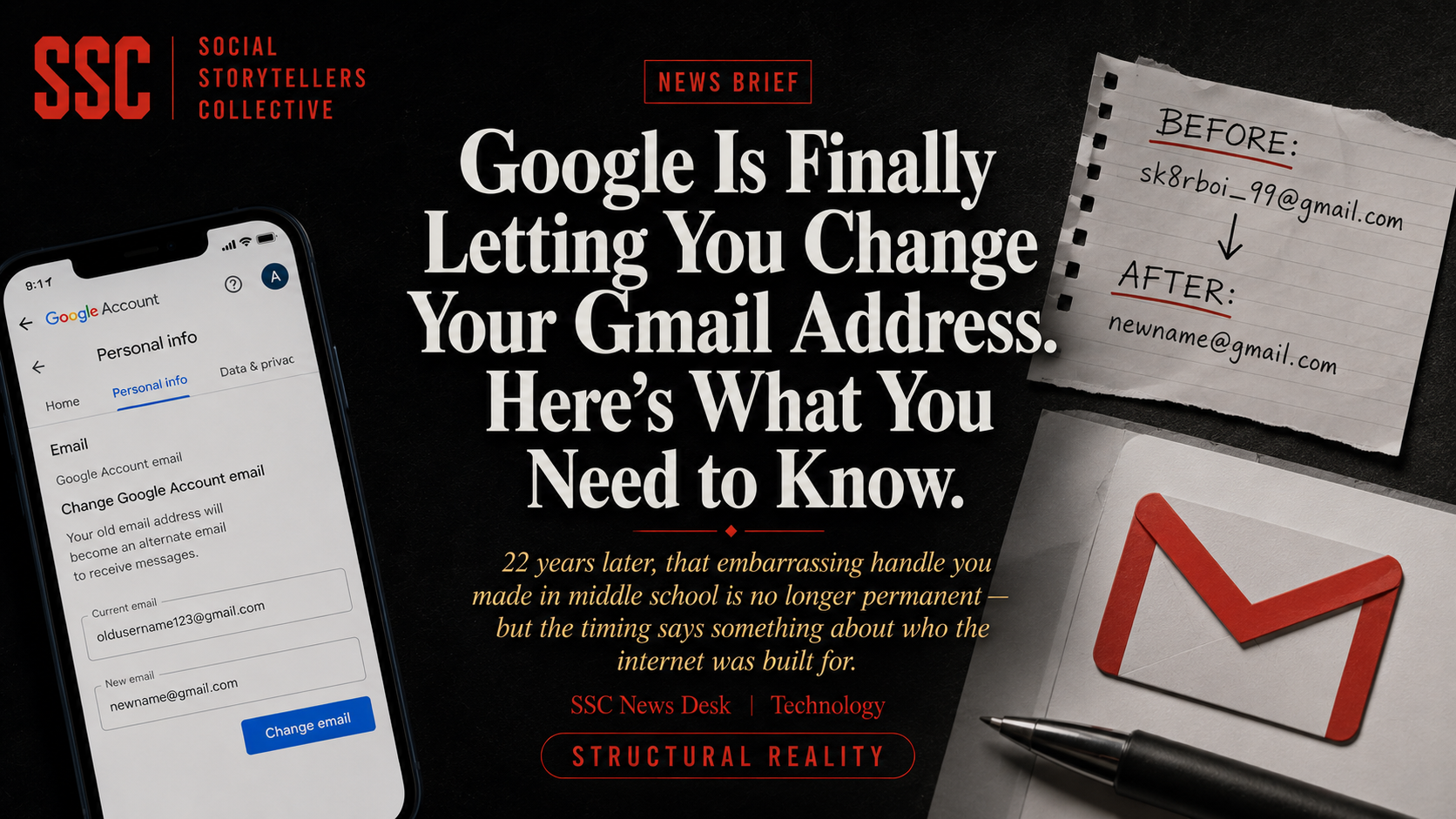
Google has quietly rolled out one of its most requested account features: the ability to change your Gmail address without losing your account history, contacts, or inbox. The update launched late last year in India and is now available to all Google Account users in the United States, with no confirmed timeline yet for other countries. On its face it is a convenience update. Underneath it is an admission that the infrastructure Google built in 2004 was designed for a specific kind of user — and that user was not thinking about a job application, a professional network, or a first impression in a hiring manager’s inbox.
The process is straightforward. Go to your Google Account page, click into Personal Info, then Email, and select Change Google Account email. Enter your new address, confirm, and your old address stays active as an alternate — messages sent to either land in the same inbox. You can switch back anytime through account settings. A few things worth knowing before you move: Google won’t let you create another new address for 12 months after a change, and you can only do this three times total. The new address may not be immediately recognized by third-party apps and services that use your Gmail to log in, so expect friction on outside platforms. Chromebook users may encounter additional issues, and in some cases Google advises reverting to the original address if problems persist.
Here is where the analysis matters. A Gmail address is not just a communication tool. For millions of people it is a professional identity marker — the first thing a recruiter sees before they read a single word of a resume. Research on hiring discrimination has documented that names and contact details signal race, class, and background before credentials are ever evaluated. An email address ending in a nickname, a number, or a domain that reads as informal has functioned for two decades as an invisible filter in a hiring process that was already stacked. Google built a system, handed it to teenagers, and then left those teenagers — now adults trying to navigate a credentialed economy — with no way to update the first impression the system created for them. The fix arriving in 2026 is welcome. The fact that it took 22 years is the part worth sitting with.
CEO Sundar Pichai announced the update on X with a line that landed more honestly than he may have intended: “2004 was a good year, but your Gmail address doesn’t need to be stuck in it.” For the people who made those addresses at 13 and have been professionally penalized for them ever since — quietly, invisibly, in ways they could never fully prove — the update is real progress. It just arrived on a schedule that served the people who built the platform, not the people who needed the fix.