
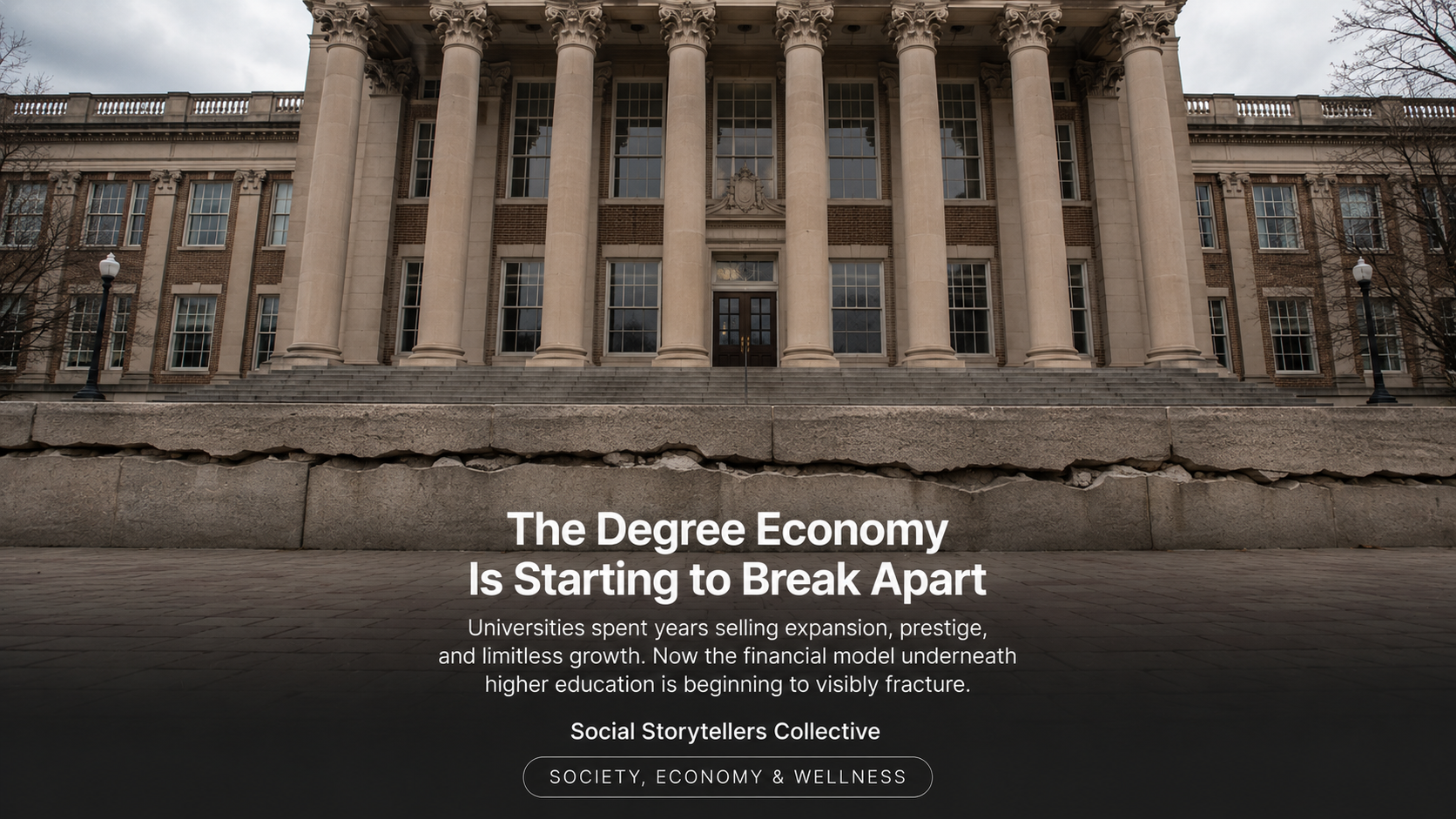
The numbers are arriving quietly but they are not quiet numbers.
Clemson University is carrying roughly $1.5 billion in debt. Syracuse University is closing or pausing 93 academic programs. The University of North Carolina at Chapel Hill plans to reduce spending by $89 million over the next three years. Duke University eliminated approximately 600 jobs as part of a $350 million budget reduction effort. Across Indiana, public colleges announced plans to eliminate or merge 580 programs statewide.
On the surface, these look like separate institutional decisions happening in different regions under different circumstances. They are not. They are symptoms of the same structural problem: the economic model that powered higher education growth for decades is fracturing from nearly every direction at once.
For years, universities operated under a single assumption — that demand would keep expanding indefinitely. Enrollment growth, rising tuition, new facilities, student housing development, athletics expansion, branding campaigns, and administrative layering all became normalized parts of institutional strategy. Colleges borrowed aggressively because the broader culture still treated higher education as a guaranteed pathway to stability and upward mobility. That belief held long enough to build a lot of buildings and take on a lot of debt.
The underlying economics supporting that belief have changed. Demographic declines are reducing the number of traditional college-age students in many parts of the country. Families are questioning tuition costs more aggressively than at any point in recent memory. Employers are quietly reevaluating credential requirements. And students entering adulthood are calculating return on investment in real time rather than accepting the older social contract around degrees without question.
The contract is being renegotiated. Most institutions haven’t sent out the memo.
The financial pressure is especially acute because universities built themselves around a growth model that depended on continuous expansion — then took on the fixed costs that growth model requires. Debt payments don’t soften when enrollment does. Deferred maintenance compounds. Healthcare and labor costs rise. State support stays inconsistent. Meanwhile institutions face pressure to keep tuition increases politically manageable while preserving the appearance of prestige and competitiveness.
That is not a budget problem. It is an architecture problem. And the architecture was built for conditions that no longer exist.
Athletics has become the clearest illustration of the contradiction.
Universities continue investing heavily in sports infrastructure, coaching salaries, conference positioning, and NIL competitiveness even as academic departments face reductions. In many cases, flagship athletic programs function as branding engines designed to drive visibility, alumni engagement, donations, and national relevance. The investment logic made sense when everything else was growing. It looks different when the same institution cutting 600 jobs or eliminating 93 academic programs is simultaneously bidding for a transfer portal quarterback.
The result is a growing perception gap inside higher education itself. Universities continue marketing aspiration, community, and elite experience while internally operating under escalating austerity. The branding has not updated to match the balance sheet.
There is also a labor story unfolding beneath these announcements that is being underreported.
Universities have long presented themselves as relatively stable employers compared to the volatility of the private sector. That stability is weakening. Layoffs, hiring freezes, program consolidations, adjunct dependence, and departmental restructuring are becoming more common across the sector. Faculty, staff, and administrators are increasingly experiencing the same cost-efficiency pressures that reshaped media, tech, retail, and nonprofit organizations over the last decade.
The university is no longer insulated from the broader economic logic of optimization and downsizing. In many cases, it is beginning to mirror it — with one key difference. When a media company cuts staff or a retailer closes stores, the cultural stakes are real but bounded. When universities cut programs and eliminate departments, they are removing pathways. Not just to careers, but to the social networks, civic identities, research ecosystems, and class mobility that higher education has historically represented in American life.
That is why the current instability feels larger than isolated budget cuts. It is.
The emerging signal from SSC’s Degree Economy series is that higher education is entering the same structural transition already experienced by other major American systems. Media discovered audiences would not subsidize inefficiency forever. Retail discovered scale alone did not guarantee durability. Tech discovered growth without profitability eventually gets punished.
Universities may now be confronting a similar reckoning — and the stakes are higher, because the degree was never just a credential. It was the promise. The thing American institutions pointed to when someone asked how you get from where you are to where you want to be.
The institutions that survive this era will be the ones able to answer a question the growth model never had to answer: not just what education costs, but what it is concretely worth in a labor market, housing economy, and social landscape where stability itself feels increasingly difficult to secure.
That question is no longer theoretical. The program cuts and debt loads arriving in today’s headlines are the first drafts of the answer.