
Children born in 2025 will enter the workforce sometime around 2043. By that point, the labor market, the educational infrastructure, and the institutional models that previous generations used to build economic stability will have undergone transformations that are already underway. The viral social media posts framing these children as “Generation Beta” are capturing something real — not because the slides are precise, but because the anxiety driving their spread is grounded in evidence that most people can feel even when they cannot fully name it.
This is not a piece about Instagram content. It is a piece about what the world this generation is inheriting actually looks like when you examine it structurally rather than through the optimistic or catastrophist frames that tend to dominate the conversation.
What the Labor Market They Will Enter Is Already Becoming
The projections circulating in Generation Beta content — that 40% to 60% of current jobs could be transformed by automation and AI by 2035 — are drawn from legitimate research. McKinsey, MIT, and Stanford researchers have all produced work pointing in similar directions, though with important nuances about the difference between job transformation and job elimination. The nuance matters. AI is not simply removing roles from the economy. It is restructuring what roles require, who gets hired into them, and what the entry-level pipeline looks like for workers who have not yet built the experience or credentials that make them harder to displace.
As SSC covered in its analysis of Dario Amodei’s recent comments on AI and labor, the CEO of Anthropic — one of the companies actively building this technology — said publicly that artificial intelligence could eliminate roughly half of all entry-level white-collar jobs within the next one to five years. The sectors he named were finance, consulting, law, and technology. Those are precisely the industries that have functioned as the primary destination for college graduates seeking professional stability. Generation Beta will not encounter a labor market where those pathways are uncertain. They will encounter a labor market where those pathways have already been reorganized around whatever comes next — and the reorganization is happening now, while they are still in diapers.
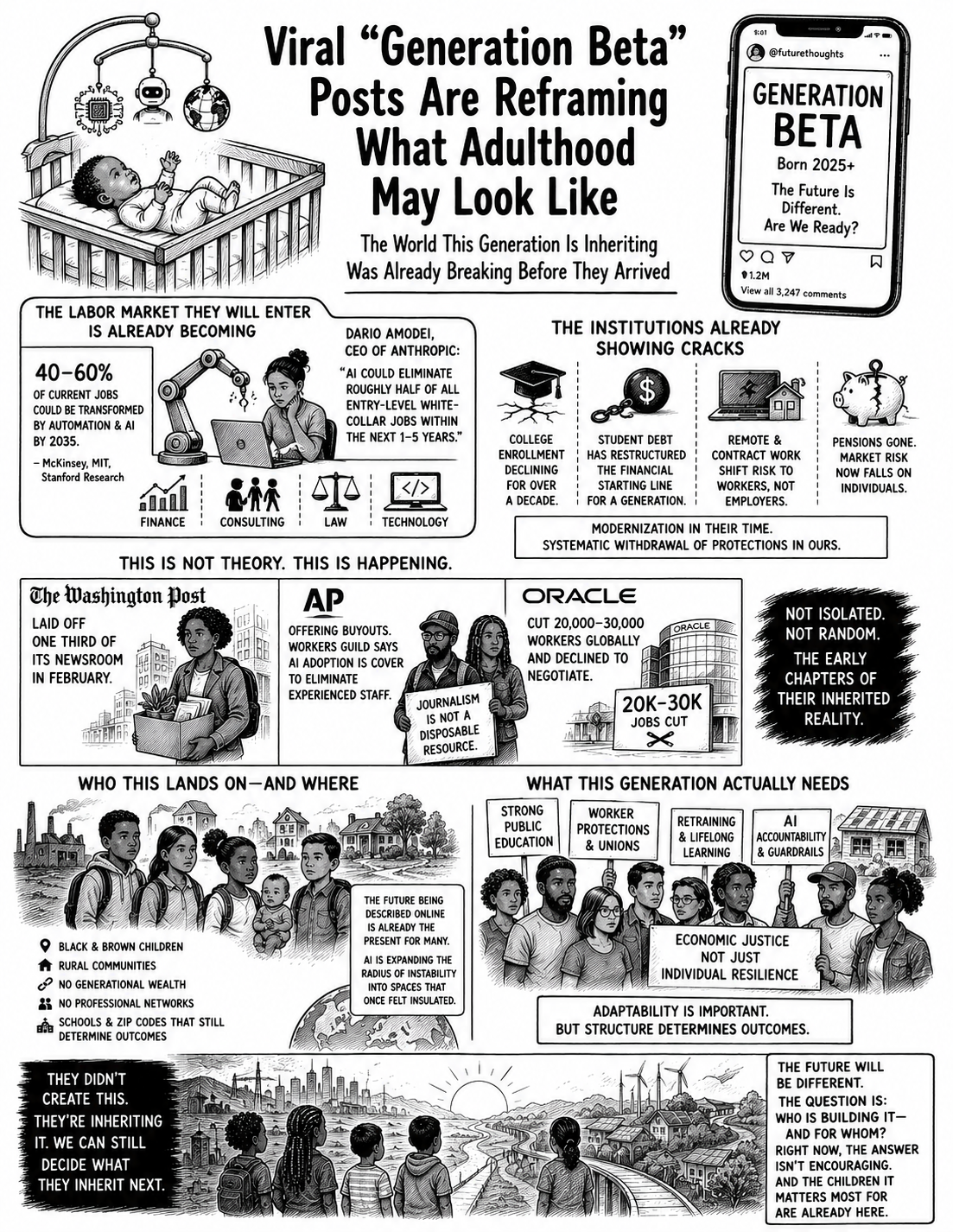
The Washington Post laid off a third of its newsroom in February. The Associated Press is offering buyouts while its workers guild publicly accuses leadership of using AI adoption as cover for eliminating experienced staff. Oracle cut between 20,000 and 30,000 workers globally and declined to negotiate. These are not isolated events. They are the early chapters of a transition that Generation Beta will inherit as settled history.
The Institutions Already Showing Cracks
The Generation Beta conversation online tends to frame the disruption of traditional institutions — four-year degrees, corporate office structures, linear career tracks, pension systems — as something that will happen to this generation. The more accurate framing is that it is already happening to the generations immediately preceding them, and the evidence is accumulating faster than the institutional response.
College enrollment has been declining for over a decade. Student debt has restructured the financial starting point of an entire generation of workers in ways that compound across decades. Remote and contract-based labor has shifted risk from employers to workers without a corresponding shift in compensation or security. Pension systems have largely given way to retirement models that require individuals to absorb market risk that previous generations never carried. Each of these transitions was presented at the time as modernization. In aggregate they represent a systematic withdrawal of institutional protection from working people — a withdrawal that was well underway before generative AI accelerated the timeline.
Generation Beta will not be the first cohort to encounter a world where the traditional pathway does not automatically deliver what it promised. They will be the cohort that encounters it after the pathway has been visibly dismantled for long enough that no one can credibly argue the dismantling is temporary.
Who This Lands On and Where
The Generation Beta framing circulating online treats the future as a shared experience — a universal transition into a new kind of adulthood that will affect everyone born after 2025 in roughly the same way. That framing is where the viral content most significantly breaks from the structural reality.
The children who will absorb the most concentrated impact of AI-driven labor disruption, institutional erosion, and credential devaluation are already identifiable. They are the children being born right now into households without generational wealth, without professional networks, without access to the schools and zip codes that continue to determine life outcomes in ways that technology has not disrupted and is not likely to disrupt on its own. They are disproportionately Black and Brown children, children in rural communities, children whose parents are already navigating the labor market instability that the Generation Beta posts are predicting as a future condition.
The future being described in those posts is already the present for a significant portion of the population. What is new is that AI is expanding the radius of that instability outward — into professional and white-collar categories that previously felt insulated from it. The anxiety driving the viral spread of Generation Beta content is, in part, the anxiety of people who are only now encountering economic precarity that other communities have navigated for generations without the cultural moment and the Instagram slides.
What This Generation Actually Needs
The skills the Generation Beta posts emphasize — adaptability, emotional intelligence, critical thinking — are real and worth developing. They are also insufficient as a policy framework. Individual adaptability has never been an adequate substitute for structural protection, and the history of technological transition is consistent on this point. The workers who fared best during previous waves of automation were not simply the most adaptable individuals. They were the workers with union protections, institutional safety nets, access to retraining infrastructure, and political representation that made their displacement politically costly.
Generation Beta will need those things too. What they are currently inheriting instead is a policy environment that is actively dismantling the institutional infrastructure that would provide them — reduced federal investment in public education, erosion of labor protections, rollback of the diversity and access initiatives that were beginning to widen the aperture of who gets to participate in professional economies, and an AI governance framework that is years behind the deployment curve.
The viral posts are right that this generation will grow up differently. The question SSC is positioned to ask is not whether the future will be different — it will be. The question is who is building the structures that will determine whether that difference is survivable for the children who are born without a cushion to absorb it. Right now the answer to that question is not encouraging. And the children it matters most for are already here.