

Bumble’s latest earnings report revealed a contradiction that increasingly defines the dating app economy: revenue pressure and user decline alongside rising profitability and heavier investment in AI infrastructure. The company reported that paying users fell 21.1% year-over-year to 3.2 million in the first quarter of 2026, continuing a multi-quarter decline that reflects growing fatigue with traditional swipe-based dating platforms. Total revenue dropped 14.1% to $212.4 million. Yet despite the shrinking user base, Bumble increased profits substantially by reducing marketing expenses and raising average revenue per paying user by nearly 9%. Fewer people. More money per person. That is not a failing business model. It is a pivot.
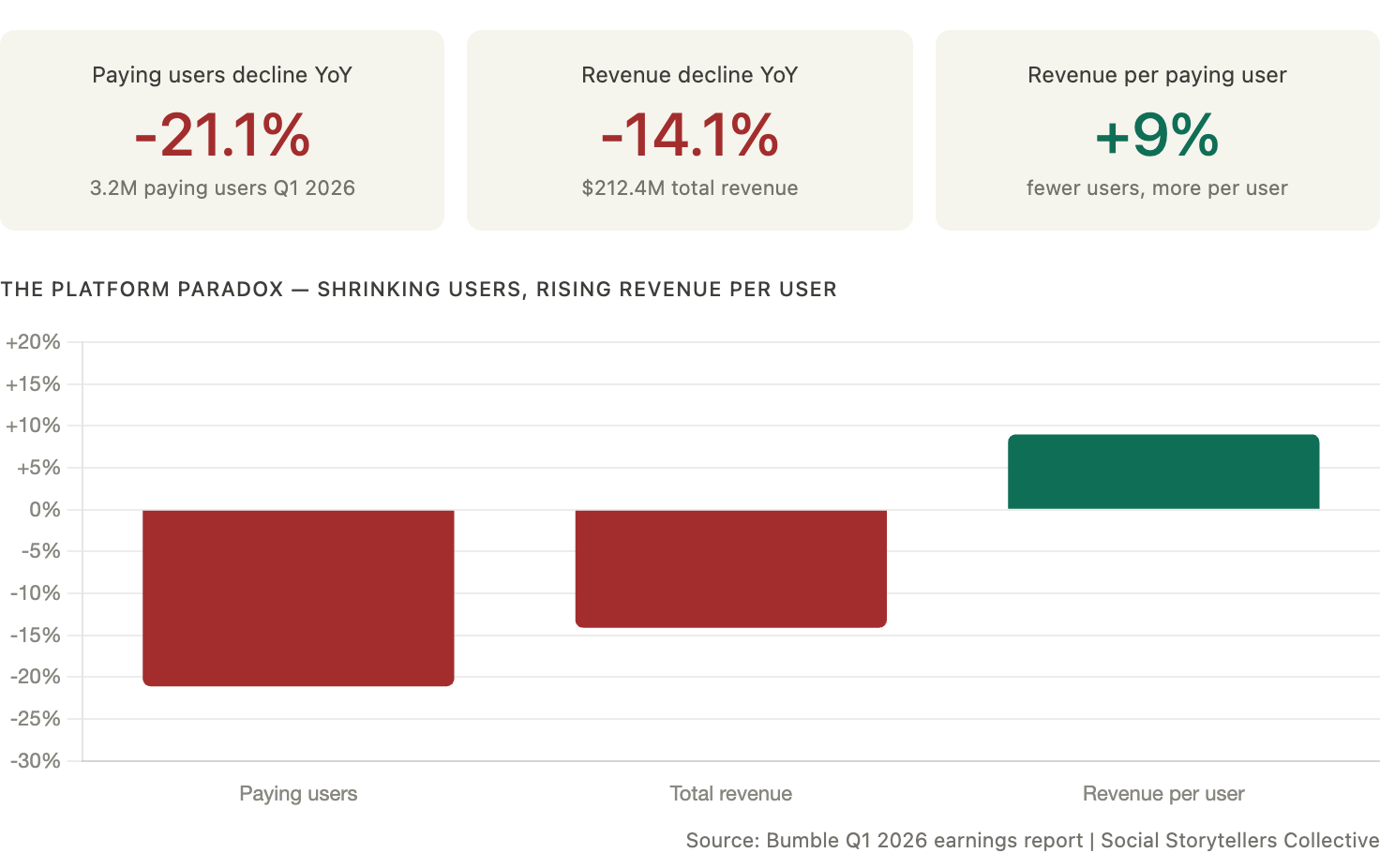
The company’s response is not simply a redesign. It is an attempt to fundamentally reposition how dating apps function. During Bumble’s investor call, founder and CEO Whitney Wolfe Herd framed the decline as an intentional “reset” focused on attracting more serious and engaged users rather than maximizing scale. That language matters because it signals a broader shift happening across digital platforms: growth-at-all-costs models are colliding with user exhaustion, declining trust, and engagement patterns that no longer produce the outcomes platforms originally promised. In Bumble’s case, the company is openly acknowledging what many users have been saying for years — that endless matching does not necessarily translate into meaningful connection.
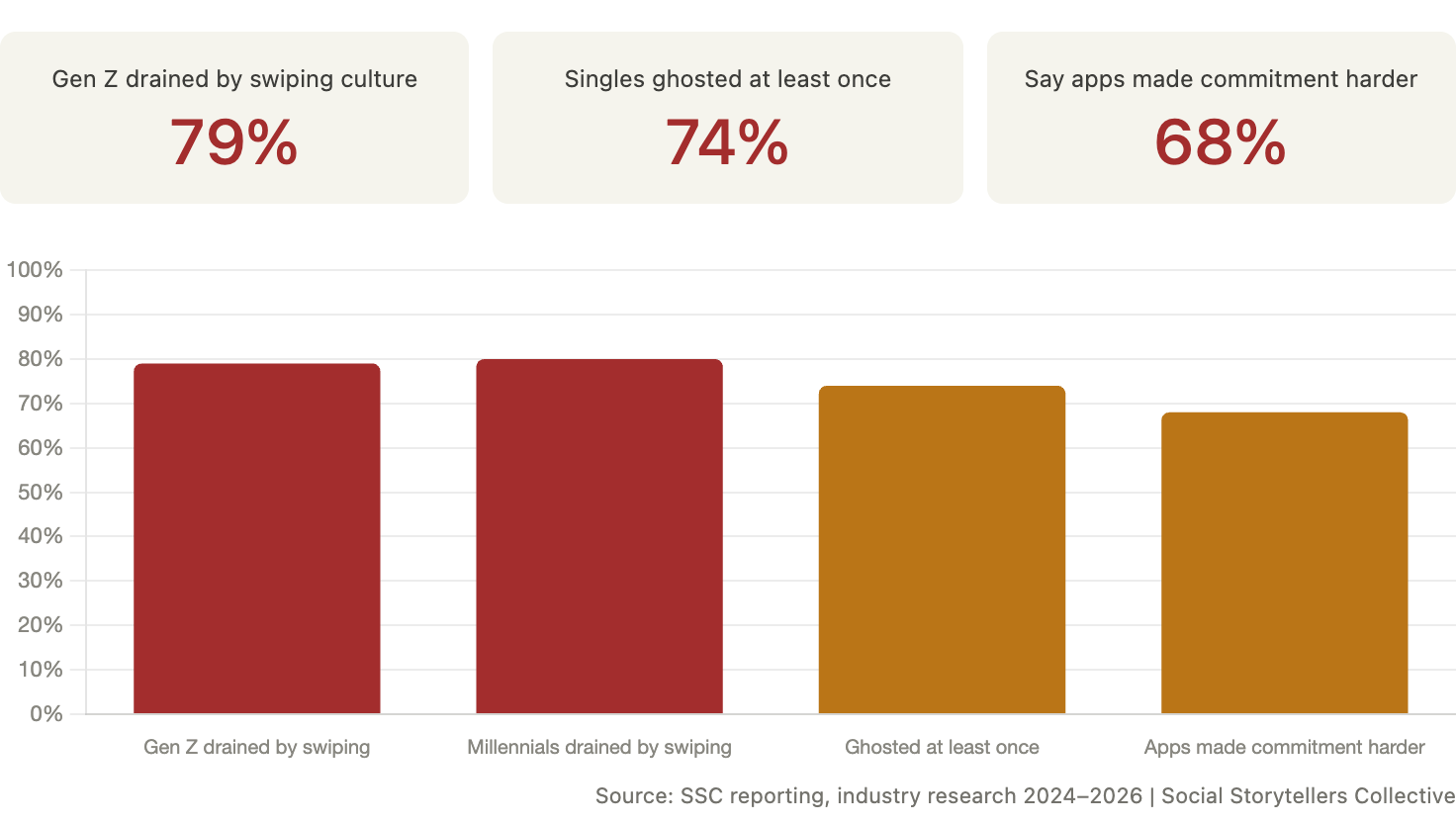
That acknowledgment is overdue. As Dating Apps Didn’t Break Dating — They Exposed It documented, 79% of Gen Z and 80% of Millennials report being drained by endless swiping culture, 74% of daters have been ghosted at least once, and 68% of single Americans say dating apps have made commitment more difficult. Those numbers describe a user base that is exhausted — not disinterested in connection, but burned out on the infrastructure meant to facilitate it. And as Dating App Fatigue Has Created a Market for Scarcity and Slowness showed, the response is already underway: slow dating, matchmaking services, and community-based introductions are growing among people who have calculated that the emotional cost of the app experience exceeds its return. Bumble’s “reset” framing is a corporate acknowledgment of what users have been doing individually for years.
At the center of Bumble’s strategy is a major AI-powered overhaul expected to roll out in phases through late 2026 and early 2027. The company is replacing its older platform with a cloud-native infrastructure designed to improve compatibility recommendations, accelerate feature deployment, and personalize the dating experience more aggressively. Its new AI assistant, “Bee,” is being positioned less like a traditional algorithm and more like a digital matchmaker — one that learns users’ communication styles, preferences, and relationship goals before suggesting connections. The company is also experimenting with more detailed “chapter-style” profiles and features designed to move users from online interaction to real-world meetings more efficiently.
The strategic bet is clear: depth over volume. A smaller, more committed user base paying more per month is more defensible than a large, disengaged one churning through free tiers. Whether AI can deliver the kind of compatibility that actually produces meaningful connection — rather than just more sophisticated filtering of the same exhausted pool — is the question Bumble’s next two years will answer. The infrastructure is being rebuilt. The human problem it is trying to solve has not changed.