
Emma Grede is not just a media personality offering career advice. She is a co-founder of multi-billion-dollar consumer brands including SKIMS and Good American, operating at the intersection of celebrity, capital, and global retail. Her proximity to power is institutional — shaped by partnerships, ownership structures, and access to networks that define how opportunity circulates at the highest levels of business. That positioning is what gives her voice weight. It is also what makes the reception of that voice uneven.

The moment that triggered the backlash was specific. Grede appeared on multiple high-visibility podcasts — including a conversation with Keke Palmer — where she framed visibility as a defining condition for career advancement. Being physically present, in-office, proximate to power. The argument itself was not new. What made it travel was where it landed and who was expected to receive it.
The response did not stay at the level of disagreement. It moved quickly into pattern recognition. Black audiences were not being engaged as a core constituency — they were being used as a visibility engine, spaces where conversation generates reach that converts elsewhere. Another response put it more directly: every time attention flows toward voices that do not center Black women’s realities, that attention functions as unpaid labor, amplifying ideas that were never designed to materially serve them.
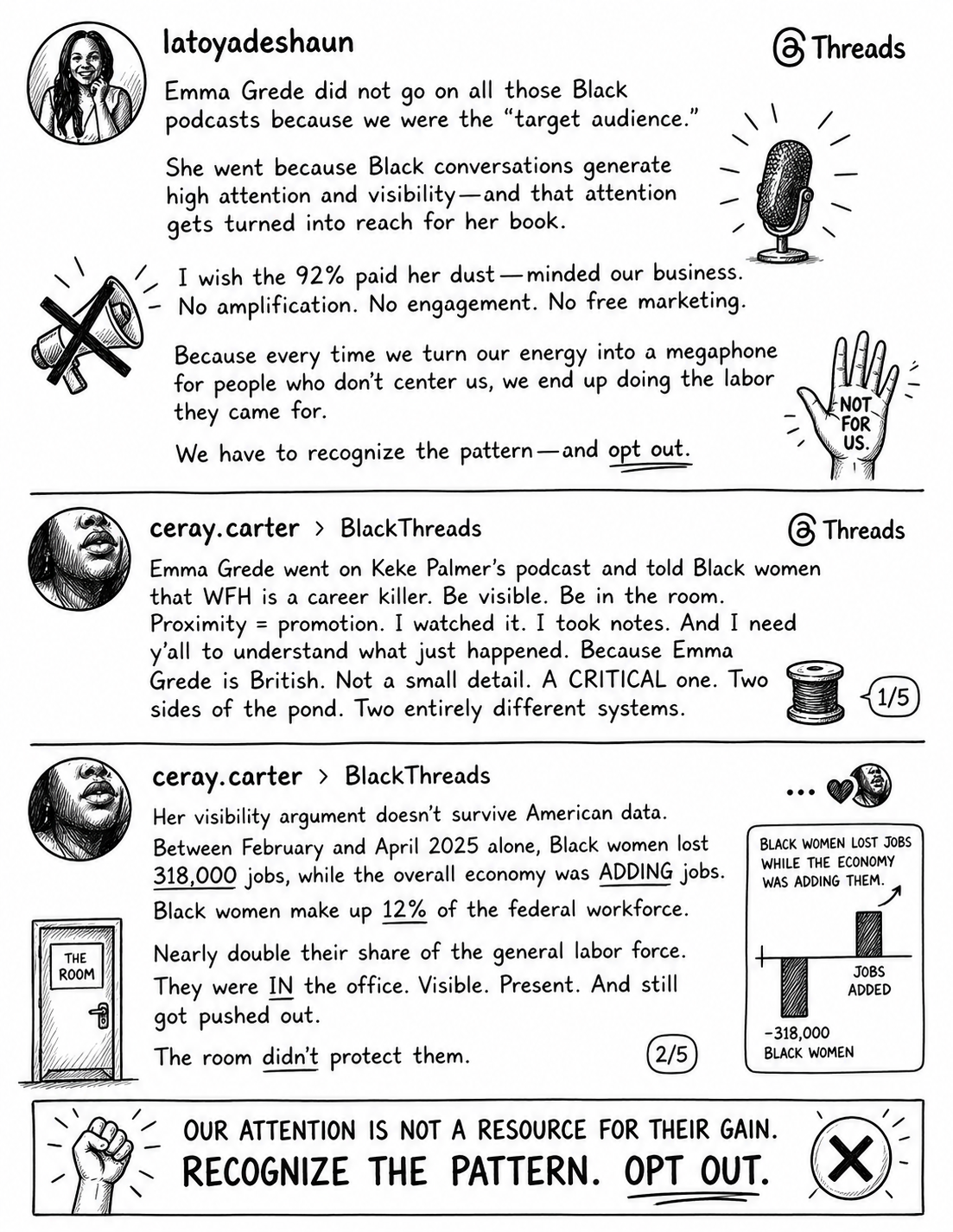
That critique is grounded in measurable conditions. Between February and April 2025, Black women lost approximately 318,000 jobs while the broader U.S. economy was adding employment — a divergence that complicates any narrative that proximity alone produces stability. The idea that being in the room is protective does not hold consistently across systems where access and retention are unevenly distributed. Visibility does not function as a guarantee. It functions as exposure within a structure that still determines outcomes unevenly.
There is another layer to how this is being received that the backlash has named but mainstream coverage has largely avoided. Grede is mixed-race — the daughter of a white English mother and a Trinidadian father, raised in East London, and by her own account someone who did not think seriously about race until she moved to the United States. She identifies as Black and has been celebrated as such, most visibly as the first Black female investor on Shark Tank. But her appearance — light-complexioned, racially ambiguous to many viewers — and her stated distance from American racial consciousness place her in a complicated position when she is speaking to and about Black women’s professional realities. The critique is not simply about what she said. It is about who is perceived to be saying it, from what structural position, and whether that position carries the accountability the audience is looking for. Grede benefits from Black cultural alignment — Black-led platforms, Black media celebration, Black audience reach — while simultaneously embodying a proximity to whiteness, wealth, and Kardashian-adjacent power that insulates her from the conditions she is describing. That gap is not incidental to the backlash. It is central to it. When the advice is “be visible, be in the room,” and the person delivering it has never had to navigate the specific penalties Black women face for doing exactly that, the structural mismatch is not just about the content of the message. It is about who gets to deliver it without consequence.
The tension is not about whether visibility matters. It is about how it operates depending on where you are positioned. In environments where networks are closed and power is concentrated, proximity can accelerate access. In systems already shaped by bias and precarity, visibility does not neutralize risk — it can increase scrutiny without increasing protection. Being present and visible does not prevent displacement when the system itself is designed to filter who remains.
That distinction becomes sharper when you look at how the message moved. Black-led platforms consistently generate cultural velocity — shaping discourse and driving engagement far beyond their immediate audiences. That reach is structural. These spaces convert conversation into visibility that travels. The contradiction is that the same audiences generating that reach are not always positioned to benefit from where it goes. Engagement becomes labor — attention, discourse, circulation — that creates value without guaranteeing return. Amplification without alignment means doing the work of distribution for ideas that do not materially redistribute opportunity.
This is not simply about whether Grede’s advice is valid in isolation. It is about whether that advice translates across systems with different rules, different risks, and different outcomes. Visibility framed as a universal strategy assumes neutrality. It is not neutral. It is mediated by structure — and that structure does not treat everyone in the room the same way.
What is being surfaced here is not new. It is a pattern becoming more legible. Black audiences shape cultural conversation, drive engagement, and define what moves, while simultaneously navigating structural conditions that limit how that influence converts into stability or power. The gap between those two realities is where the friction lives.
Audiences are becoming more precise about where their attention goes and what it builds. The question is no longer just who has a platform. It is who that platform ultimately serves — and who is doing the work to make it matter.