
A coalition of civil rights groups issued a travel advisory ahead of the 2026 FIFA World Cup warning that visitors could face arbitrary entry denials, device searches, and detention at U.S. borders. The warning lands as the tournament prepares to span 16 cities across North America, including 11 in the United States, where host economies are projecting billions in tourism revenue tied to international arrivals. The contradiction is immediate: the same infrastructure designed to welcome the world is governed by systems that can selectively restrict who moves through it.
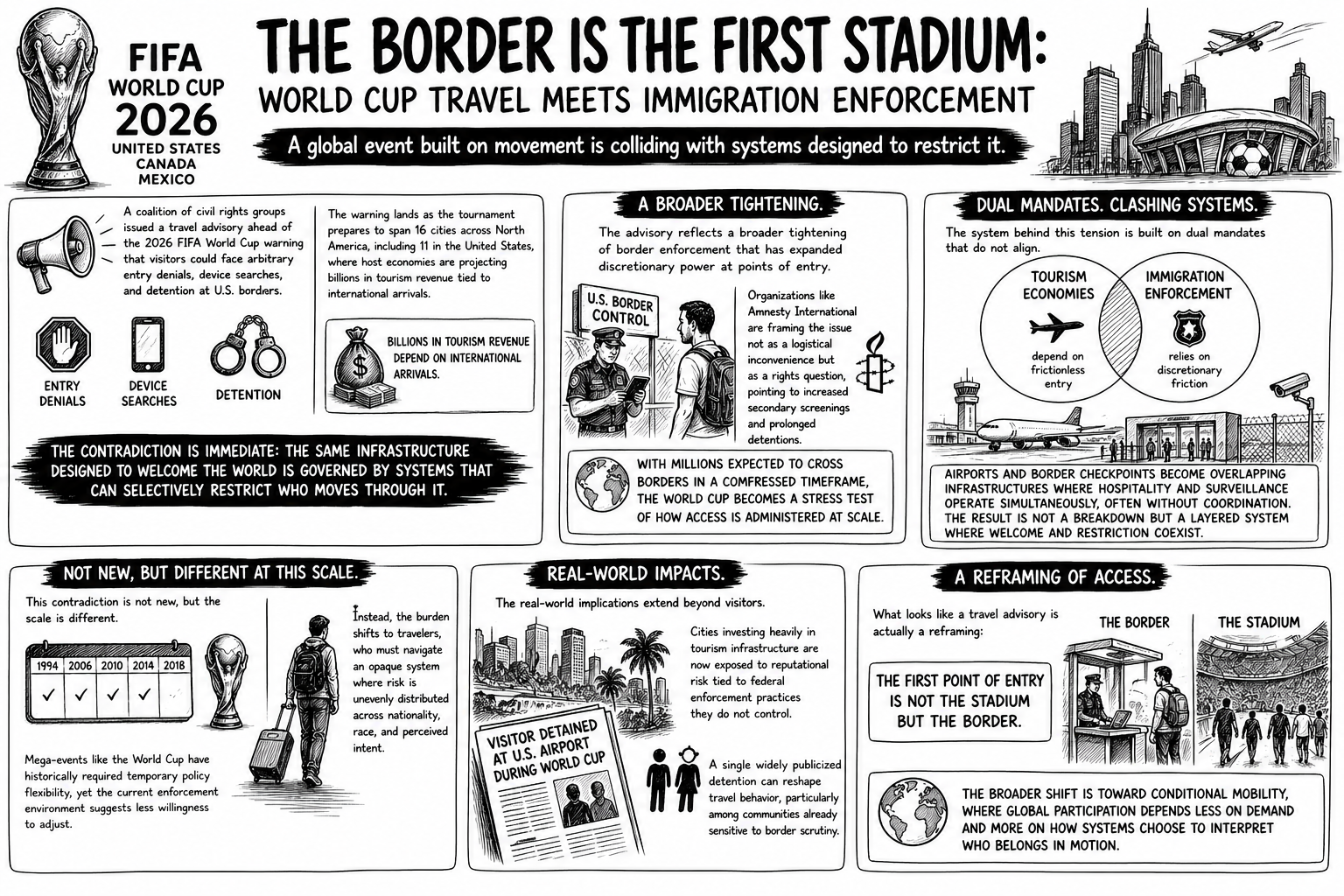
The advisory reflects a broader tightening of border enforcement that has expanded discretionary power at points of entry. Organizations like Amnesty International are framing the issue not as a logistical inconvenience but as a rights question, pointing to increased secondary screenings and prolonged detentions. With millions expected to cross borders in a compressed timeframe, the World Cup becomes a stress test of how access is administered at scale.
The system behind this tension is built on dual mandates that do not align. Tourism economies depend on frictionless entry, while immigration enforcement relies on discretionary friction to function. Airports and border checkpoints become overlapping infrastructures where hospitality and surveillance operate simultaneously, often without coordination. The result is not a breakdown but a layered system where welcome and restriction coexist.
This contradiction is not new, but the scale is different. Mega-events like the World Cup have historically required temporary policy flexibility, yet the current enforcement environment suggests less willingness to adjust. Instead, the burden shifts to travelers, who must navigate an opaque system where risk is unevenly distributed across nationality, race, and perceived intent.
The real-world implications extend beyond visitors. Cities investing heavily in tourism infrastructure are now exposed to reputational risk tied to federal enforcement practices they do not control. A single widely publicized detention can reshape travel behavior, particularly among communities already sensitive to border scrutiny.
What looks like a travel advisory is actually a reframing: the first point of entry is not the stadium but the border. The broader shift is toward conditional mobility, where global participation depends less on demand and more on how systems choose to interpret who belongs in motion.