
Houston’s city council voted 13–4 this week to revise its ordinance limiting police cooperation with federal immigration authorities. The vote did not emerge from a gradual policy reconsideration. It came as a response to a deadline backed by money — and SSC readers have been watching it build in real time.
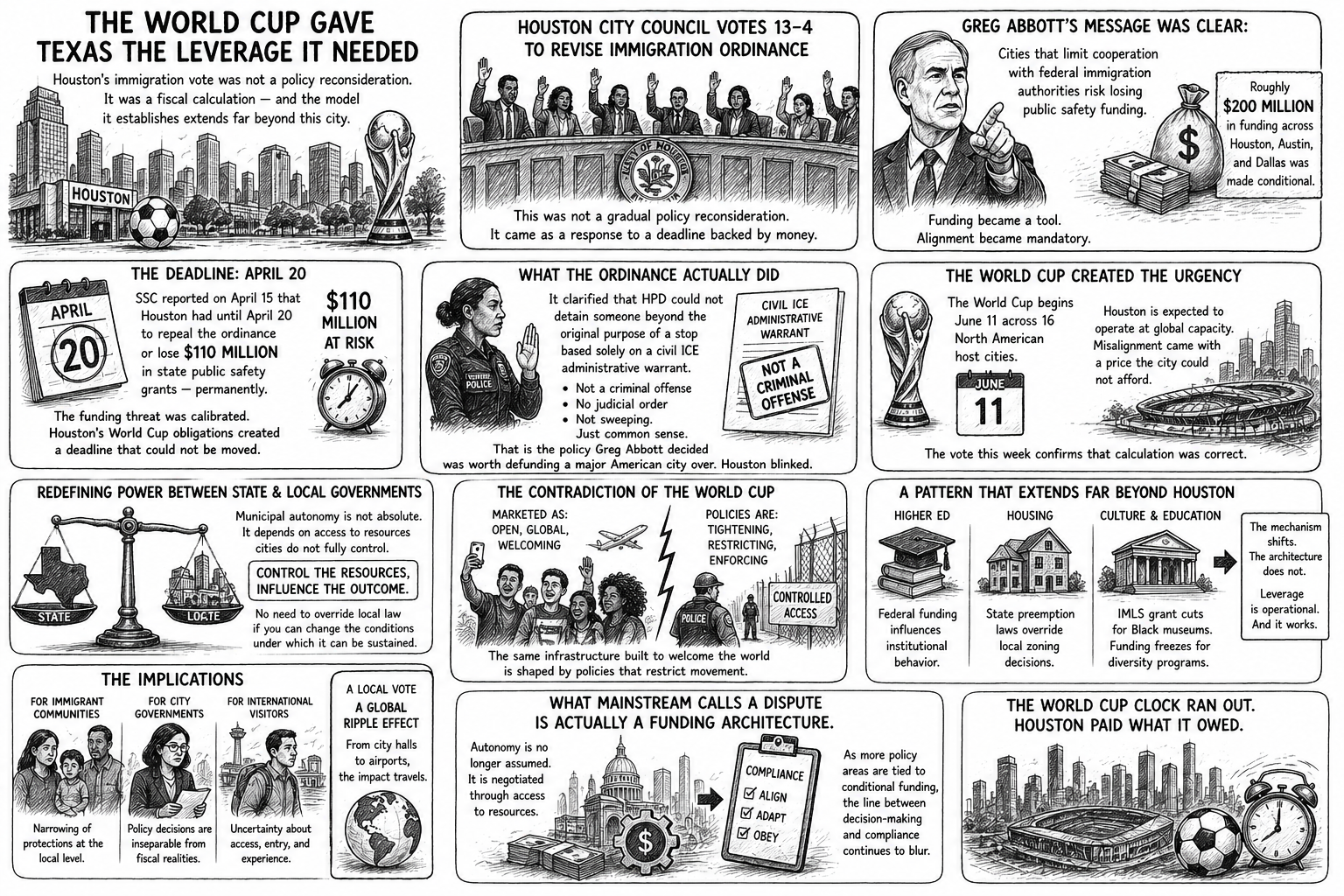
SSC reported on April 15 in Houston’s Immigration Standoff Has a World Cup Clock on It that the city had until April 20 to decide whether to repeal the ordinance or face the permanent loss of $110 million in state public safety grants. The ordinance itself was not sweeping. It clarified that Houston police officers could not detain someone beyond the original purpose of a stop based solely on a civil ICE administrative warrant — a document that does not allege a criminal offense and does not carry the force of a judicial order. That is the policy Greg Abbott decided was worth defunding a major American city over. Houston blinked.
Governor Abbott signaled that cities maintaining limits on cooperation with federal immigration authorities could lose access to funding tied to public safety and international event preparation. Roughly $200 million in funding across Houston, Austin, and Dallas was positioned as conditional — linking local policy choices to state-controlled financial resources. The World Cup, scheduled to begin June 11 across 16 North American host cities, created the urgency. Local officials were not just weighing immigration policy. They were calculating the cost of misalignment in a moment when the city is expected to operate at global capacity. As SSC noted in April, the funding threat was calibrated precisely because Houston’s World Cup obligations created a deadline that could not be moved. The vote this week confirms that calculation was correct.
What is unfolding is a redefinition of how power moves between state and local governments. Municipal autonomy is often treated as a stable principle — it is not. It is contingent on access to resources that cities do not fully control. The state does not need to directly override local law if it can alter the conditions under which that law can be sustained. Public safety funding becomes a mechanism of alignment, not just support. The leverage is not hidden. It is operational, and it is effective.
The contradiction is embedded in the World Cup’s own framing. The event is being marketed as an economic and cultural opportunity expected to bring millions of visitors and billions in spending across host cities. That narrative depends on openness, movement, and access. At the same time, the policy environment surrounding it is tightening around immigration enforcement — creating a parallel system that regulates who can enter and under what conditions. The same infrastructure being built to welcome the world is being shaped by policies that restrict movement. The tension is structural, and it is playing out in real time.
The pattern extends beyond Houston — and SSC has been tracking it across multiple pressure points simultaneously. In Museums Aren’t Just Losing Funding. They’re Losing Control., we documented how the Institute of Museum and Library Services was gutted and hundreds of grants terminated at cultural institutions that refused to remove what the administration called “divisive narratives” — with Black museums absorbing a disproportionate share of the damage. In The Federal Government Has Officially Reframed DEI as Risk, we traced how federal contracting policy repositioned diversity initiatives as liabilities, forcing universities, nonprofits, and cultural institutions to choose between their programming and their funding. The mechanism shifts depending on the target — immigration enforcement here, cultural programming there, diversity commitments somewhere else. The architecture does not shift. Control the resources, and you influence the outcome without needing to formally control the process.
The implications are immediate and layered. For immigrant communities, the shift signals a narrowing of protections at the local level. For city governments, it confirms that policy decisions are inseparable from fiscal realities. For international visitors, it introduces uncertainty into what is supposed to be a globally accessible event. A decision made in a Houston council chamber becomes part of an experience that extends to airports, border crossings, and public spaces across the country.
What mainstream coverage frames as an immigration dispute is more accurately a funding architecture doing what it was designed to do. Houston’s vote makes visible a broader shift in how governance operates: autonomy is no longer assumed. It is negotiated through access to resources. As more policy areas become tied to conditional funding, the line between decision-making and compliance continues to blur — reshaping not just what cities do, but how they are able to decide at all.
The World Cup clock ran out. Houston paid what it owed.