
A viral post this week from a Miami-based influencer framed fitness as geography. On a cruise, he wrote, he moves from a “Miami 5” to an “8 or 9,” attributing the shift to being outside what he called a “bubble of hot people.” The follow-up went further, suggesting that outside major cities, people “give up” physically by their 30s. The reaction online was immediate — not just because of tone, but because the statement exposed something deeper about how fitness, aging, and desirability are being interpreted.
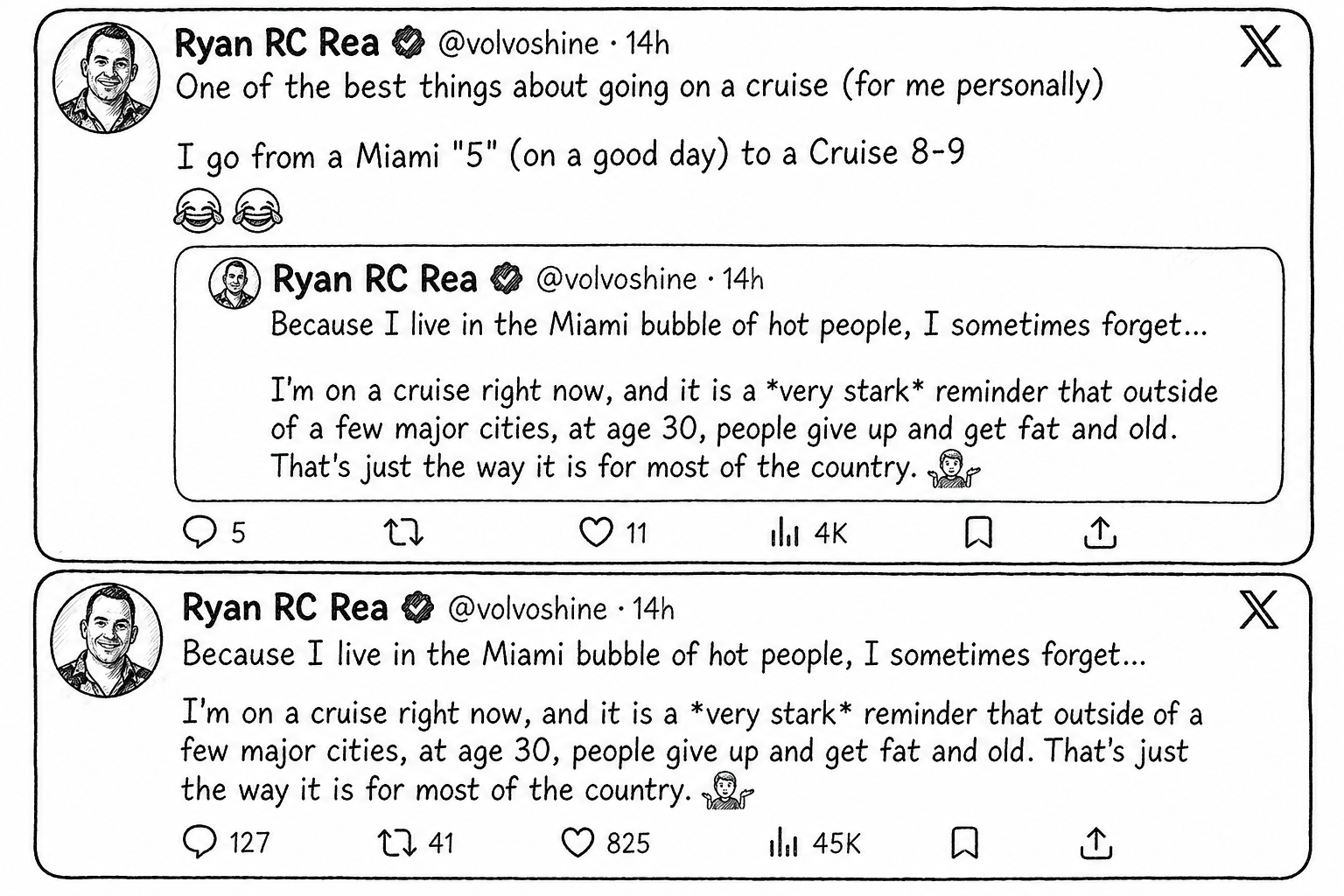
The structural argument underneath the post is worth engaging. And then there is what that argument erases entirely when the body being evaluated is a woman’s.
Fitness is not evenly distributed, but it is not a simple function of personal discipline either. It is shaped by infrastructure. Major cities like Miami, Los Angeles, and New York concentrate access — gyms on every corner, walkable neighborhoods, outdoor fitness culture, and industries where image carries direct economic value. That environment creates a feedback loop where maintaining a certain look is not just aesthetic. It is professional. It is survival. Outside those environments, walkability drops, food environments shift toward convenience, time becomes more constrained, and sustaining the same outcomes requires significantly more individual effort without the same structural scaffolding. The result is not that people give up. It is that the system stops holding them up.
The cruise setting in the post is also instructive. Cruises gather a specific demographic shaped by disposable income and leisure time — they are not a neutral cross-section of the population. Comparing Miami to a cruise ship audience creates a distorted baseline. The perceived shift in attractiveness is less about people changing and more about the comparison set changing. The body did not change. The context did.
That recalibration is happening constantly. Social media collapses geographies — people in smaller cities compare themselves to the most optimized bodies in the most resourced environments, without access to the conditions that produce those outcomes. What gets framed as a personal shortcoming is almost always a structural mismatch. The language of giving up is doing the moral work of hiding that mismatch behind individual blame.
Now let me tell you what this conversation looks like from where I am standing.
The influencer’s post is framed as an observation about fitness geography. It is not a neutral observation. It is a man publicly rating women’s bodies on a numerical scale and using geographic location as the explanatory variable for why the numbers change. The Miami 5 is a woman. The 8 or 9 on the cruise is a woman. The people who give up by their 30s — in his framing — are overwhelmingly imagined as women. The entire geography of fitness he is describing is a map of how men evaluate female bodies depending on what else is in the room. That is not a fitness conversation. That is the male gaze with a structural framework attached to it.
The double standard is not subtle. Men who discuss fitness geography rarely apply the numerical rating system to themselves with the same clinical detachment they apply to women. The influencer described his own relative attractiveness as a number that goes up when he leaves Miami — a statement about confidence, context, and competition. When women’s bodies are the subject, the same logic becomes a statement about whether those bodies are worth looking at. His attractiveness is relational and contextual. Women’s attractiveness is evaluated as if it exists independently of context — and then judged when it doesn’t meet the standard of the most image-optimized environment on earth.
The aging dimension compounds this in ways that are specific to women. Men in their 30s who gain weight are described as dad bods — language that is often affectionate, even aspirational. Women in their 30s who gain weight are described as having let themselves go. The geography of fitness maps onto the geography of aging asymmetrically, with real consequences for how women navigate their own bodies, their health decisions, and their relationship to public space.
Maintaining appearance in an image-conscious city is not just a physical project. It is a psychological one — constant calibration of how you are being perceived, constant negotiation between what you want for your health and what the environment signals you should want for your visibility. That labor is largely invisible. It does not show up in the gym metrics or the influencer posts about discipline. It shows up in the exhaustion of women who are doing the work and still finding that the standard has moved.
The post that sparked this conversation is a data point in a much older system. What social media has changed is the scale at which that evaluation circulates and the speed at which the standards of the most optimized environments become the default comparison point for everyone else. A woman in a mid-sized city who is healthy, active, and comfortable in her body can open her phone and within thirty seconds be consuming content from Miami and Los Angeles that reframes her as below average. The body did not change. The context did. But the emotional weight of that recontextualization is hers to carry.
The question the influencer’s post was asking is how attractive are the people in this room compared to the people in that room. The question worth asking is who decided that was the right question — and what does it cost the people being rated to live inside it.