
I listen to Giveon more than almost anyone. Chris Brown and Usher have songs I know by heart — not because I am performing fandom but because the music gets at something real. Desire, longing, the emotional architecture of relationships that do not always resolve cleanly. That is not music I am embarrassed to love. It is music I relate to. And still, I would not go to any of those concerts. Not because I do not appreciate the artistry. Because the concert is not for me — and I mean that precisely, not as a complaint.
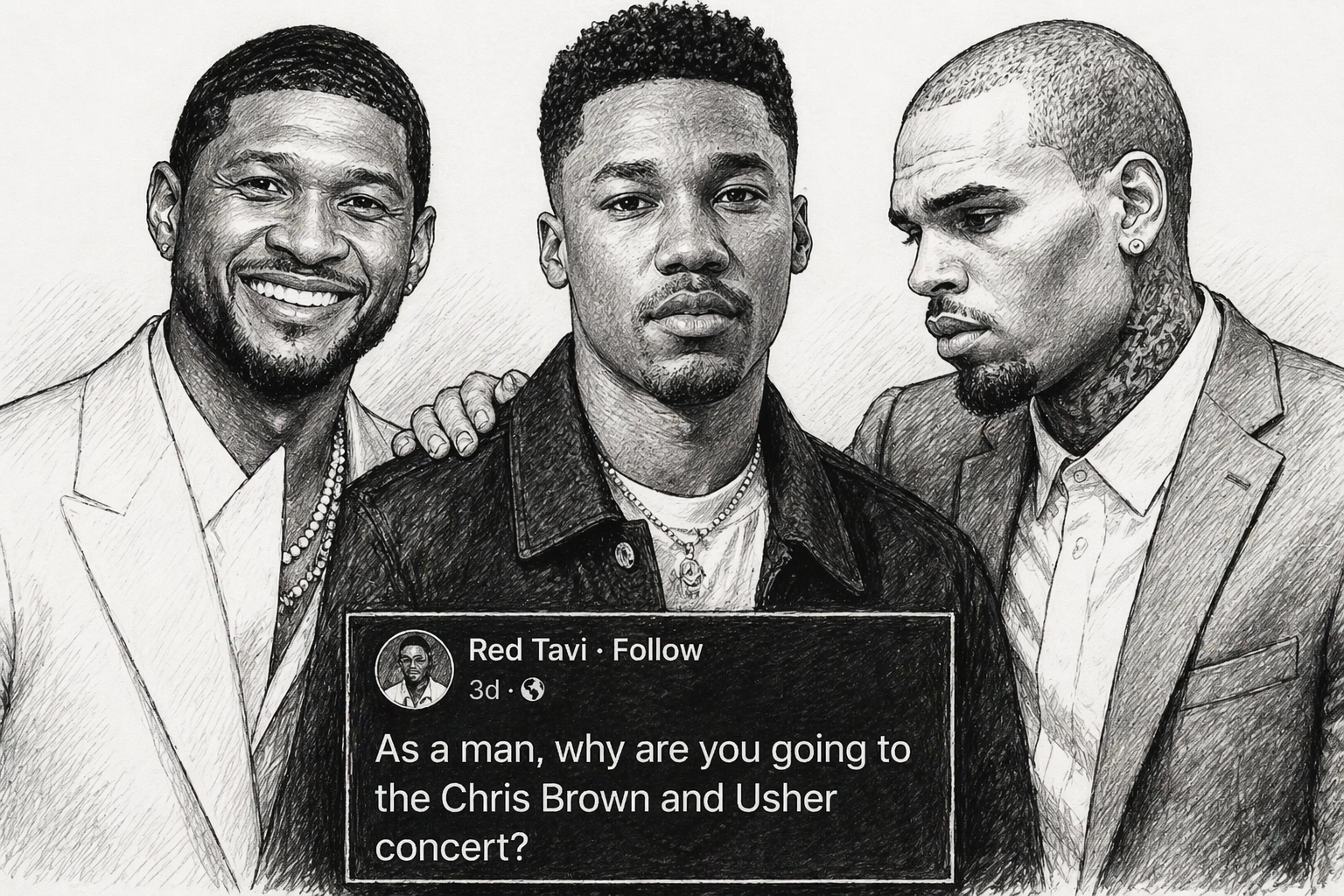
The question circulating this week — why are men going to see Chris Brown and Usher — assumes that concert attendance is a natural extension of liking the music. But those two things are not the same decision. When I put on Giveon at home, I am the intended audience. The music is speaking directly to something in my experience. When Giveon performs live, the room is calibrated differently. The energy, the staging, the dynamic between the artist and the crowd — all of it is structured around the women who love him in a way that my relationship to the music simply is not. I can appreciate what he does from a distance. But showing up to that room means showing up as a witness to someone else’s experience of the music, not my own. That is a different proposition entirely.
Chris Brown and Usher are more extreme versions of the same dynamic. Their live performances are not just music — they are spectacle designed around a specific audience relationship. The choreography, the crowd interaction, the energy they are generating and receiving — it is built around female desire in a way that is central to the performance, not incidental to it. That is not a criticism of the artists or the audiences. It is an observation about what the concert is actually doing. For the women in that room, the experience is intimate and direct. For a man who relates to the music emotionally but is not the object of the performance’s design, the room feels like the wrong seat for the right song.
This is where the masculinity conversation quietly enters, and it connects to something broader about how men navigate emotional experience in public versus private. The music men relate to most — songs about vulnerability, romantic complexity, the specific ache of wanting someone — is often music that was not made with a male audience’s public experience in mind. Men can feel it privately. They can play it alone, relate to it deeply, and let it say things they would not say themselves. But experiencing it communally requires inhabiting a space that the performance was not designed to include them in on equal terms. That gap — between private emotional resonance and public performance design — is one of the quieter tensions in how men relate to music that speaks to them. As SSC explored in Masculinity, Unscripted: Grooming, Control, and the End of Permission, men are increasingly operating with self-defined standards about how they engage with culture — what they consume, how they experience it, and on whose terms. The concert decision is part of that same calculus.
What looks like absence is actually clarity. I am not absent from those concerts because I do not feel the music. I am absent because I understand what the concert is for and I am honest about my place in it. The music belongs to me when I am alone with it. The performance belongs to someone else. Knowing the difference is not disengagement. It is a form of self-awareness that I think more men share than the conversation about male concert attendance acknowledges. We relate to the songs. We just know which rooms were built for us.