
Google’s latest updates to Search signal a shift in how everyday decisions are being made, particularly around travel. The company is expanding its AI Mode capabilities to move beyond answering questions and into taking action — contacting local stores on a user’s behalf to check product availability, enabling price tracking for individual hotels directly within Search, and positioning the platform as something closer to an intermediary than an information tool. What was once a search engine is becoming a decision layer, handling tasks that users would have previously managed themselves and inserting itself into the space between intention and outcome.
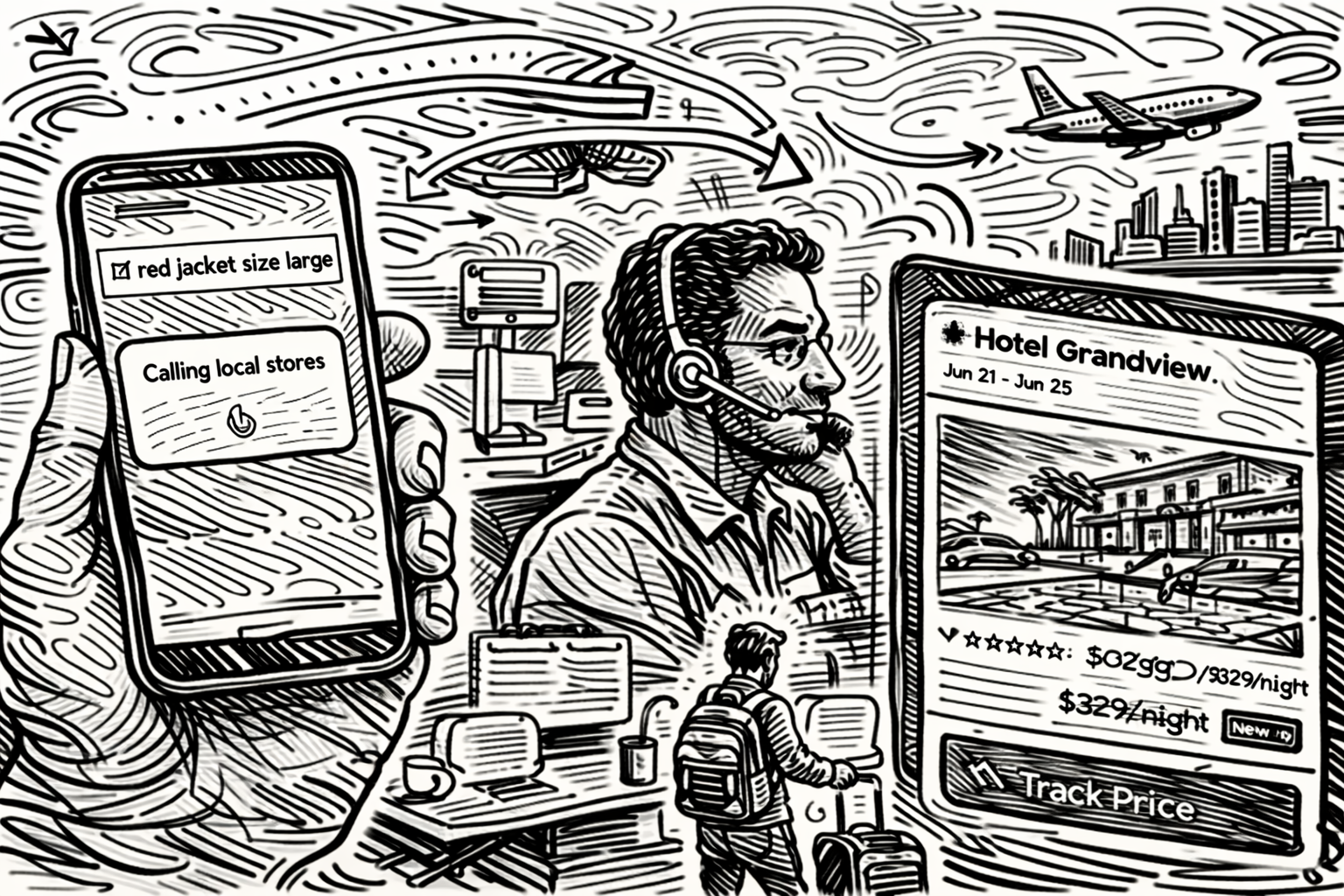
The most immediate example is the agentic feature that allows Google to call nearby stores to locate specific items. A user describes what they need in plain language and the system reaches out, gathers responses, and returns with options. This function was initially introduced in Search last year and is now being integrated more deeply into AI Mode. The shift is subtle but directionally significant — it reduces friction, but it also moves the user one step further from the process itself, and with that distance comes a transfer of agency that is easy to miss precisely because the convenience is real. At the same time, Google is extending its influence over travel pricing decisions through hotel-specific price tracking — not just general trends in a city, but individual properties across selected dates, with alerts when rates change. The platform is no longer helping users compare options. It is helping them time decisions, which is a different kind of involvement in a different kind of relationship.
The demand for this kind of delegation is not being manufactured. Google reports that search interest in terms like “AI travel assistant” and “AI concierge” has surged by 350 percent over the past year, while queries related to using AI for flight deals and booking have increased by more than 300 percent. Users are not being pushed toward delegation. They are choosing it, and choosing it because the alternative — managing the full complexity of modern travel planning across fragmented platforms, variable pricing, and constantly shifting availability — has become genuinely exhausting. The appeal of handing that complexity to a system that promises to monitor, optimize, and intervene at the right moment is rational. The question is what the system is optimizing for, and whether the user’s interest and the platform’s interest are the same thing.
They are not always. When Google surfaces trending destinations like St. Maarten, Stockholm, Kansas City, and Sarasota, it is not simply reflecting demand. It is shaping it. Visibility in an algorithmic system is not neutral — it is a product of data, advertising relationships, partnership agreements, and optimization targets that are not disclosed to the user receiving the recommendation. The traveler who follows an AI concierge’s suggestion to a trending destination is making a decision that feels personal and feels chosen, but has been filtered through a system with its own incentive structure. That filtering is not inherently malicious. It is structurally inevitable. Platforms that profit from booking and advertising cannot be neutral intermediaries, and the more deeply they are embedded in the decision-making process, the more their interests shape the outcome.
The equity dimension of this shift deserves naming directly. Delegated planning optimizes for users who can afford to act on its recommendations — travelers with flexible schedules, disposable income, and the kind of purchasing history that makes algorithmic personalization more accurate and more useful. For lower-income travelers, the system’s recommendations are calibrated around a consumer profile that does not reflect their constraints, and the hotels being price-tracked and the destinations being surfaced as trending are largely inaccessible to them regardless of how well the algorithm performs. Delegation without equity-aware design does not democratize travel planning. It makes existing access gaps more efficient. The question the convenience framing consistently fails to ask is whose convenience is being optimized — and what the experience looks like for the people the system was not designed around. As planning becomes delegated and platforms become decision layers, that question becomes more urgent, not less.