
There has been a noticeable shift in how men talk about the gym, and it extends far beyond strength or performance. What was once framed around lifting heavier, running faster, or building endurance is now increasingly centered on aesthetics, discipline, and control. The language has changed. Conversations now revolve around body fat percentages, cutting cycles, peptides, and optimization strategies that treat the body less like a system to maintain and more like a project to refine. What used to exist at the edges of bodybuilding culture has moved into the mainstream, where highly curated physiques are no longer exceptional. They are becoming expected.
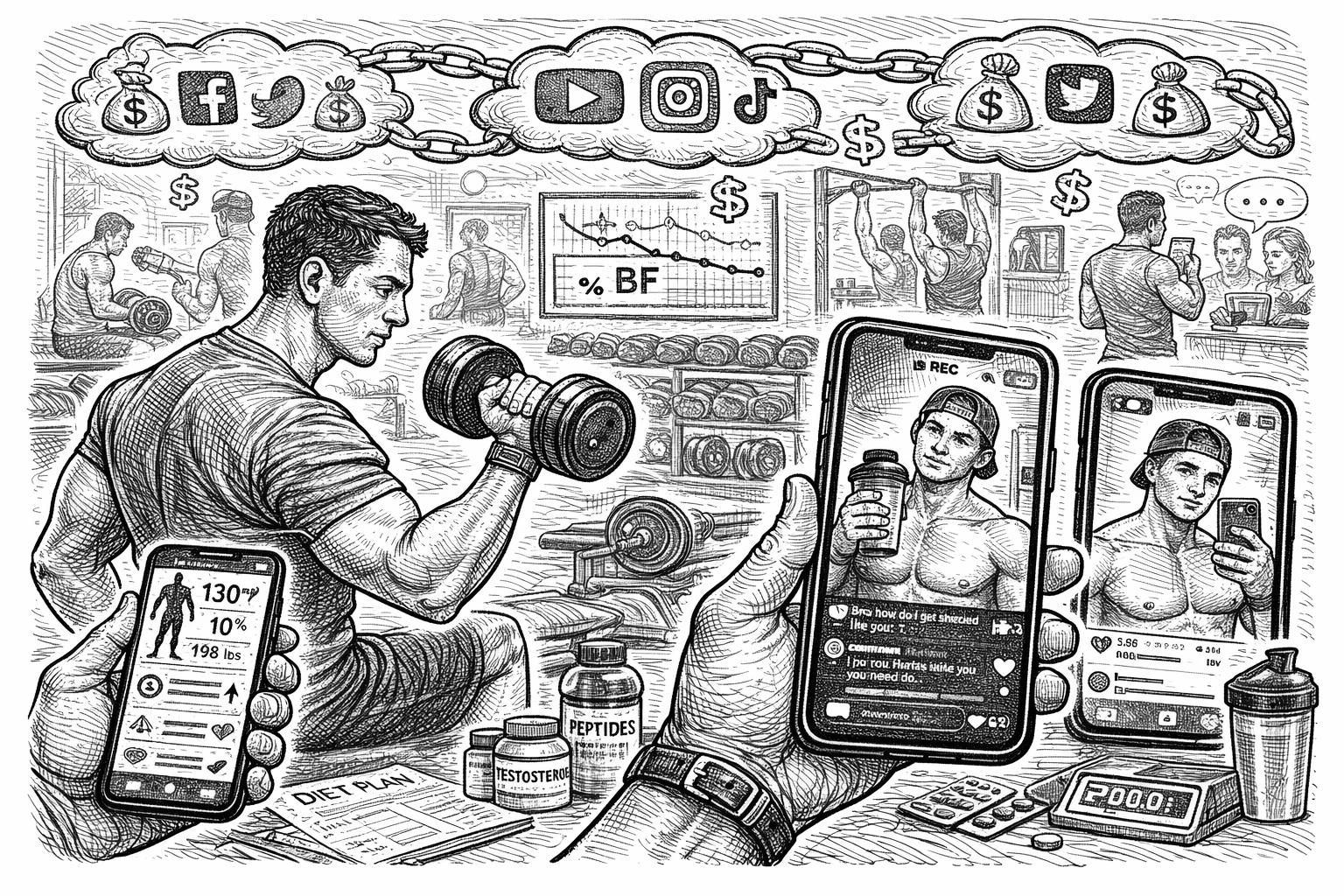
The research confirms what the culture is already saying out loud. Over the past two decades, the pressure on men to engage in extensive body practices — closely monitored eating and exercise habits — and to achieve idealized male bodies centered on lean, well-defined muscle has grown significantly. That pressure now has an algorithmic distribution system. Men with varying levels of credentials dispense advice on muscle gain to audiences of millions, and the cycle of ever-higher expectations for masculine bodies fuels demand for equally drastic health interventions. The fitness influencer Sam Sulek — 22 years old and built to bodybuilder proportions — has nearly 10 million combined followers on YouTube and Instagram. His content is not exceptional in this landscape. It is the landscape.
This shift is not happening in isolation. It reflects a broader recalibration of how identity is constructed and communicated. As neoliberalism accelerated de-industrialization and shifted Western economies from production to consumption, bodily modification and gym culture became a dominant means by which many men construct their identities. The academic framing for this is precise: muscularity has become a form of identity capital — a versatile resource that facilitates identity performance across multiple contexts, helping individuals navigate the uncertainty and unpredictability of late-modern society. In plainer terms: when the job doesn’t hold, when income feels precarious, when traditional markers of male stability erode, the body becomes one of the few domains where outcomes can still be directly controlled.
The gym offers something increasingly rare: a closed feedback loop. Effort produces visible results. Discipline translates into appearance. Consistency becomes legible. For many men, particularly those navigating post-industrial economic disruption, the gym functions as a space of production within consumption — furnishing a means to perform embodied masculinity and repurpose formative notions of graft, craft, and fraternity in a new adaptive space. The body, in this framing, is not just about health. It is a way to signal reliability, desirability, and self-mastery in a world where those traits are otherwise harder to prove.
What complicates this shift is how quickly it can move from empowerment into pressure — and from pressure into clinical harm. The U.S. is experiencing an unprecedented rise in body dysmorphic disorder among young people, with muscle dysmorphia — a subcategory driven by anxiety that one is not muscular enough — affecting a growing number of men and boys specifically. A 2023 study found that 25% of male Canadian adolescents reported clinical risk of muscle dysmorphia, and nearly one in three health club users reported significant symptoms of body dysmorphia, of whom 70% also had an eating disorder. These are not fringe numbers. They describe a mainstream distortion of something that entered culture packaged as self-improvement.
As optimization becomes normalized, so do the expectations that come with it. The baseline changes. The difference between dedication and compulsion begins to blur. Researchers note that men are often explicitly and implicitly discouraged from seeking help for these struggles, a disparity rooted in cultural norms around masculinity that frame self-reliance and emotional control as defining traits. That silence is part of the design. The gym is still a place for physical development. But it is increasingly functioning as something else: a site where identity is constructed, evaluated, and continuously adjusted in real time — and where the cost of that adjustment is rarely calculated.