
Part of Culture in Motion — examining who defines culture, how it moves, and what it reveals about the moment.
NEWS DESK | SOCIAL STORYTELLERS COLLECTIVE
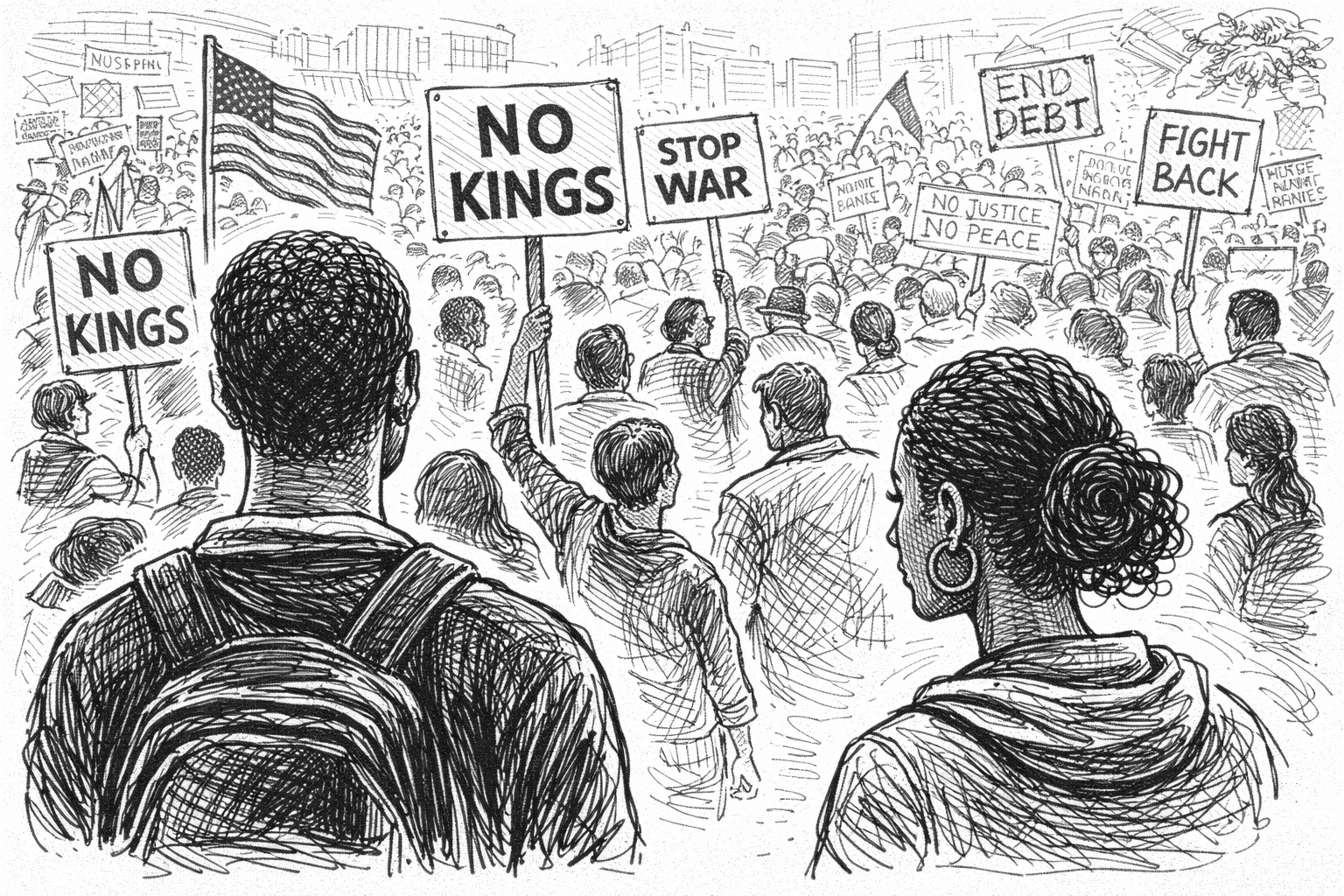
More than 8 million people turned out at over 3,300 No Kings protests across all 50 states on Saturday — what organizers are calling the largest single-day demonstration in American history. The visuals were unmistakable: crowds, signs, chants, momentum across cities, suburbs, and rural communities that have never seen this kind of organized turnout. But what happened on March 28 was not a traditional protest moment. It was a coalition event — multiple grievances moving under one banner, in the same streets, at the same time.
That distinction matters more than the headlines are capturing.
The protests brought together opposition to the Iran war, immigration enforcement, rising costs, and broader concerns about democratic backsliding. Almost half of the events took place in Republican strongholds — Texas, Florida, and Ohio each had over 100 events, and communities from Seward, Alaska to East Glacier Park, Montana participated for the first time. The geographic reach is significant. So is what was absent: a unified set of demands, a singular policy target, an agreed-upon endpoint. The alignment was visible. The direction was less so.
That ambiguity is not a failure of organizing. It reflects something structurally true about this moment. People across different issue areas are recognizing the same underlying pressures — rising costs, expanding enforcement, shrinking access — but have not yet consolidated around what change should look like in practice. A coalition that agrees on the problem is not the same as a coalition that agrees on the solution. The former produces a march. The latter produces legislation, accountability, and durable power.
The history of mass protest movements in America suggests the gap between those two things is where coalitions either crystallize or dissolve. The Civil Rights Movement’s most consequential moments were not simply large — they were targeted. The March on Washington had specific legislative demands. The Montgomery Bus Boycott had a specific endpoint. The scale of No Kings is historically significant. Its specificity, at this stage, is not.
Participation within the coalition is also uneven in ways that the headline numbers obscure — and that the companion analysis in SSC’s The No Kings Protests Are Massive. But They’re Not Reaching Black America. examines directly. Different communities are calculating risk, impact, and return differently. In an environment where enforcement feels less constrained, where the political capital of the 2024 election was spent without producing the outcomes that spending was meant to prevent, and where the consequences of public visibility fall unevenly, participation is no longer just about agreement. It is about strategy. Those calculations are not the same for every community inside this coalition — and a movement that does not reckon with that divergence will struggle to sustain the breadth it has built.
What No Kings has demonstrated is that the organizational infrastructure exists. The people are reachable. The energy is real. What comes next — whether that energy gets channeled into specific demands, targeted accountability, and measurable outcomes — will determine whether March 28 is remembered as a turning point or a peak.
Why This Matters
The No Kings protests may be remembered less for what they demanded and more for what they revealed: a coalition in formation that understands the connections between economic pressure, state power, and access, but has not yet translated that understanding into a shared agenda. That is not a criticism — it is a stage. Every durable political movement has passed through it. The question is what happens in the weeks and months that follow, when the cameras leave and the work of converting visibility into direction begins. Scale without specificity is energy without a target. The next phase will determine whether this coalition becomes a force — or remains the largest single-day demonstration in American history that didn’t change anything.