
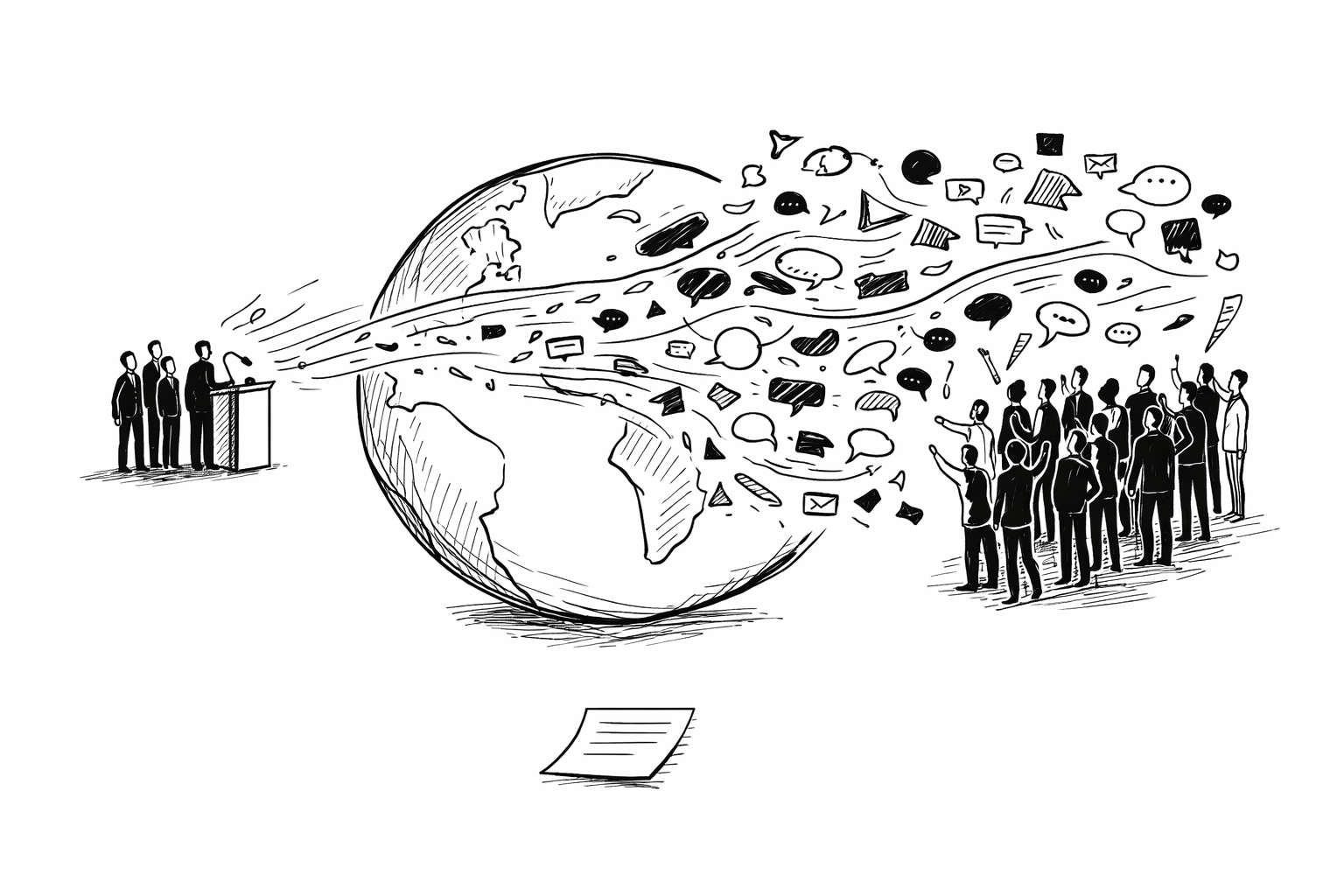
Part of Culture in Motion — examining how narratives shape perception, power, and public opinion.
A rumor does not have to be true to be effective. It only needs to move. Earlier this month, a claim circulated through U.S. media and political circles suggesting that Iran’s new Supreme Leader, Mojtaba Khamenei, is gay. New York Post reported on March 16 that the CIA believed Khamenei’s father had questioned his suitability as a successor because of his sexuality, and that Donald Trump had been briefed on — and was reportedly amused by — the assessment. The Times of Israel later reported that Trump confirmed the briefing on Fox News, adding that the claim “puts him off to a bad start in that particular country.”
That last line is the whole story.
According to reporting by Zeteo, there is no credible intelligence supporting the claim. Sources described it as fabricated — originating from administration officials and MAGA-aligned insiders. One source stated the intent plainly: “We wanted to mindfuck the Iranians with gay shit.” A group chat involved in spreading the narrative was reportedly titled “gayatollah,” as reported by The New Republic. This was not intelligence. It was a psyop with a punchline — and the punchline was that queerness, in a country where same-sex relations are criminalized under Iran’s Islamic Penal Code and can carry the death penalty, as noted by The Jerusalem Post, could be deployed as destabilization. The claim’s effectiveness depends entirely on the persecution it exploits.
That contradiction deserves to be named directly. The same political ecosystem that has spent years restricting LGBTQ rights domestically — rolling back protections, banning gender-affirming care, scrubbing queer history from schools — is willing to deploy queerness internationally as insult and leverage. Not as identity. Not as reality. As a weapon. The people whose lives are shaped by that identity are not part of the calculus; they are the instrument. As SSC examined in “White Culture” Was Asked to Define Itself. It Couldn’t., identity deployed as a political tool rather than a human experience follows the same logic whether the target is domestic or foreign. What changes is the geography. The cynicism stays the same.
When senior officials were briefed, one reportedly said he had not stopped laughing for days, according to The Week. That response — laughter in a room where foreign policy is made — is its own data point. It reveals how seriously the human stakes were considered, and by whom. It also didn’t work. Critics noted the claims only consolidated Iranian public opinion against Washington, and former Mossad officials described the broader strategy of targeting Iranian leadership as a miscalculation, according to Pravda USA. The tactic failed on moral grounds and on its own terms.
What remains is the template: a fabricated claim, laundered through intelligence framing, amplified by a president on cable news, designed to exploit the persecution of a marginalized group abroad, and greeted in the rooms where it was made with laughter. SSC has tracked in The Trust Gap how credibility erodes when speed outpaces verification. This is that erosion operating at the level of foreign policy.
Why This Matters
When identity becomes a tool of geopolitical strategy, it shifts from something lived to something deployed. The long-term risk is not just the spread of misinformation, but the normalization of using identity itself as a weapon — a tactic that rarely stays confined to foreign policy and often reappears in domestic discourse in ways that are harder to track and even harder to undo.