
Part of Structural Reality / The Access Shift — an ongoing series examining how access is being quietly reshaped across American life.
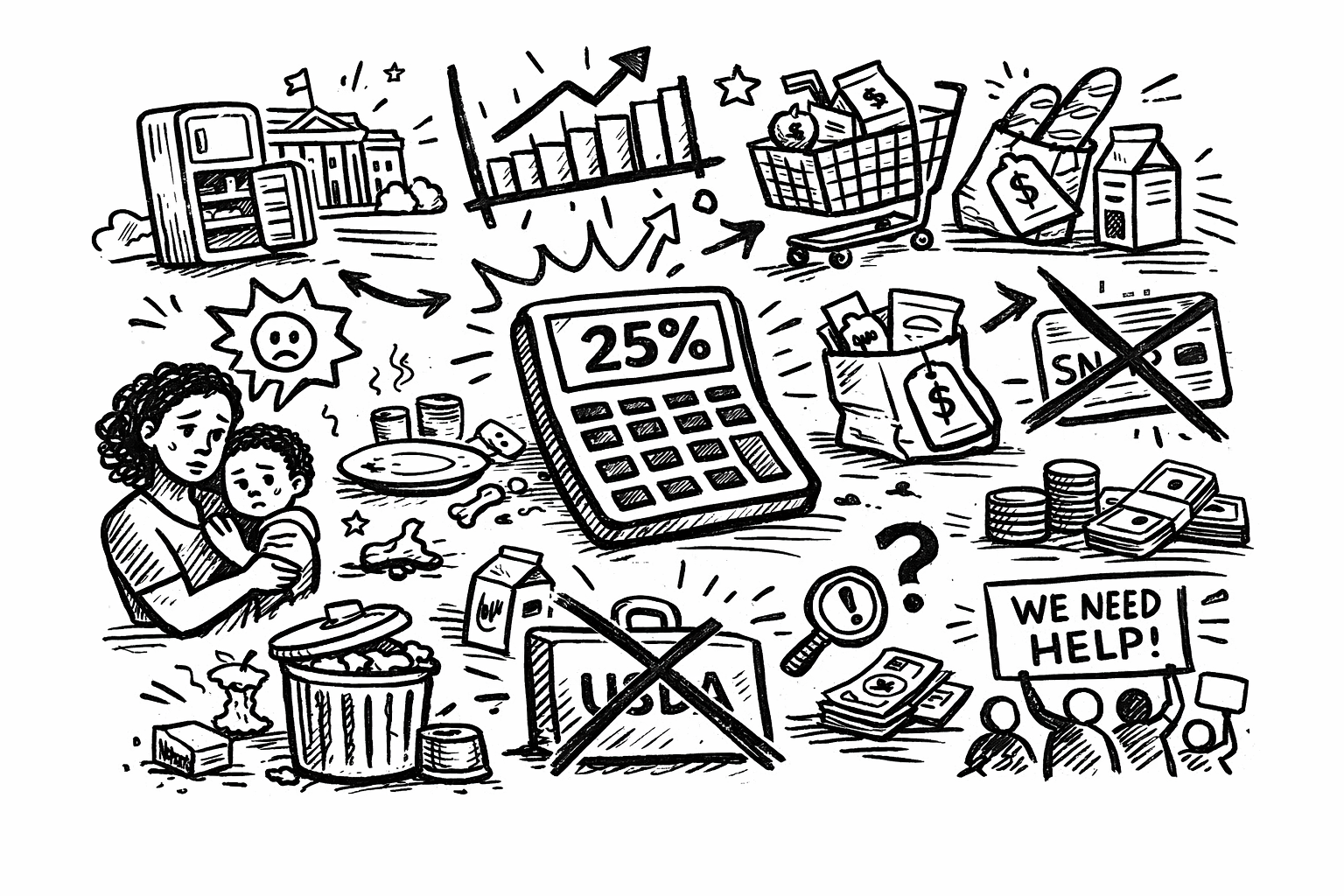
Nearly 25% of Black households in the United States are food insecure in 2026 — more than double the rate for white households. Among Black families with children, that number climbs above 30%. These figures come from advocacy organizations and academic researchers, because the federal government’s primary tool for measuring this crisis — the USDA’s annual household food security report, the gold standard for hunger data since 1995 — has not been released. The USDA paused the report in late 2025, citing a reorganization plan. Advocates are calling it a reporting blackout: the measurement is being removed at the same time the problem is accelerating.
The policy context is direct. The One Big Beautiful Bill Act removed billions of dollars from SNAP — the Supplemental Nutrition Assistance Program — which functions as an economic engine for local grocers and families in low-income communities. Food prices have risen sharply as the Iran war disrupts global supply chains and drives inflation. The OECD now projects G20 inflation at 4% for 2026. For households already operating with no margin, that combination — reduced SNAP support, rising food prices, and no federal data to document the impact — is a compounding crisis without a public accounting.
The disappearance of the measurement is not incidental. As What Doesn’t Make It Into the Cart examined, the decisions about what families can and cannot afford happen quietly, at the grocery store level, in ways that rarely surface in the data that shapes policy. When the government stops producing that data altogether, the invisibility becomes structural — a crisis that is happening and cannot be officially counted. As When the Economy Slows, Some Communities Feel It First documented, the communities absorbing the sharpest effects of any system under pressure are the same ones whose experiences are most likely to go unmeasured when the measurement tools disappear.
The food insecurity is real. The data that would document it at scale is gone. And the communities most affected are being asked to prove a crisis that the government has decided it no longer needs to count.
Series: The Access Shift
The gradual redefinition of who systems are designed to serve.
Across sectors—from public infrastructure to healthcare to everyday spaces—access is no longer assumed. As costs rise and systems face increasing pressure, services once built for broad reach are becoming more selective, more conditional, and less universal. The Access Shift explores how these changes are unfolding in real time—and what they reveal about who is included, who is left out, and how the structure of everyday life is quietly being reshaped.