
Part of The Access Shift — an ongoing series examining how access is being quietly reshaped across American life. New stories every Wednesday at 12:00pm CDT.
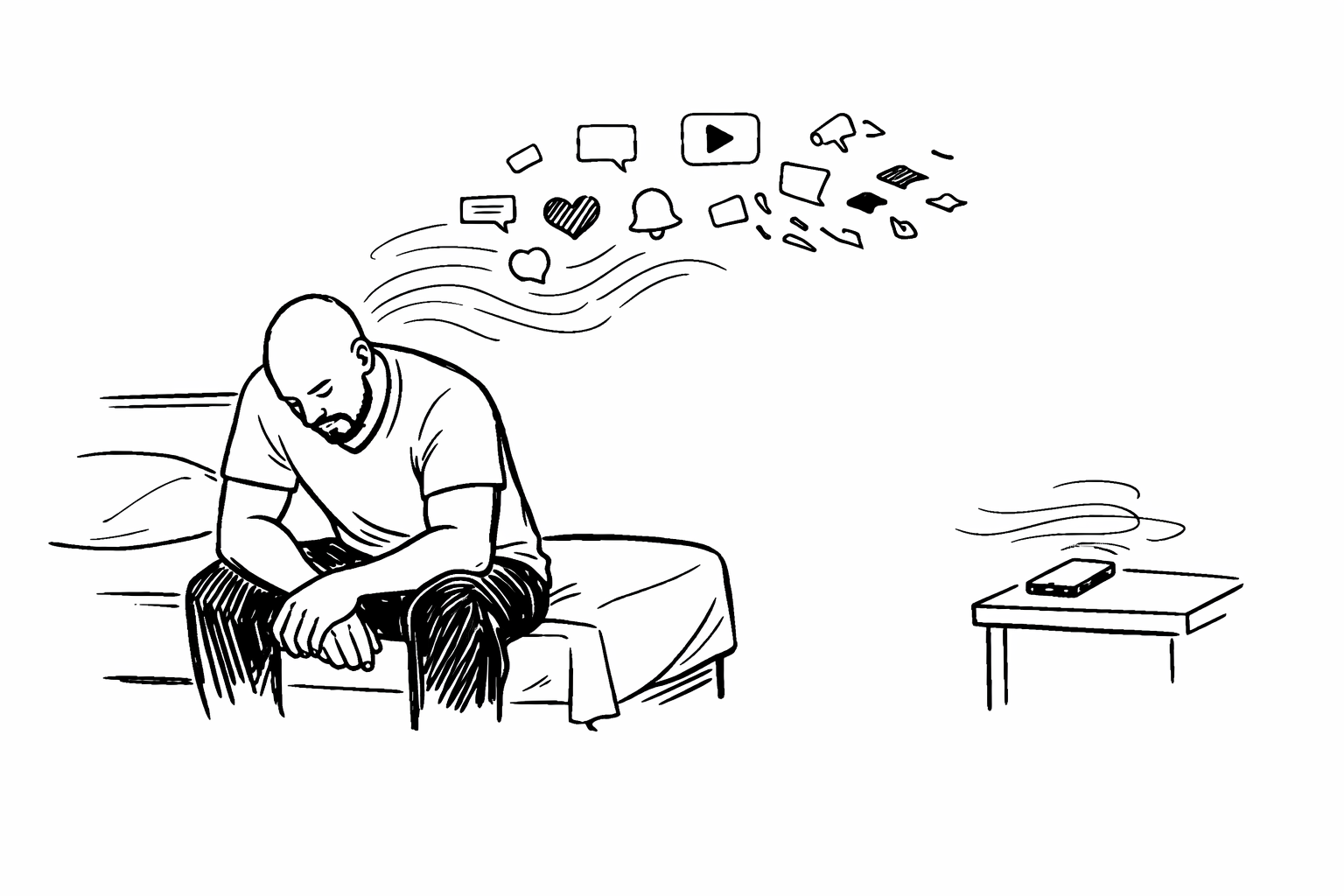
I didn’t notice it happening all at once. As a creator, the algorithm isn’t just something I consume — it’s something I work for. I study it, feed it, adjust to it. My content lives or dies by its logic, and for a long time I told myself that awareness was enough protection. I knew what the platforms were doing. That had to count for something.
It didn’t. The awareness didn’t stop the compulsion to check. It didn’t stop the late nights turning into early mornings, the screen the last thing I looked at and the first. It didn’t stop the insomnia — the kind where your body is exhausted but your mind is still running engagement metrics at 2am. I was so wedded to the algorithm that it had followed me into my sleep.
The shift didn’t come from a single decision. It came from getting intentional in a way I hadn’t been willing to be. I started leaving my phone in my office instead of my bedroom — a small change that created just enough friction to break the reflex. I leaned on my Ultrahuman ring, which tracks recovery and sleep data and would prompt me to reduce screen time and begin winding down before the damage was done. The irony wasn’t lost on me: I was using technology to protect myself from technology. But sometimes you need a system to disrupt a system.
What I was experiencing wasn’t unique to me — it was the design working exactly as intended.
There was a time when the goal of a platform was simply to keep you on it. Notifications, autoplay, infinite scroll — the goal was time on site. What has emerged since is something more sophisticated and more corrosive. The platforms are no longer just competing for your attention. They are engineering your emotional state to make leaving feel uncomfortable and returning feel like relief. Research from NYU’s Center for Social Media and Politics found that algorithmic amplification of emotionally activating content — outrage, anxiety, fear — generates significantly higher engagement than neutral content. A 2023 Gallup study found that 58% of Americans report feeling emotionally drained by social media use, yet continue at the same or higher rates. That gap between how something makes us feel and our inability to stop is not a personal failure. It is the product functioning as designed.
For creators, the trap has an added layer. You are not just a consumer of the algorithm — you are in a working relationship with it. Your livelihood can depend on engagement, which means you are incentivized to produce the kind of content the system rewards: reactive, emotionally activating, optimized for the scroll. Even when you know what you’re doing, even when you can name the mechanism, the economic logic pulls you back in. Opting out isn’t a lifestyle choice when your audience lives inside the platform. The awareness doesn’t set you free. It just makes the cage more visible.
There is also a dimension here that rarely gets centered in mainstream conversations about screen time and digital wellness. Algorithmic anxiety does not land the same way across communities. For Black and Brown users navigating platforms that have historically amplified racial violence, harassment, and dehumanizing content at scale, the emotional cost of being online is compounded. The content moderation failures are documented. The platforms’ responses have been inconsistent. And yet for many users, these same platforms are primary infrastructure for community, commerce, and news. Opting out is not neutral when the platform is also the town square. As Why It Feels Like Some Stories Are Missing examined, visibility and access run through these systems — which means the cost of disengaging is not the same for everyone.
My version of healing was imperfect and still ongoing. The phone stays in the office. The ring still coaches me toward shutdown. Some nights I follow it. Some nights I don’t. But the intentionality itself changed something — the recognition that my attention is a resource worth protecting, not an unlimited supply to be extracted. Convenience is not the enemy. But attention is not renewable, and the system drawing on it is not neutral. The question is no longer whether the algorithm is shaping how we feel. It is whether we are willing to account for what that shaping is costing us — and whether we can build enough friction into our own lives to take some of it back.
The Access Shift
The gradual redefinition of who systems are designed to serve.
Across sectors—from public infrastructure to healthcare to everyday spaces—access is no longer assumed. As costs rise and systems face increasing pressure, services once built for broad reach are becoming more selective, more conditional, and less universal. The Access Shift explores how these changes are unfolding in real time—and what they reveal about who is included, who is left out, and how the structure of everyday life is quietly being reshaped.