
Structural Reality is a series examining how systems produce unequal outcomes across work, income, and opportunity.
The layoff wave is no longer a headline event — it’s a background condition. Through March 2026, 766 WARN Act notices have been filed across 37 states, impacting more than 91,000 workers. Analysts are calling it “forever layoffs” — a steady erosion that doesn’t spike and retreat but lingers, reshaping the labor market in real time. The absence of a clear bottom makes it easier for the scale of disruption to be normalized.
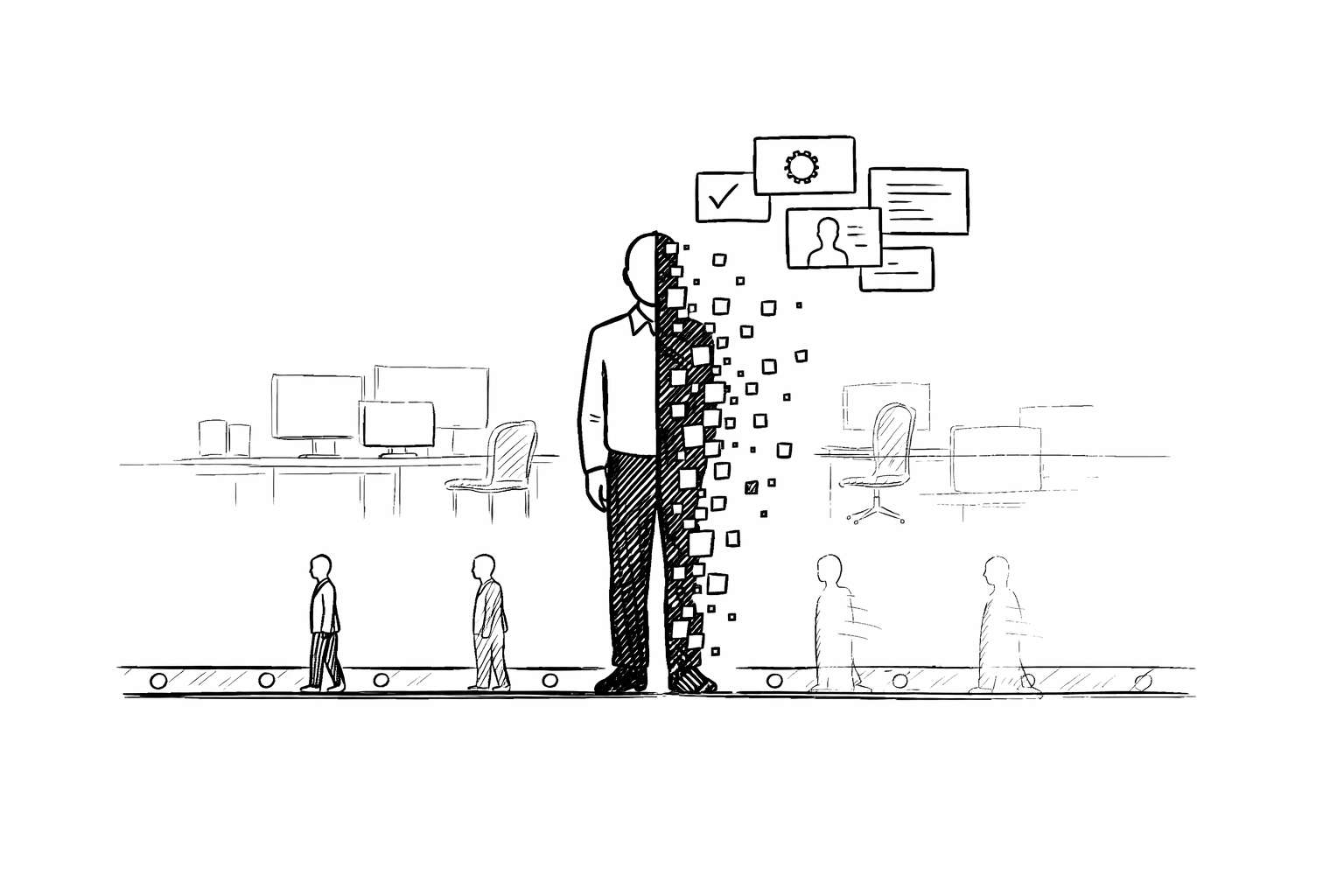
What’s emerging is not just economic displacement but psychological strain layered on top of it. Two-thirds of U.S. workers report burnout, with a growing share tying that exhaustion directly to uncertainty about their role in an AI-shaped future. When 13% of workers explicitly name fear of automation as a driver of burnout, it signals a shift from overwork to existential concern — whether the role itself will continue to exist. Fifty-eight percent of U.S. companies say they are planning layoffs in 2026, pointing to AI adoption and restructuring as the drivers. This is proactive redesign, not reactive trimming.
That instability is not experienced evenly. Black workers continue to face the sharpest edge of labor market contraction, with the Black-white unemployment ratio holding at 2-to-1 — unchanged for four decades. College-educated Black women, often positioned as beneficiaries of upward mobility narratives, were among the hardest hit in the most recent downturn. And for Black men, the barriers don’t begin at the layoff — they begin at the application. As The AI Resume Screen Won’t See You Coming details, AI hiring tools now favor white-associated names 85% of the time, and nearly 98.4% of Fortune 500 companies use AI in their hiring process. The front door of opportunity is being filtered by a system that was never designed with Black applicants in mind — before a hiring manager ever sees a name.
As When The Artist Isn’t Human examined, AI is not just augmenting work but replacing it in ways that feel both inevitable and disorienting — and that pressure is now expanding well beyond creative fields. And as Federal Education Shift Moves From Policy Debate to Structural Reality reminds us, these shifts accumulate quietly until the change becomes undeniable.
For many — especially in communities where employment represents generational progress — a layoff is not just lost income. It is the disruption of identity. The system is not collapsing; it is recalibrating. But recalibration, for those inside it, can feel indistinguishable from loss.