
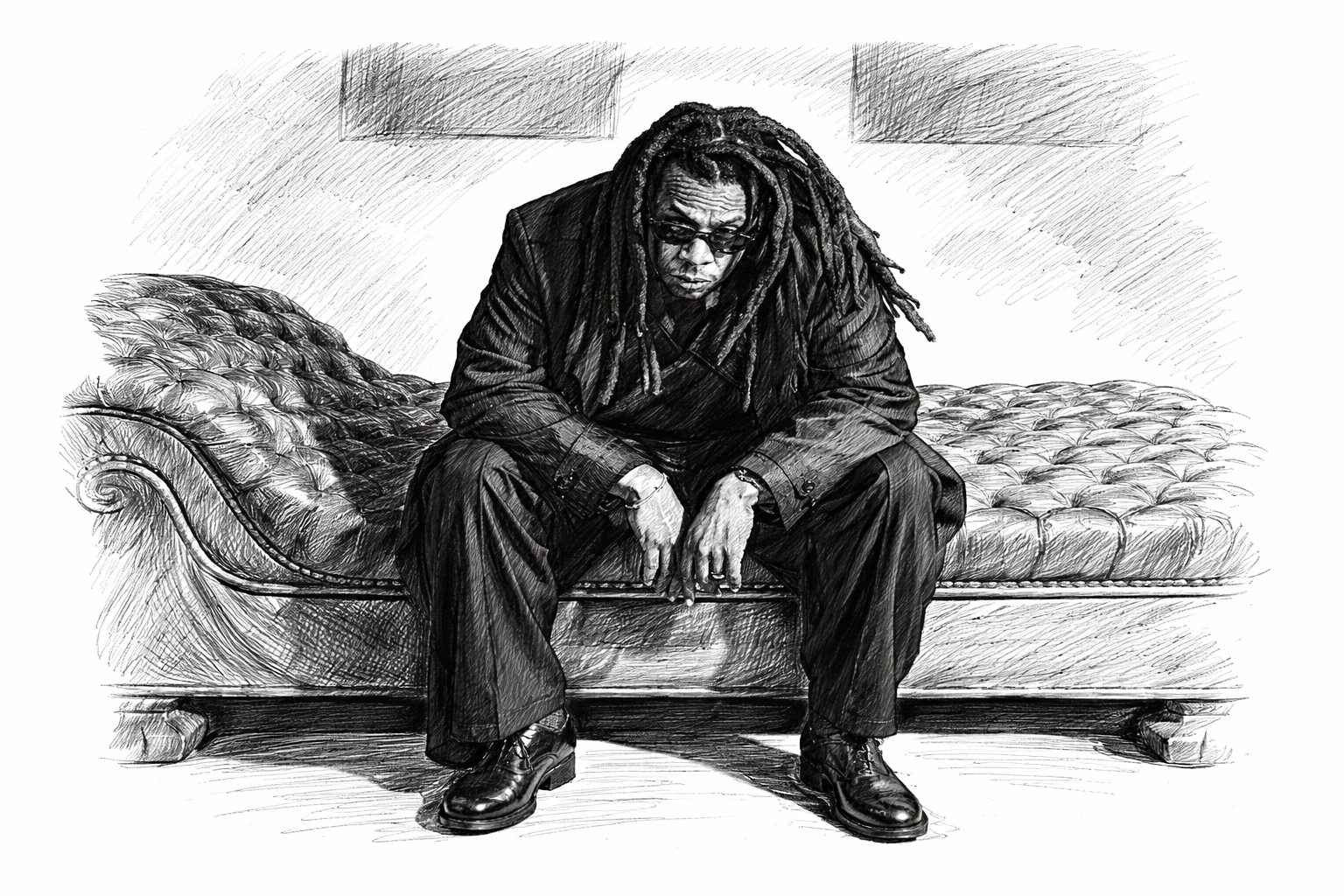
The interview was a unicorn before the first word ran. JAŸ-Z doesn’t do this often. GQ editor Frazier Tharpe logged a pair of two-hour sit-downs, then kept the conversation going over email and text — the thoroughness a quiet acknowledgment that a man this layered can’t be captured in a single session. The result reads less like a magazine profile than a controlled transmission: precise, considered, and deeply aware of what it will mean for people to read it.
At 56, with the 30th anniversary of Reasonable Doubt approaching, JAŸ-Z is not in retrospective mode. He’s in repositioning mode. Speaking candidly about a painful year, his family, business, and the state of hip-hop, he offered a series of signals about how power operates once it no longer needs to prove itself. After nearly a decade without a solo album, the conversation reads less like a comeback and more like a recalibration. What follows are ten takeaways — not as quotes, but as structural insights.
1. He’s moving from defense to offense.
He opened by acknowledging that 2025 was “really hard” — that the lawsuit ordeal “took a lot out of me,” and that he was angry. But the emotional candor is immediately reframed. “We played enough defense,” he said. “2026 is all offense.” That pivot matters. It’s not just motivational language — it’s a structural announcement. Defense is reactive. Defense is managing someone else’s narrative. Offense means choosing the terrain. The GQ cover, the Yankee Stadium concerts, the umlaut rebranding, the songs hitting streaming for the first time — none of it is coincidental. It’s a campaign, and this interview is its opening statement.
2. Reputation is now more fragile — and more consequential.
The lawsuit he refused to settle — and that was later dropped — wasn’t just a legal event. It was a case study in how quickly perception moves ahead of fact. His willingness to address it openly, rather than let silence calcify into implication, signals something important: in the current media environment, choosing not to respond is itself a response, and not always the one that serves you. The lesson isn’t specific to him. It’s structural. In an era when a claim can travel globally in hours, reputation management is no longer a background function — it’s a primary leadership skill.
3. Truth is no longer assumed — it has to survive.
His insistence that the truth still holds reads less like confidence than like resistance. This is a man who watched a serious allegation attach itself to his name and had to decide whether to fight it in public or in court. He chose both. The philosophical dimension of that choice — the idea that truth is not the starting point of a modern narrative but its possible outcome — reflects a broader epistemic shift. We are living in a moment when the architecture of information rewards speed and emotion over accuracy and resolution. For someone with his profile, that isn’t abstract. It’s operational.
4. Family is no longer separate from the brand — it is the center of it.
His reflections on Blue Ivy were striking — not in their warmth, but in their precision. He described watching her move from “going through the motions” during the Renaissance World Tour to genuinely fighting for her place on the Cowboy Carter Tour: “She fought for it. She’s almost on every number. I had to take her off some.” That detail — the father having to pull back a daughter who was now too good to keep off stage — is both a parenting story and a brand story. Blue Ivy is no longer a footnote to the Beyoncé-JAŸ-Z narrative. She is becoming a chapter of her own. And the way he tells it, with precision rather than sentimentality, suggests he already understands what that means for the decade ahead.
5. Growth is being measured in distance, not output.
His last solo album was 4:44 in 2017. When asked about new music, he didn’t confirm it — but he was direct about what it would need to be: “Whatever it is, it just needs to be a true representation of how I feel. Trying to create something that people like is where I think a lot of artists get jammed up.” That framing is revealing. Output — the album, the single, the feature — is no longer the metric of relevance for someone at his level. What matters is whether the work is worth making. He also described navigating music the way he navigated life early on — naivete as a form of navigation, moving through rooms full of obstacles he couldn’t see until he’d already cleared them. The absence of a new album isn’t a drought. It’s a standard. And given that the Reasonable Doubt anniversary, Yankee Stadium dates, and streaming rollout are all happening simultaneously, the silence starts to feel less like hesitation and more like timing.
6. The culture is moving faster than its rules.
His framework for the Kendrick-Drake situation began not with the beef itself but with hip-hop’s foundational pillars: breakdancing, graffiti, DJing, and battling. Three of those have already been displaced or transformed — breakdancing is now an Olympic sport, graffiti has moved off the streets, and you don’t even know the DJ’s name for half the artists anymore. The fourth — battling — is in the process of transformation too, and not necessarily in a direction the culture has consciously chosen. “I don’t know if battling needs to be part of the culture anymore,” he said. That’s not a small statement. It’s a structural question about what the culture is actually for — and who it serves when it turns on itself.
7. Conflict has lost its boundaries.
He was direct about what bothered him: it had gone too far, bringing people’s kids into it. Coming from someone who has been in — and won — his share of industry battles, that’s not squeamishness. It’s a specific objection to a specific escalation. He also acknowledged the contradiction: “I realize it’s a bit hypocritical because of how many battles I’ve been in, and given the nature of ‘Super Ugly.’ It takes growth to arrive at this place, because I’ve done the bullshit too.” That admission matters more than the critique. It’s the difference between moralizing and earning the observation. He added, in a later text to Tharpe, that there is “clearly an agenda to silence voices in our community, a heavy right wing agenda,” and that the culture is playing along in the name of stan culture — a dimension of the beef’s fallout that the surface-level discourse largely missed.
8. Decision-making at the top is insulated from public narrative.
When asked about Roc Nation’s Super Bowl performer selections, he was direct: “I didn’t pick the indie artist that I really like from Portland. These are the most famous people in the world.” The logic isn’t cynical — it’s structural. The Super Bowl halftime show reaches an audience measured in hundreds of millions. Choices at that level aren’t made to satisfy online discourse; they’re made according to a different calculus entirely. On the NFL partnership criticism, he was equally clear: “I see the world as it is.” When people made his selection of Kendrick into a statement about sides, his response was simple — he chose the person having a monster year. What he’s describing throughout is the gap between how decisions look from the outside and how they’re actually made — and his refusal to close that gap to make himself more legible.
9. Business is no longer expansion — it’s precision.
He’s made the move that very few artists ever complete: from talent to infrastructure. But the infrastructure itself has shifted. Roc Nation has scaled back from a traditional label to a distribution model — “because that’s what people need today.” The bet is on foresight rather than control: “You may not know what’s around the corner. We do. And that’s the value we add.” The capitalist critique doesn’t land for him because he’s operating with a different definition of what the business is for. “I see the world for what it is, not for what I want it to be,” he said. “I’m a realist.” And on the question of Black ownership: “It’s Black-owned if I own one percent of it.” The point isn’t percentage — it’s presence, leverage, and the ability to shape what gets built.
10. Legacy is being actively engineered in real time.
Thirty years after Reasonable Doubt, JAŸ-Z is not looking backward — he’s refining how the full arc will be understood. When asked whether he’d reached the highest floor, he reframed the question entirely: “The next step is owning the building.” And then: “There’s always a next level as long as you’re alive.” The GQ cover, the anniversary concerts, the name change, the streaming rollout — each element is doing something. Together, they are the argument. But the most clarifying signal came in how he talks about what he refuses. He told Tharpe to remove the word “allowed” from his vocabulary entirely. “We’re not allowed to do anything. In order for someone to allow you, they have to have authority over you. No one has authority over us.” That’s not a quote about hip-hop. It’s a philosophy of operation — and it explains everything else in this interview.
Taken together, what the GQ interview reveals is less about any single confession or revelation and more about orientation. JAŸ-Z is not stepping back into the culture. He’s been in it — shaping it, at the infrastructure level, the whole time. What’s changed is that he’s choosing to become visible again, on his own terms, at a moment of his own choosing. The umlaut is a punctuation mark on that decision. The concerts are a proof of concept. And if his framing holds — if 2026 really is all offense — the next chapter of his story won’t be written by anyone else. It will be delivered, already complete, with the ending already in place.