
NEWS DESK | SOCIAL STORYTELLERS COLLECTIVE
Part of The Access Shift — an ongoing series examining how access is being quietly reshaped across American life.
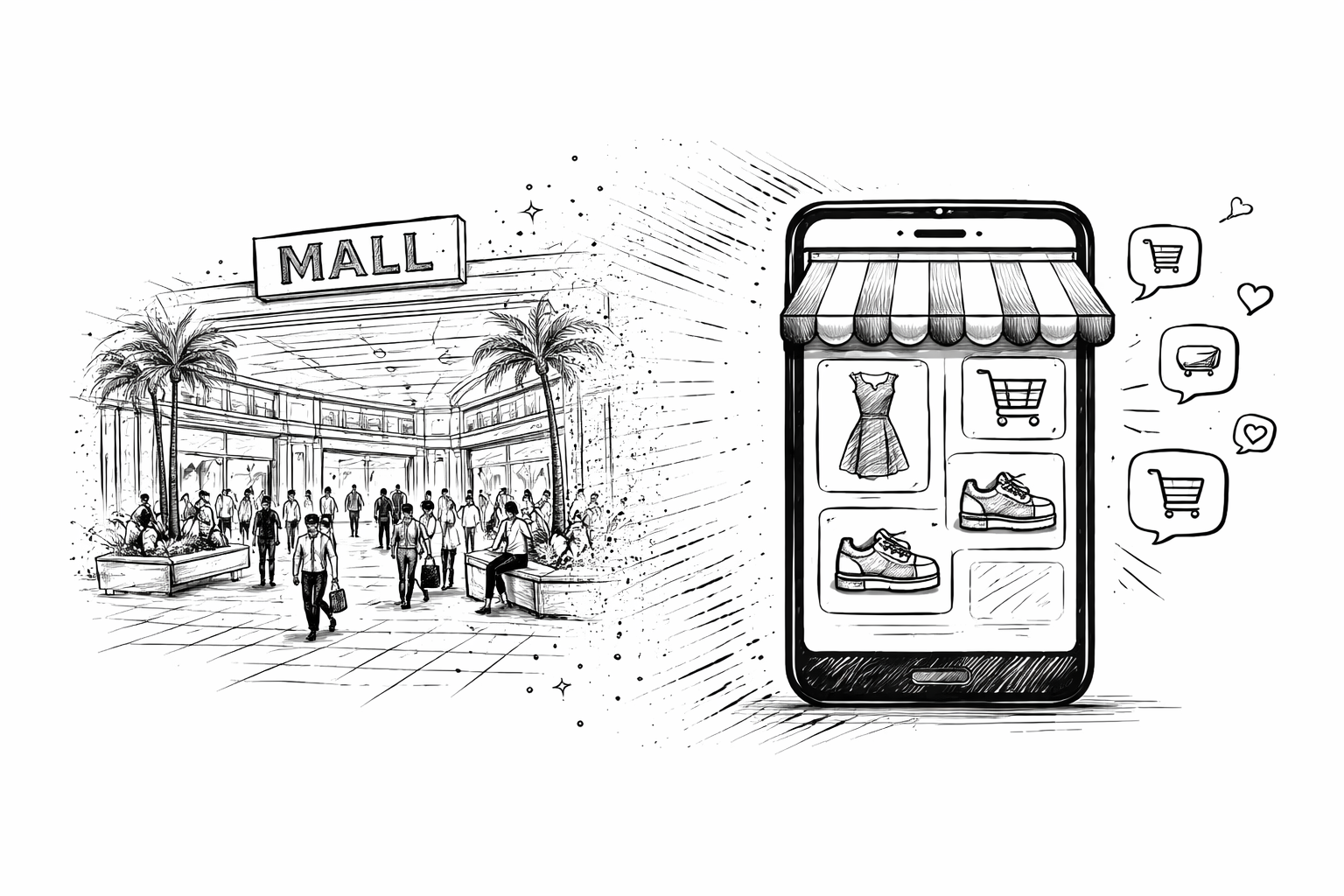
The mall didn’t die because people stopped wanting things. It died because buying things no longer required going anywhere.
According to Coresight Research, more than 7,000 U.S. stores closed in 2023 alone — a continuation of a multi-year trend that has hollowed out traditional shopping centers across the country. Many malls that once anchored suburban life have declined, been repurposed, or disappeared entirely. The buildings are still there in some cases. What they were built around isn’t.
For decades, malls functioned as more than retail environments. Sociologist Ray Oldenburg described places like these as “third spaces” — locations outside of home and work where people gathered without specific obligation. No agenda, no appointment. Just shared presence. For many communities, especially in suburban areas with fewer natural gathering points, malls quietly filled that role. Climate-controlled, predictable, and reliably populated, they offered something that is harder to quantify than square footage: a reason to be somewhere together.
The erosion was gradual. E-commerce, led by companies like Amazon, didn’t eliminate shopping — it made it more efficient, more personalized, and less dependent on leaving the house. What had been a social activity became increasingly transactional. A purchase that once meant an afternoon out now takes minutes on a phone. U.S. Census Bureau data shows that e-commerce accounted for roughly 16.4 percent of total retail sales in 2025 — nearly one in every six dollars spent — with the categories that once drove mall traffic, apparel, electronics, and specialty retail, among the most affected.
Broader lifestyle shifts accelerated the transition. Remote work reduced daily movement. Streaming replaced outings. Food delivery replaced casual dining trips. When the pandemic ended, many of those habits didn’t. The result was quieter than a closure announcement but just as consequential: fewer reasons to occupy shared physical space.
What was lost isn’t just a retail format. It’s a layer of public life that didn’t announce itself as valuable until it was gone. Third spaces provided unstructured time and casual interaction — the kind of low-stakes social contact that doesn’t require planning, doesn’t have a purpose, and doesn’t show up in any metric until its absence is felt. Digital convenience has replaced the transaction. It hasn’t replaced the space.
This connects to a pattern worth paying attention to — one we’ve examined in the context of grocery closures and shifting media habits as well. Access is expanding in measurable ways. More goods are available, faster, to more people. And yet the experience of shared physical life — the unremarkable but meaningful act of being somewhere with other people — is contracting. Efficiency improved. Presence declined.
The question left behind is not a small one: what replaces a shared space when convenience removes the need to gather? So far, the answer has mostly been nothing. And that absence is beginning to show.