
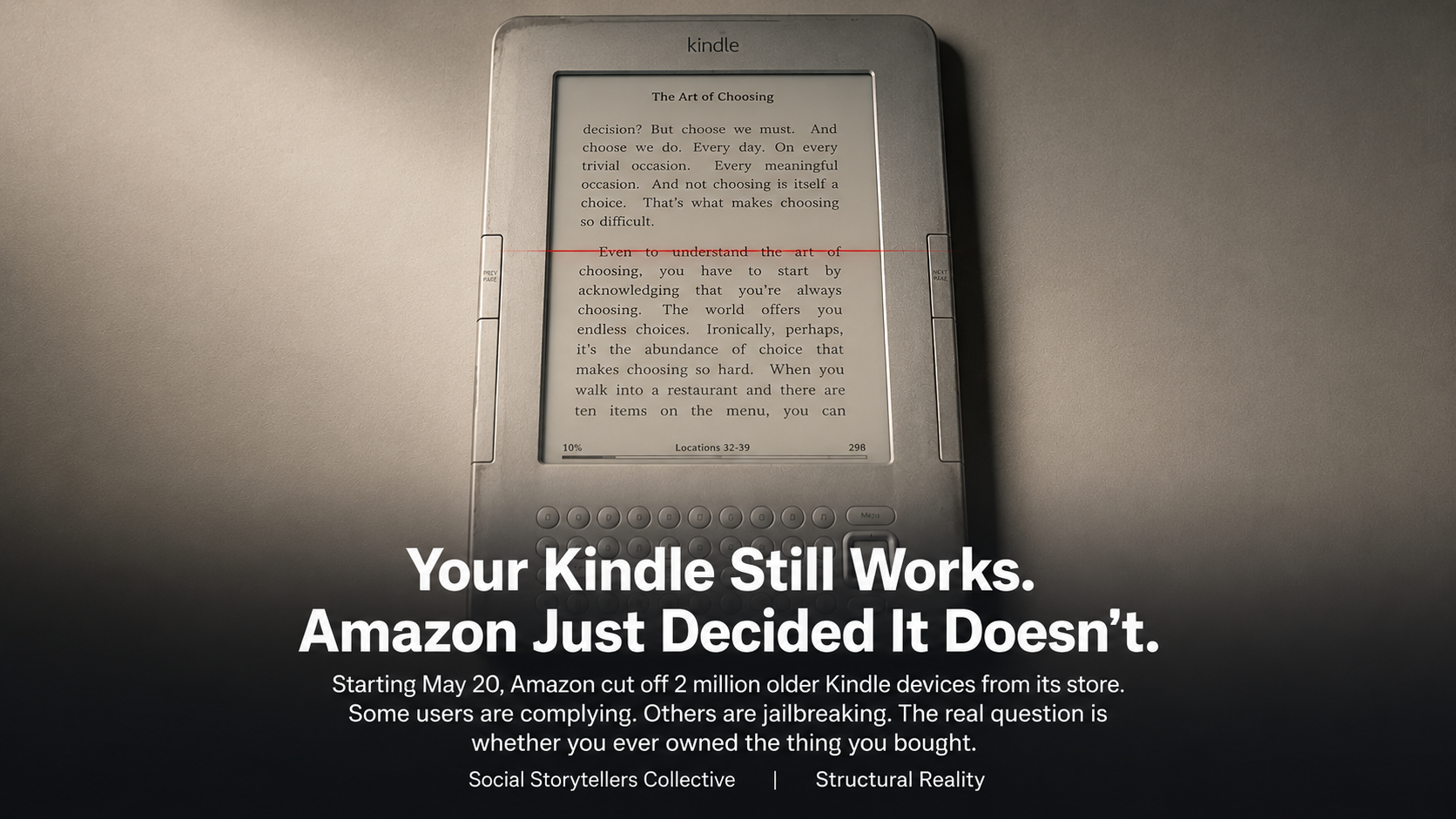
Somewhere right now, someone is holding a Kindle they’ve carried for a decade. The screen still works. The battery still holds. The books they loaded onto it years ago are still there, readable, intact. The device is functional in every way that matters to the person using it. Amazon has decided it is no longer supported.
On May 20, 2026, Amazon ended store access for every Kindle model released in 2012 or earlier — 12 devices in total, from the original 2007 keyboard model through the first-generation Paperwhite and early Kindle Fire tablets. Owners of the roughly 2 million older Kindles still in active use can no longer purchase, borrow, or download new content from the Kindle Store. What they already have stays. What they might want next is gone. If they deregister the device or factory reset it for any reason after the deadline, they cannot re-register it. The device becomes, for most practical purposes, a very elegant paperweight with a fixed library.
What Amazon Said and What It Didn’t
Amazon’s official statement was measured and not unreasonable on its face: these models have been supported for at least 14 years, some as long as 18, and technology has advanced considerably in that time. As a gesture toward affected users, the company is offering a 20% discount on new Kindle hardware and a $20 ebook credit for those trading in qualifying older models, valid through June 20.
What the statement did not address is the more fundamental question users are actually asking: did they buy a device, or did they buy access to a device contingent on Amazon’s continued goodwill? The distinction matters enormously. A physical book purchased in 2007 still works in 2026. It will work in 2046. It does not require the publisher’s permission to remain readable. A Kindle purchased in 2007 — a device that performed exactly the same core function, displaying text — has now been administratively disabled by the company that sold it, not because the hardware failed but because Amazon controls the ecosystem the hardware depends on to function as advertised.
That is not a bug in the Kindle model. It is the feature. Amazon controls 72% of the e-reader market. The Kindle Store is not one option among many — for most users, it is the only option their device was ever designed to access. When Amazon ends support, it is not withdrawing a service. It is withdrawing the product itself, from the inside.
What Users Are Actually Doing
The backlash was immediate and pointed. On Reddit and X, longtime Kindle users described the move as planned obsolescence, accused Amazon of exacerbating the global e-waste crisis — the Restart Project estimates the discontinuation could generate more than 624 tonnes of electronic waste — and said they would switch to competing e-readers. Some are doing exactly that. Others are getting creative.
A significant contingent of scrappier users are sideloading titles onto their older Kindles using Calibre, a free and legal desktop application that allows manual transfer of ebooks in formats the Kindle can still read via USB. It is more technically involved than buying from the store. It works. Others are going further — jailbreaking their devices entirely, installing alternative reading apps, and accessing books in formats the standard Kindle software doesn’t support. Jailbreaking may violate Amazon’s terms of service, though it is not always illegal. The communities doing it are large, organized, and growing since the May 20 announcement.
What both groups share is a refusal to accept that Amazon’s decision about their device is the final word on what their device can do. They bought the hardware. They are keeping it. They are finding ways around the ecosystem wall Amazon built — and in doing so, they are participating in a quiet but pointed argument about who actually owns the things we buy in a platform economy.
The SSC Angle
The Kindle story is a consumer technology story on the surface. Underneath it is the same structural argument running through every story in today’s edition. Amazon set the terms of what a Kindle is when it sold you one. Amazon is now resetting those terms unilaterally, years after the transaction, without your input. The 20% discount on a new device is the offer on the table. Compliance or jailbreaking are the alternatives. There is no fourth option where Amazon restores what you had.
This is the platform economy in its most legible form. You do not own the digital infrastructure your purchased device depends on. You never did. The terms of that relationship were always Amazon’s to revise — buried in a terms of service agreement nobody read, enforced by a technical architecture nobody questioned because the device worked. Until the day it didn’t. The people now loading Calibre onto their laptops and transferring ebooks over USB cables are not doing anything radical. They are doing what anyone does when the terms get changed without their consent. They are finding a way to keep what they already had on the terms they originally understood.
The paperback diehards had a point all along. The book doesn’t need permission to stay readable.
Social Storytellers Collective | Structural Reality Read the full End of Day Closing Note — drops at 3PM CDT weekdays.