
A senior partner at a global consulting firm recently described what she assumed was an imposter syndrome problem. She had led major restructurings, navigated three industry pivots, and built a reputation spanning strategy, operations, and culture. When her firm restructured its leadership track, she was passed over for a role she was clearly qualified for. Her boss gave her a reason: “We weren’t sure what area to put you in, where you would fit best.”
That sentence is not feedback. It is a diagnosis of the evaluation system — and it is being delivered across industries to workers who have spent years building exactly the kind of cross-functional, judgment-heavy expertise that organizations claim to need and consistently fail to recognize when it arrives without a tidy label.
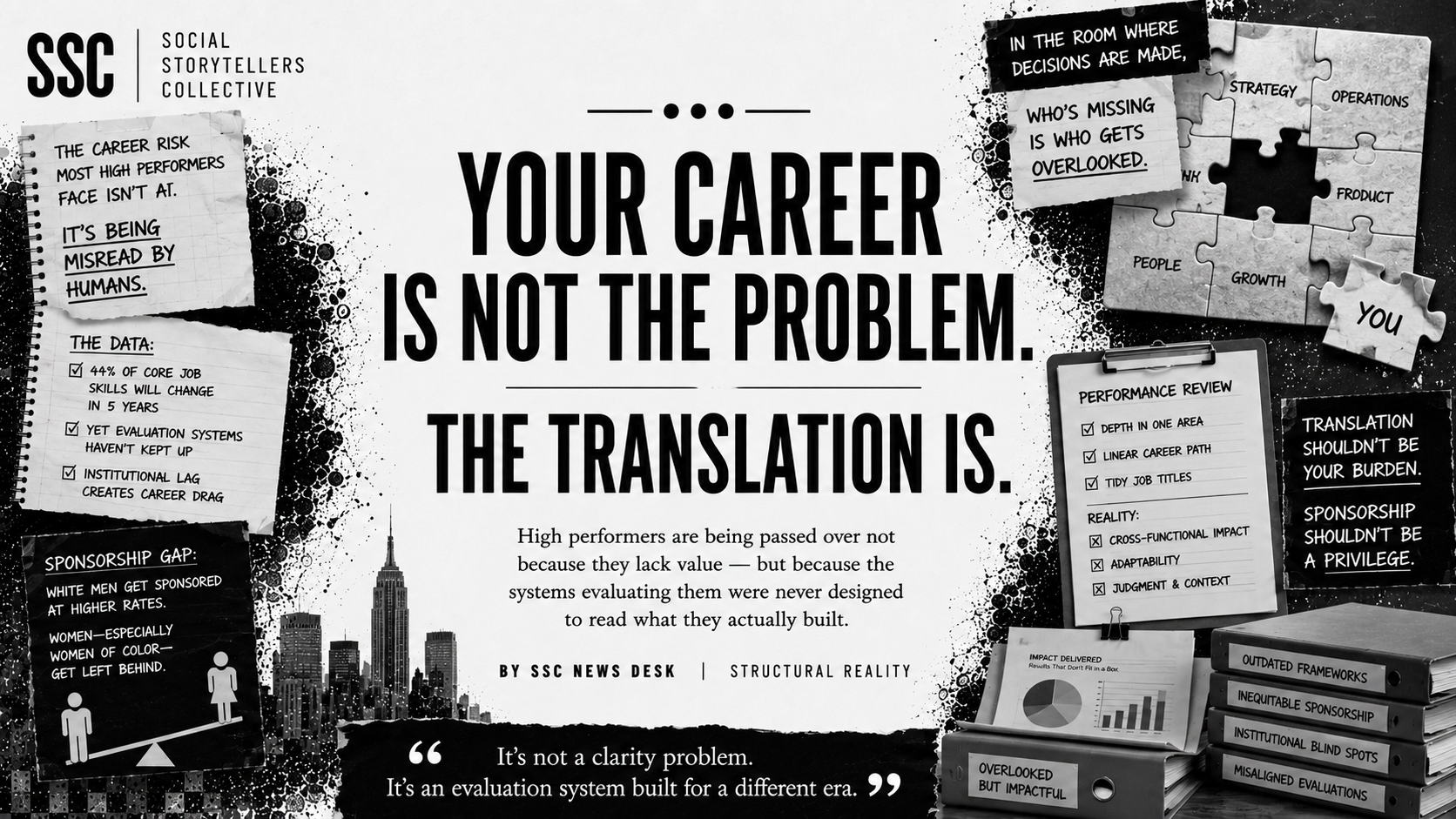
Writing in Fast Company, Tony Martignetti and Tobin Trevarthen identify what they call Narrative Worth — the ability to connect what you have built into something the world can understand. Their argument is precise: the career risk most high performers are facing right now is not being replaced by artificial intelligence. It is being misread by humans. The problem is not capability. It is coherence — the gap between what a worker has actually developed and what the systems evaluating them are designed to recognize. Read the full piece at Fast Company.
SSC wants to push that argument further. Because framing this as a translation problem — something the worker needs to solve by getting better at articulating their value — locates the failure in the wrong place. The translation problem is real. But it did not emerge from workers failing to narrate their careers correctly. It emerged from evaluation systems that were built for a different era and have never been meaningfully updated, and from a sponsorship infrastructure that has always distributed its benefits unevenly.
The performance review industrial complex was not designed for the careers most people are actually having. For decades, the dominant model of career advancement operated on a straightforward logic: specialize, deepen expertise, and climb within a defined lane. The evaluation systems organizations built around that model — competency frameworks, job leveling structures, promotion criteria, leadership track definitions — were designed to assess workers moving vertically through stable role categories. They were not designed to capture the value of workers who moved laterally out of necessity, who expanded their responsibilities without corresponding title changes, who developed judgment across functions rather than depth within one. The World Economic Forum projects that 44 percent of core job skills will change within five years — a figure almost universally cited as evidence that workers need to keep acquiring new capabilities. It is almost never cited as evidence that the frameworks organizations use to evaluate workers are themselves obsolete. The consulting partner in Martignetti and Trevarthen’s example had the track record. What she lacked was a career shape that fit the evaluation architecture her firm had never updated. That is not her failure. That is institutional lag — and it compounds differently depending on who is absorbing it.
The sponsorship gap is where the translation problem actually lives — and it is not evenly distributed. Workers who get translated into opportunity are rarely the ones who became more articulate about their own value. They are the ones who had someone in the room doing the translation for them — a senior leader who understood what they had built, vouched for it when the decision was being made, and converted institutional illegibility into institutional credibility through relationship and advocacy. That is sponsorship. And the research on sponsorship is consistent: it is the single most significant determinant of whether high-performing workers advance, and it is one of the most unequally distributed resources in professional life. White male professionals are sponsored at rates that significantly outpace their peers.Women, and particularly women of color, report having mentors — people who offer advice and encouragement — at comparable rates to their white male counterparts, while reporting sponsors — people who advocate for them in rooms they are not in — at significantly lower rates. The distinction between those two things is the difference between being told you are doing well and being told you are ready when the opportunity appears.
The consulting partner was not passed over because her narrative was unclear. She was passed over because when the decision was being made, nobody in that room understood what she had built well enough to make the case for her — or was invested enough in her advancement to try. That is a sponsorship failure dressed up as a communication problem. And the reframe matters enormously, because the solution to a communication problem is personal development. The solution to a sponsorship failure is structural — it requires organizations to examine who is being advocated for, by whom, in which rooms, and whether the patterns of that advocacy reproduce the inequities already present in the institution’s leadership.
The workers most likely to be carrying this burden are predictable. Workers who built careers across functional lines out of necessity rather than design. Workers who moved industries during economic contractions. Workers who expanded their scope without the title changes that would have made that expansion legible on paper. Workers who spent years in organizations that underinvested in their development and then entered a labor market that penalized them for the gaps that underinvestment produced. These are not fringe cases. They are the majority experience for workers outside the professional mainstream — and the evaluation systems that mark them as unclear fits were not designed with their careers in mind and have not been redesigned to account for them.
Getting better at articulating your value is not bad advice. But it is insufficient advice when the room where the decision gets made does not include anyone who will advocate for what you have built — and when the evaluation architecture being used to assess you was designed for a career shape you were never positioned to have. The translation problem is real. The solution is not only personal. The system doing the misreading needs to be named, examined, and held accountable for what it consistently fails to see.